With a month to go until the US midterm elections and his fellow Republicans fearful of losing their hold on Congress, President Donald Trump held a get-out-the-vote rally late last week in the crucial state of (checks notes) … Alabama?
Trump won that Deep South state in 2024 by about 30 percentage points. A day earlier, the president kicked off his late-stage campaign tour in Oklahoma, a state that last voted for him by 34 percentage points, and also made a stop in traditionally conservative Texas.
Even though the president is not running for office, he has made clear he intends to make the final run-up to election day All About Him. Many Republicans at risk of losing their races likely wish he wouldn‘t.
Polls show the president to be more unpopular than he has ever been, with analysts projecting Democrats to gain enough seats to grab control of the House. They have a puncher’s chance at landing the Senate as well.
The fear among Republican strategists is that Trump could make a bad situation worse, that his all-consuming presence in competitive states and districts will only remind voters of a White House tenure that has been marked by persistent inflation, high energy prices and war.
So far, Trump’s political operation appears to be trying to square the circle by having him stump in states where he remains appreciated and there is less risk of blowback.
At those rallies, Trump has implored his supporters to engage in some make-believe: “Pretend I’m running please,” Trump told the crowd in Oklahoma.
Over the weekend, Trump warned his supporters in a fundraising pitch that “this could be my final 4 weeks as president” despite the fact that his term is scheduled to end in January 2029.
The idea was that should Democrats seize control of even one house of Congress, Trump’s agenda is almost certainly DOA. Trump has also publicly fretted he could be impeached again.
Expanding the electoral map
There’s some logic to this approach. Historically, voter turnout in midterm elections in the United States falls well short of that of presidential contests. As a candidate, Trump has demonstrated he can drive infrequent voters to the polls. That can make a difference in a marginal race.
But the mere fact that Trump has had to visit ruby-red regions at all underscores the quandary Republicans find themselves in.
Americans are a deeply unhappy lot. They’re worried about the economy, angry about the proliferation of AI and data centers and exasperated by the war with Iran. And they appear to be eager to take their frustrations out on the party in power and the man in charge.
Trump, along with congressional Republicans, has arguably exacerbated the situation by offering few policy solutions and being slow to adapt to shifting political winds.
The president has resisted changing up his game
The president, in particular, has resisted changing up his game. His support for data centers has been steadfast–even in places such as Ohio where their construction has become a flashpoint.
And at times, he has appeared woefully out of touch by obsessing over pet projects such as the White House ballroom, the renovation of the Kennedy Center and the building of a “triumphal arch” near Arlington Cemetery in Washington.
In a rare moment of candor last week, Trump told an audience at the White House that he had done a “very bad job of explaining how good the country is doing.”
All of that has had the effect of expanding the electoral map for Democrats. One of the reasons the stop in Mobile, Alabama made sense for Trump is that the area is adjacent to a surprisingly competitive House of Representatives race.
The Washington Post noted that where a decade ago, Trump played to a rapturous stadium crowd of 30,000, this time he appeared in an arena that holds just 10,000 and that there were plenty of empty seats in the upper levels.
The new midterm dynamic
Ohio, where Trump campaigned on Saturday, might be most reflective of the new midterm dynamic. Once considered a battleground, it’s a state Trump has won handily three times.
But polls show Republican Senator Jon Husted trailing his Democratic opponent Sherrod Brown. The Republican gubernatorial candidate, Vivek Ramaswamy, has also fallen behind Democrat Amy Acton.
On top of promoting data centers in his Saturday remarks, Trump also threatened to starve the state of federal funds should Democrats take over.
Last month, Husted appeared to try to distance himself from Trump by calling for a swift end to the Iran war. Brown’s camp was quick to point out that the senator had voted several times to back Trump and keep the conflict going. Ashley Hinson, a Republican Senate candidate in Iowa, has also said the war should be brought to a close.
Republicans and their proxy groups have fallen back on hot-button social issues
Breaking with Trump on the war may be one of the few arrows Republican candidates have in the quiver. Boasting about jobs and the economy appears to be a nonstarter, particularly in farm states hammered by Trump’s tariffs, his beef-import policies and high diesel prices and in states such as Michigan that have suffered as a result of his trade battle with Canada.
Given their limited options, Republicans and their proxy groups have fallen back on hot-button social issues, alleging Democrats such as Brown support nonconsensual transgender surgery for teens or trans athletes participating in women’s sports. They’ve also warned that Democrats will raise taxes if given the chance.
According to a study by the Wesleyan Media Project, close to 50 percent of the TV ads run by Republican candidates in September focused on taxes. Another 18 percent consisted of anti-trans ads.
The final battle
On Monday, Trump traveled to Nebraska – home to a Senate race that was once considered off the board. This week, he is scheduled to return to Texas, where he staged a first-of-its-kind “midterm convention” last month.
Embattled Republican Senate candidate Ken Paxton reportedly told associates that Trump’s event damaged his prospects, according to audio obtained by the New York Times.
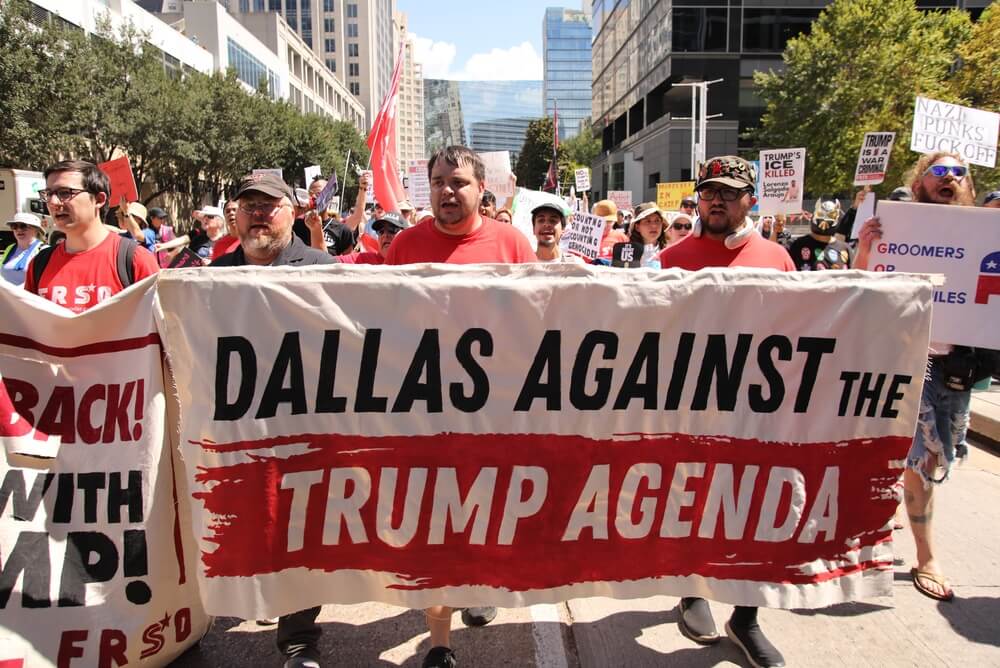 Trump has pledged to visit 35 or even 40 battlegrounds, but it’s unclear if that means he will venture into tight races where his presence could be a liability
"So to be honest with you, the numbers – when we did that convention – it dropped our numbers. Everybody’s numbers dropped. Right now, yeah, not good,” Paxton reportedly said.
Trump has inserted himself into the midterm conversation in another way by pushing for a $20 million taxpayer -funded ad campaign that touts his achievements and warns about the dangers of “socialism” and “communism.”
In one spot, aired in black-in-white, Trump walks menacingly toward the camera while declaring in a voiceover that “this is the final battle.” (After an outcry, Trump said late Monday that his super PAC will pay for the ads rather than the government.)
The firm AdImpact estimates the spots ran nearly 2,800 times during the last week of September, including in markets in swing states such as Maine and Pennsylvania. So even if Trump doesn’t set foot in competitive areas, he’ll be on TV in several of them whether local Republicans like it or not.
Ultimately, the form Trump’s travel plans will take between now and November remains to be seen. The president has pledged to visit 35 or even 40 battlegrounds, but it’s unclear if that means he will venture into tight races where his presence could be a liability.
His itinerary will help shed light on whether the president can play a key role in salvaging the final two years of his term or whether this swing will amount to nothing more than a greatest hits tour by an aging rocker who isn’t filling the seats like he used to.
Oh well. There’s always the t-shirt.
