Ukraine’s foreign policy has increasingly focused on transforming external assistance into a security architecture capable of supporting the country through a prolonged war and, eventually, deterring further Russian aggression.
Ukraine’s partners are gradually shifting from short-term deliveries to deeper integration of defence production, air defence, drone technology, financing, sanctions policy and long-term military cooperation.
This shift is strategically significant because Russia’s capacity to sustain a prolonged war means Ukraine cannot rely indefinitely on periodic emergency aid packages.
The immediate priority remains air defence. Ahead of another winter, Kyiv is seeking to protect critical infrastructure and reduce the strategic effect of Russian attacks on Ukraine’s energy system.
At the same time, the government is attempting to increase domestic production and establish joint manufacturing arrangements with foreign partners.
Canada has become one of the clearest examples of this approach. Following President Volodymyr Zelenskyy’s meeting with Prime Minister Mark Carney in Calgary, Ottawa announced $2 billion in support for Patriot missiles, F-16 ammunition, joint drone production and Ukraine’s energy sector.
The emerging Canada-Ukraine framework envisages localised defence production in both countries, and cooperation in unmanned systems, cybersecurity and military technologies.
The planned Drone Deal would further institutionalise this relationship. Rather than simply transferring equipment to Ukraine, the objective is increasingly to connect Ukrainian technological capabilities with the industrial capacity of partner states.
A similar logic is evident in Ukraine’s cooperation with Australia and Finland. Kyiv signed a long-term support and cooperation agreement with Canberra covering military training, participation in the NSATU and PURL mechanisms, the Drone Coalition, energy assistance, economic recovery, and veteran rehabilitation.
Ukraine has also concluded a drone deal with Finland, bringing the number of such agreements with international partners to eleven.
These arrangements point to a broader evolution in Ukraine’s diplomatic strategy. Kyiv is seeking not only political commitments but mechanisms that can build military capabilities over several years.
Air defence remains the most immediate test
The urgency of this strategy is demonstrated by the scale of the military assistance announced in September.
The United States, France and Germany provided additional air-defence missiles. Belgium supplied F-16 ammunition and three F-16 aircraft.
The United Kingdom has committed £100 million to PURL for the procurement of air-defence capabilities, including Patriot missiles, and plans to facilitate the delivery of a further 95,000 drones by the end of the year, together with tens of thousands of long-range artillery shells financed by other countries.
Denmark announced a $275 million defence package focused in part on air defence, while Spain committed additional air-defence missiles, artillery ammunition and F-16 ammunition.
The Netherlands allocated $300 million to the “Drone Line” project and announced the transfer of 300 anti-drone missiles. Germany announced additional Patriot interceptor missiles and F-16 ammunition.
Air defence is becoming one of the central pillars of Ukraine’s long-term security relationship with its partners
Finland has approved its 34th military assistance package, worth €290 million, while Sweden has announced a $28 million support package, half of which is to be channelled through PURL.
Poland has announced preparations for another assistance package and its participation in the Anti-Ballistic Coalition.
The United States also approved a potential $2.68 billion sale to Ukraine of air-defence modernisation equipment, associated equipment and services.
Taken together, these decisions demonstrate that air defence is becoming one of the central pillars of Ukraine’s long-term security relationship with its partners.
The objective is no longer simply to replace missiles used in combat, but to build a more resilient system capable of withstanding repeated Russian missile and drone campaigns.
Europe is becoming part of Ukraine’s defence-industrial strategy
The European dimension is particularly important. The EU has transferred €3.3 billion to Ukraine through the Ukraine Support Loan, with funds available for critical defence requirements, including missiles and drones.
EU member states also agreed to release €6.6 billion through the European Peace Facility to support Ukraine.
More strategically, the EU-Ukraine Drone Alliance began operating in Brussels, bringing together nine Ukrainian and nine European companies.
Its objective is to develop a joint European capacity in drones and counter-drone systems, while integrating Ukraine’s battlefield experience into European defence planning.
This may ultimately prove more consequential than individual weapons deliveries. Ukraine has gained extensive operational experience in drone warfare, electronic warfare and the rapid adaptation of unmanned systems under combat conditions.
Ukraine becomes a key contributor to Europe’s own defence capabilities
European states possess capital, industrial capacity, and access to larger defence markets.
Combining these advantages could create a new model of defence-industrial cooperation, in which Ukraine becomes a key contributor to Europe’s own defence capabilities.
The same logic is evident in the Carpathian Integration Initiative launched by Ukraine. The first summit on 18 September brought together Ukraine, Austria, Poland, Romania, Serbia, Slovakia, Hungary and the Czech Republic in the new “Carpathian Eight” format.
Although the initiative has a broader economic and regional agenda, including cross-border logistics, energy and humanitarian security, its strategic significance lies in strengthening Ukraine’s links with the Central European security and economic environment. For Kyiv, regional integration is increasingly becoming part of national resilience.
Sanctions are becoming a parallel instrument of security policy
Military assistance is being accompanied by continued efforts to increase the economic cost of Russia’s war.
Ukraine has introduced sanctions against vessels linked to Russia’s shadow fleet, entities and individuals associated with Rostec, Russian propagandists and individuals involved in organising Russia’s illegal elections in occupied Ukrainian territories.
The United States also increased pressure on Russia. President Donald Trump signed the Lindsey Graham legislation, expanding the potential sanctions framework against Russia and providing for measures targeting designated Russian entities, as well as countries purchasing Russian energy or facilitating sanctions evasion. Washington also added VTB to its sanctions list related to Iran.
Ukraine’s partners are increasingly treating Russia’s ability to finance the war as part of the same strategic problem as Ukraine’s battlefield needs
The EU has extended restrictions against more than 3,000 individuals and entities until September 2029 and imposed new sanctions related to the deportation and forced transfer of Ukrainian children, as well as the repression of the democratic opposition and the erosion of the rule of law in Russia.
Australia and Canada also expanded their sanctions regimes, including measures against Russian individuals, companies and shadow-fleet vessels.
The significance of these measures lies less in any individual sanctions package than in the emerging convergence between military support and economic pressure.
Ukraine’s partners are increasingly treating Russia’s ability to finance, equip and sustain the war as part of the same strategic problem as Ukraine’s battlefield needs.
The humanitarian cost reinforces the case for sustained support
The ongoing need for such assistance is underscored by the humanitarian situation.
According to UN High Commissioner for Human Rights Volker Türk, more than 15,000 civilians were killed or injured in Ukraine during the first eight months of 2026 as a result of Russia’s aggression. Russian forces continue to strike residential areas, schools, hospitals, rail infrastructure and commercial facilities despite limited movement along the front.
The use of guided aerial bombs in the Donetsk, Kharkiv, Sumy and Zaporizhzhia regions has caused thousands of civilian casualties.
Russia’s objective is not limited to destroying military targets
The UN has also documented extensive sexual violence against civilians and prisoners of war, with Russia responsible for the overwhelming majority of documented cases.
The intensification of attacks on energy and food infrastructure adds another dimension to the campaign.
Russia’s objective is not limited to destroying military targets. Sustained pressure on energy, transport and food production can increase the economic and political costs of resistance, particularly as winter approaches.
This makes air defence a strategic rather than merely military requirement. Protecting Ukraine’s energy system is directly linked to maintaining economic activity, civilian resilience and political stability.
Europe’s response will be tested by Russian pressure
Russia is simultaneously attempting to influence the political environment surrounding Western assistance.
The European Commission has rejected suggestions that Russian threats against diplomats in Kyiv could lead to a reduction in European support.
Commission spokesperson Christian Wigand said that the EU’s position remains unchanged and that pressure on Moscow will continue.
The statement followed reports that some Western governments were considering contingency arrangements for their diplomatic missions in Ukraine, including a possible relocation from Kyiv to Lviv or eastern Poland in an emergency.
Russian pressure is increasingly directed not only at Ukrainian infrastructure but also at the political mechanisms sustaining Western involvement
The issue is significant because Russian pressure is increasingly directed not only at Ukrainian infrastructure but also at the political mechanisms sustaining Western involvement.
If Moscow can persuade European governments that continued engagement with Kyiv carries unacceptable security risks, it could weaken the coalition supporting Ukraine without achieving a breakthrough on the battlefield.
The EU’s response therefore has a signalling function. Maintaining a diplomatic presence in Kyiv demonstrates that Russian intimidation has not yet altered the basic political calculation of Ukraine’s European partners.
Ukraine is also developing its own long-range capabilities
The gradual expansion of external support is occurring alongside the development of Ukraine’s indigenous strike capabilities.
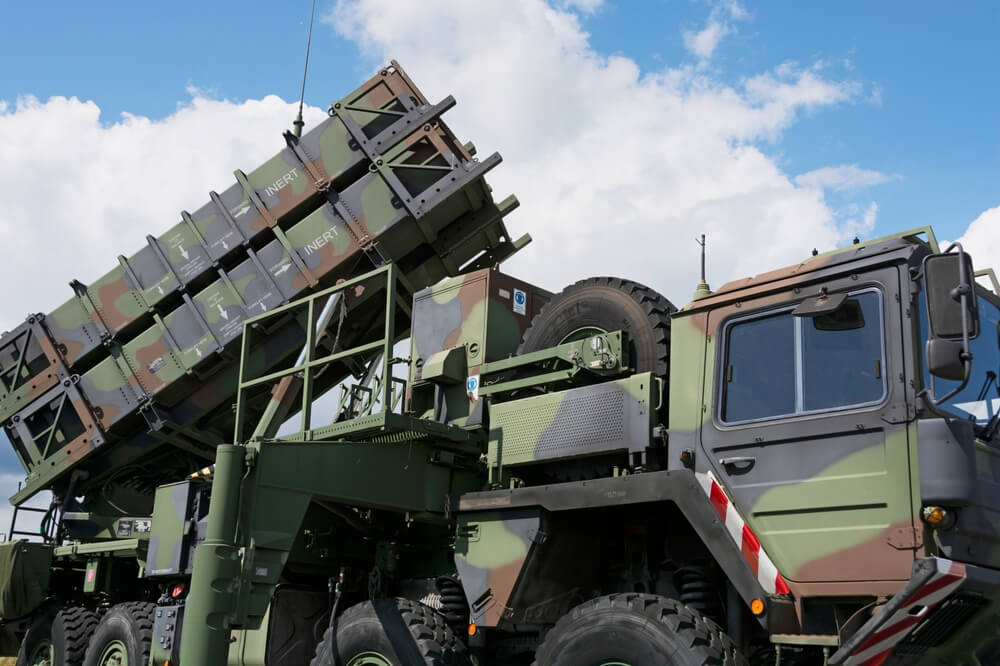 Ukraine’s dependence on foreign weapons remains substantial, particularly in air defence
President Zelenskyy said that the FP-9 ballistic missile, developed by Fire Point, could be ready for operational use as early as autumn.
The missile is reportedly designed for mobile ground launch, with a claimed range of up to 850 kilometres and a warhead weighing up to 800 kilograms. Zelenskyy also announced the first successful combat use of the Ukrainian FP-7 ballistic missile, reportedly with a range of around 250 kilometres.
The development of these systems has broader strategic implications. Ukraine’s dependence on foreign weapons remains substantial, particularly in air defence, but the emergence of domestically produced long-range capabilities could gradually expand Kyiv’s ability to impose costs on Russia’s military-industrial and energy infrastructure.
Zelenskyy has stated that Ukraine will continue to strike Russian oil-refining facilities in response to Russian attacks on Ukrainian energy infrastructure, while maintaining that civilian targets will not be attacked.
From assistance to strategic integration
For Ukraine, the strategic objective is to reduce the vulnerability created by dependence on episodic foreign deliveries.
For Europe and other partners, the objective is increasingly twofold: to help Ukraine withstand Russian aggression and to incorporate Ukrainian battlefield experience and industrial capacity into their own defence planning.
This also explains why the coming winter will be an important test. Russia is likely to continue using missiles and drones against Ukraine’s energy infrastructure in an attempt to exploit civilian vulnerabilities and weaken political resilience.
Ukraine’s foreign policy will increasingly shift from managing the immediate demands of war to building a long-term security ecosystem
Ukraine’s ability to protect its energy system will depend not only on the number of interceptors available, but also on whether the emerging framework of international cooperation can deliver weapons, production capacity and financing at the required speed.
The strategic question is therefore shifting. It is no longer simply whether Ukraine’s partners are willing to continue supporting Kyiv.
The more important question is whether they can turn political commitments into a durable defence-industrial and security architecture capable of sustaining Ukraine for as long as Russia remains committed to the war.
If the current trend continues, Ukraine’s foreign policy will increasingly shift from managing the immediate demands of war to building a long-term security ecosystem in which Ukraine is both a beneficiary and an increasingly important contributor to European defence.
Oleksandr Levchenko, a former Ukrainian diplomat, is a professor at the State University (Kyiv) and a member of the Academy of Geopolitics and Geostrategy (Kyiv).
