It’s rarely been easy to be a farmer in modern-day America. But lately, for some it’s become close to impossible.
Ask Dan Ryner, who operates a corn, soybean, cattle and alfalfa farm in Madison County, Iowa. A few years ago, Ryner borrowed about $400,000 annually to operate his farm. Today, he needs roughly $600,000 and says he barely breaks even.
The Trump administration’s tariffs have driven up the cost of machinery and equipment, while the war in Iran jacked up his monthly fuel bill from less than $3,000 to about $4,500.
“You try to cut every corner you can,” Ryner told the Iowa Independent last month, “and sometimes it’s damn near impossible.”
A thousand miles south, Texas cattle buyer Hayden Scarborough faces a different challenge. The administration temporarily lowered barriers to imported beef in hopes of bringing down grocery prices.
Scarborough told the Dallas Observer that the resulting competition could devastate ranchers just as higher cattle prices were finally making cattle production profitable again.
And in Warren, Ohio, tariffs designed to protect American steelmakers are squeezing Thomas Steel Strip, which makes specialty steel used in batteries.
The company relies on a grade of imported steel that its union says isn’t available domestically – and which is now subject to a 50 percent tariff. A United Steelworkers representative said the tariffs have cost the company business and helped shrink its workforce from about 170 to 150.
Expanding the map for Democrats
Taken together, the stories detail the impact of Trump’s trade policies on farmers, ranchers and manufacturers. But they also signify something else: Iowa, Ohio and Texas are three states where Republicans once appeared well positioned to hold Senate seats as the party tries desperately to cling to power in Congress.
Now, Senate races in all three are competitive as the November midterm elections approach. Trump won all three states by comfortable margins in the 2024 election.
The president has accomplished a dubious feat: he has expanded the map for Democrats.
Trade has become a central issue in the vast majority of states that are home to white-knuckle Senate elections
Trade has become a central issue in the vast majority of states that are home to white-knuckle Senate elections, with several of them sharing a border with Canada.
Trump’s recent escalation of his trade war with the country’s longtime ally – in which the U.S. slapped tariffs on products as varied as whiskey and motorcycles – came at an unwelcome moment for his party. The cross-border skirmish is expected to affect markets in such places as Michigan, Maine and New Hampshire at a time when affordability has become the watchword of the midterm fight.
Seizing the moment
Some Republicans are trying to distance themselves from Trump as best they can.
Republican Senator Susan Collins of Maine, a top Democratic target, called the penalties imposed on Canada “a mistake,” while John Sununu, running for the Senate in New Hampshire, said the trade war “doesn’t make any sense” and called for building materials to be exempted from the tariffs in order to lower construction costs.
Marc Short, who served as Vice President Mike Pence’s chief of staff in the first Trump administration, said on CNN last week that the president’s decision to pick a fight with Canada was a “real head-scratcher” given that during his first term, the U.S. negotiated a far-reaching trade pact with both Canada and Mexico.
You don’t need tariffs on Canada. You don’t need tariffs on France or Germany - Sherrod Brown
Meanwhile, Democrats are seizing the moment. Josh Turek, the Democratic Senate nominee in Iowa, is running competitively against Republican Rep. Ashley Hinson in a state Trump carried by 13 points two years ago.
Turek has spent much of his time touring small businesses complaining of rising costs and has argued that Trump’s policies will lead to a “farmageddon” and another 1980s-style farm crisis. (Think Willie Nelson singing at Farm Aid.)
Turek has cast himself as a prairie populist in the tradition of Tom Harkin, the last Democrat elected to the U.S. Senate from Iowa, who left office in 2015. An Iowa win would put Democrats in a strong position in their effort to capture the net four seats they need to grab control of the Senate and torpedo Trump’s agenda.
It’s a bit of a different situation in Ohio, where Sherrod Brown is trying to reclaim a Senate seat he held for 18 years. Brown, in a sense, was a better-behaved proto-Trump, advocating tariffs to boost American manufacturing and protect union jobs.
But Trump’s approach to tariffs, Brown has said, is “scatter-brained” and “haphazard.”
“You don’t need tariffs on Canada. You don’t need tariffs on France or Germany,” Brown told an Ohio TV station earlier this year.
Signs of discontent
Trump won Iowa by 13 percentage points in 2024. In a recent Emerson College poll, however, 52 percent of Iowa voters disapproved of his job performance, compared with 44 percent who approved.
There are also signs of discontent among farmers, a bloc that for the most part has loyally supported Trump despite the fact that he first started making it harder for them to sell their crops in markets such as China almost a decade ago. (He tried to make up for it by sending them bushelfuls of cash.)
The Emerson poll found that 58 percent of Iowa voters oppose U.S. tariffs on Canadian products, while 42 percent support them. And 71 percent said they are concerned about Canada’s retaliatory tariffs of up to 50 percent on U.S. imports.
Along that line, a national survey of farmers conducted earlier this year by the Farm Journal found that 55 percent of respondents said federal policies over the previous year had hurt their operations.
The economic effects of Trump’s trade policies have become increasingly measurable
Tellingly, 39 percent were classified as politically “persuadable” in 2026 – considering voting for a different party, an independent or third-party candidate, not voting, or remaining undecided.
Democrats are trying to fit the struggles of farmers, ranchers and others into a broader affordability argument, contrasting voters’ concerns about prices with Trump’s focus on White House construction projects and his business interests.
The economic effects of Trump’s trade policies have become increasingly measurable. Yale University’s Budget Lab estimates that Trump’s current tariff regime will ultimately raise consumer prices by about 0.7 percent, costing the average household roughly $1,100 a year.
Federal Reserve researchers, meanwhile, have found evidence that the tariffs imposed in 2025 have already worked their way into store prices. They estimate that the levies raised prices for core consumer goods by 3.1 percent through February 2026 and boosted overall core prices by 0.8 percent.
'Just one more time'
The White House is pushing back where it can. Trump continues to insist that his trade policies have brought unprecedented revenue into the country. The tariffs, he said at the Republican gathering in Dallas last week, are “going to make America rich. It’s making us richer than we ever thought.”
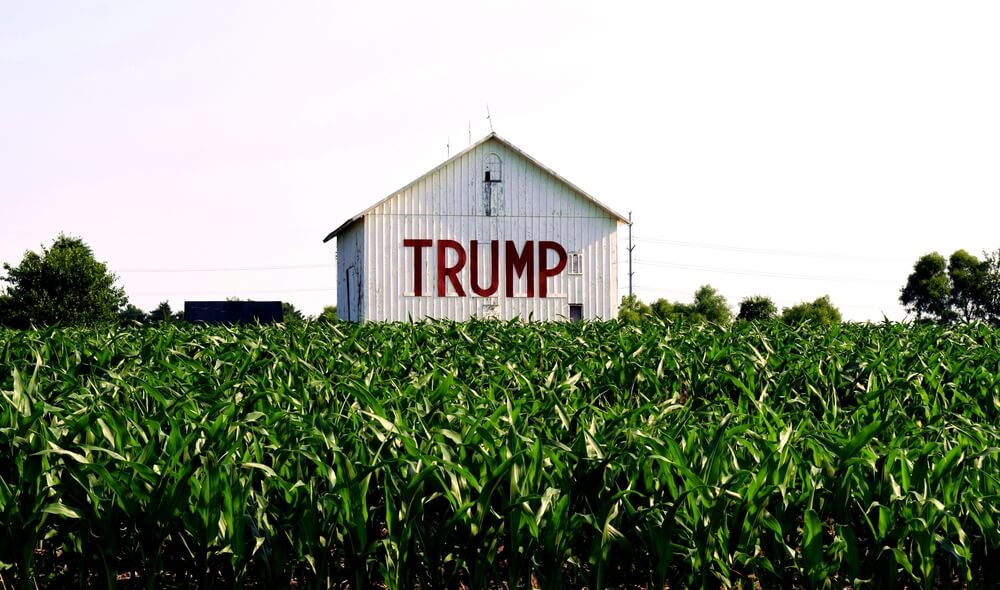 There’s a basic reason why it will be difficult for Republican Senate candidates to create some space between themselves and the president. He won’t let them
At least one Trump-friendly conservative group is supporting the president’s efforts with advertising that accuses Canada of benefiting disproportionately from trade while failing to stop illicit tobacco and drugs from crossing the northern border.
The spot is backed by Building America’s Future, a conservative nonprofit that has received tens of millions of dollars from Elon Musk. The group said the ad is part of a targeted five-figure digital campaign in Washington, DC, where it’s more likely to reach the media and policymakers than voters.
Beyond that, there’s a basic reason why it will be difficult for Republican Senate candidates to create some space between themselves and the president. He won’t let them.
Trump has said he plans to embark on a series of rallies to backstop candidates – although whether that happens remains to be seen. In doing so, Trump appears to want to make the midterms as much a referendum on his performance as he can.
“I’m asking you to pretend that I’m on the ballot,” Trump said in Dallas. “I’m on the ballot. I’m on the ballot. Just one more time.”
Right now, Democrats would have it no other way.
