As the 2026 political season unfolds, we should stop pretending that American politics is a purely domestic drama. Our divisions are homegrown, but they have not developed in isolation.
The Kremlin has exploited them with considerable success, and Donald Trump has amplified that success by turning any serious discussion of Russian influence into a punch line about the “Russia hoax.”
Russian interference was never just an espionage operation or a campaign scandal. With the help of Donald Trump and the MAGA movement, it is now woven fully into American public life.
The most dangerous thing Vladimir Putin has done to the United States is not hack a server, poison a dissident, or invade his neighbor.
It is convincing millions of Americans that truth is negotiable, institutions are fraudulent, alliances are sucker’s deals, and democracy itself is little more than a rigged spectacle.
Russia has not needed to overpower the United States. It has only needed to study our weaknesses, feed them, and watch us turn on ourselves.
Putin’s Russia practices a form of political warfare designed not merely to spread lies but to fracture reality, erode trust, and leave democratic societies incapable of coherent self-defense.
Kremlin needs Americans to hate each other
None of this absolves Americans of responsibility for our own political condition. Our polarization is certainly homegrown.
Our conspiracies are mostly homemade, rooted in long American traditions of demagoguery, grievance politics, media sensationalism, and mutual suspicion. But Putin’s Russia has learned to weaponize our weaknesses with ruthless skill.
The Kremlin does not need Americans to love Russia. It only needs Americans to hate each other, doubt authority, and treat every fact as partisan spin.
Once that happens, Moscow does not need to defeat the United States. Americans do the work themselves.
This is not a new doctrine. Since the Bolshevik era, Kremlin strategy has followed a simple maxim, if you cannot defeat the West outright, make it confused, divided, and morally exhausted.
The Soviet KGB called this tactic “active measures,” using forged documents, false narratives, covert funding, propaganda, and political agitation as weapons.
Moscow did not invent our appetite for tribalism, spectacle, and zero-sum contempt, but it certainly accelerated the rot
Today, that tradition continues through cyberattacks, disinformation, troll farms, conspiracy networks, and political narratives designed to make democracies look weak and truth itself feel unattainable. For Putin, these are central instruments of statecraft.
The key point is that Russian political warfare is not really about persuasion in the ordinary sense. It is not about winning an honest argument.
It is about paralysis and making citizens unsure what is true, who to trust, and whether public life is even salvageable.
The goal is to shape how the target thinks so that the target starts making bad choices on its own.
That is exactly where American politics has landed – in a place where a foreign adversary no longer needs to impose chaos because our own political class can be counted on to amplify it.
Moscow did not invent our appetite for tribalism, spectacle, and zero-sum contempt, but it certainly accelerated the rot.
That brings us to Donald Trump.
Vanity, grievance, transactional worldview
The most important question is not whether Trump fits the Hollywood stereotype of a fully controlled foreign asset. The more unsettling possibility is that he does not need to.
Indeed, Trump is something almost more useful to the Kremlin, a political figure whose vanity, grievance, transactional worldview, and contempt for democratic checks repeatedly push him in directions that benefit Moscow.
Someone need not be a spy to become valuable to an adversary. He need only reward the adversary’s narratives, weaken his own country’s institutions, and normalize exactly the kind of cynicism on which authoritarian regimes thrive.
Trump’s 2016 campaign included extensive contacts between campaign figures and Russian intermediaries
The record is hard to dismiss. Trump’s 2016 campaign included extensive contacts between campaign figures and Russian intermediaries, while his business interests included concealed arrangements that gave the Kremlin obvious leverage.
He then defended Putin over U.S. intelligence findings, treated Russian interference as a partisan annoyance rather than a national threat, and taught millions of Americans to chant “hoax” whenever the facts became inconvenient.
This was more than personal corruption or political shamelessness. It was a gift to Moscow, turning a counterintelligence threat into a tribal loyalty test and distrust of American institutions into a badge of partisan identity.
The Russia problem is bigger than the Russia scandal
In healthy democracies, foreign interference sparks outrage. In today’s America, however, the culture war has become so consuming that even foreign interference is judged less by its threat to the nation than by its usefulness to one side or the other. Investigations become “witch hunts.”
Evidence becomes optional, and loyalty to Party matters more than loyalty to constitutional order.
Russia succeeded not only because it interfered but because the American response itself became another arena of civic erosion, driven by habits of partisan warfare and civic distrust that long predate Putin.
This is why the Russia problem is bigger than the Russia scandal. The issue is not just who met whom in 2016.
Those poisons are not foreign in origin alone, they also draw on old American habits of nativism and division
The deeper issue is that U.S. politics has become fertile ground for exactly the methods the Kremlin has refined for decades: disinformation, manufactured grievance, conspiracy culture, and contempt for neutral institutions.
Those poisons are not foreign in origin alone, they also draw on old American habits of nativism and division.
Once a society no longer believes in evidence, process, or legitimacy, it becomes vulnerable to manipulation.
Every story becomes a weapon, and every institution becomes an enemy. That is not democracy defending itself. It is democracy in decay.
Putin’s war is not simply a regional dispute
Nowhere is this more evident than in the argument over Ukraine.
Putin’s war is not simply a regional dispute. It is a test of whether the United States still understands the difference between an imperfect ally and a brutal imperial aggressor.
Sadly, Trump’s rhetoric and negotiating posture have increasingly mirrored Kremlin assumptions – that Ukraine must accept dismemberment, that NATO expansion is the real provocation, and that Volodymyr Zelensky is somehow the obstacle to peace rather than the leader of an invaded country.
However, a rushed settlement on Russian terms would not be realism. It would be capitulation and a recipe for future war.
And it would not stop with Ukraine.
In plain English, dismantle the post-Cold War order, weaken NATO, terrify neighboring countries, and prove that democratic promises are worthless
Putin’s aim is larger than territory. It is to force the West to accept a new security order built on intimidation, spheres of influence, and the right of large states to dominate smaller ones.
We are seeing it in the Iran war and the Strait of Hormuz crisis, in Venezuela after Maduro’s fall, in Cuba’s deepening power collapse, and in Greenland under renewed pressure over sovereignty.
In plain English, dismantle the post-Cold War order, weaken NATO, terrify neighboring countries, and prove that democratic promises are worthless.
If the United States signals that it can be pressured into abandoning allies while flattering aggressors, every revisionist power in the world will draw the obvious lesson. Every friend and ally will draw it too.
Hysteria is not the answer
The irony is that Russia is not nearly as strong as its mythology suggests. Its economy is brittle. Its war has exposed corruption, dysfunction, and staggering military waste. Its coercive style is, in many ways, compensation for weakness.
Russia uses deception because it cannot persuade, subversion because it cannot inspire, and coercion because it cannot build a legitimate order others want to join.
However, a declining power can still be a dangerous one, especially when it has discovered that America’s internal fractures are easier to exploit than Europe’s borders are to redraw.
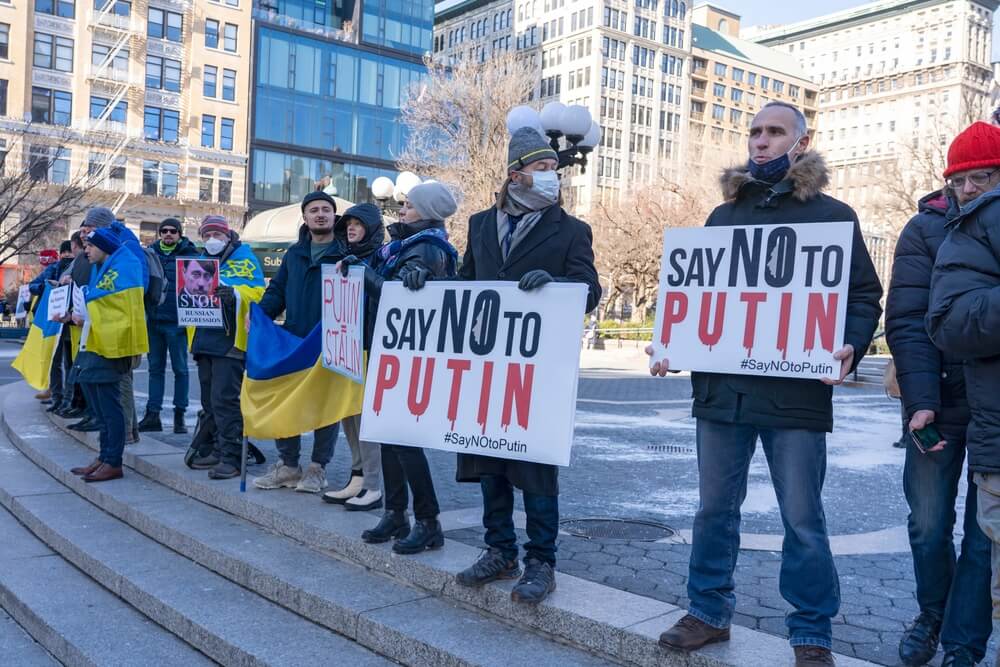 Unless Americans rediscover some loyalty to truth, evidence, and democratic legitimacy, Putin will keep harvesting what he has planted here for years
The state of U.S. politics as it relates to Putin’s Russia is that American political discourse has been compromised, not in the simplistic sense that every provocateur is secretly taking orders from Moscow, but in the deeper and more unsettling sense that much of public life now runs on instincts Putin would welcome – distrust everything, discredit institutions, demean allies, celebrate raw power, dismiss truth as manipulation, and cast democratic fragility as virtue while treating authoritarian aggression as hardheaded realism.
The answer to our situation is not hysteria. Not every domestic argument is a Russian plot or every bad actor on Moscow’s payroll.
Much of our democratic coarsening is self-inflicted. But pretending this is just normal politics is a form of denial.
The United States is confronting an adversary that understands something many Americans still refuse to admit – a democracy can be defeated from within, not because its people are stupid, but because enough of them can be convinced that nothing deserves their trust.
That is the real battlefield. And unless Americans rediscover some loyalty to truth, evidence, and democratic legitimacy, Putin will keep harvesting what he has planted here for years.
John Sipher ( @johnsipher.bsky.social ) is a non-resident senior fellow at the Atlantic Council and co-founder of Spycraft Entertainment. He worked for the CIA’s Clandestine Service for 28 years and is the recipient of the Agency’s Distinguished Career Intelligence medal. He is also a host and producer of the "Mission Implausible" podcast, exploring conspiracy theories.
