On the night of 27–28 April, armed groups affiliated with ISIL stormed the village of Guyaku in the Gombi area of Nigeria's north-eastern Adamawa State, killing at least 29 civilians.
The attack was carried out at close range. Churches, classrooms and residential buildings were burned. ISIL claimed responsibility.
A similar pattern occurred in February, when more than 24 people were killed in the village of Kirchinga in the neighbouring Madagali district.
Adamawa Governor Ahmadu Fintiri visited the scene and condemned the incident. With that, the institutional response was effectively over.
Such attacks no longer serve as news; they have become statistics. This normalisation of violence is key to understanding the dynamics developing in north-eastern Nigeria and the wider Sahel region.
A structural change in the nature of the threat
The attack in Guyaku is not an isolated event, but part of a clear trend of escalation. Data from the organisation ACLED (Armed Conflict Location & Event Data Project) show that the number of violent incidents involving jihadist groups in the tri-border zone between Benin, Niger and Nigeria increased by 86% between 2024 and 2025, while the number of deaths during the same period rose by 262%.
These dynamics do not indicate stabilisation or saturation of the conflict, but rather its expansion.
The change is not only in scale but also in how operations are conducted. In May 2025, Islamic State West Africa Province carried out a series of coordinated attacks on military bases in Borno State, including the Marte base, where the Nigerian military suffered losses in personnel and equipment.
At the same time, in Adamawa and Yobe states, attacks targeted only civilian settlements, with no attempt to strike military sites.
When previously opposed structures are harmonised at the operational level, it is a clear sign that the conflict is entering a more stable yet more dangerous phase
This difference is not accidental. It is a consistently applied operational division: attacks on the army occur where its deployment is weak or predictable, while civilians are targeted in areas lacking a real state presence.
This pattern serves not only a tactical function. Its effect is to displace the population and establish control over territory through constant pressure and fear.
Another factor is the increasingly visible operational cooperation between Islamic State West Africa Province and Boko Haram factions in the Lake Chad area.
The exchange of knowledge on the production of improvised explosive devices and tactical procedures indicates a level of coordination that was absent during the period of mutual conflict.
When previously opposed structures are harmonised at the operational level, it is a clear sign that the conflict is entering a more stable yet more dangerous phase.
The Sahel as the key to the conflict
The situation in Nigeria cannot be understood without considering changes in the security structure of the Sahel. Military coups in Mali, Burkina Faso, and Niger disrupted the previous model of cooperation with the West and created opportunities for reliance on Russia.
French forces did not withdraw as planned but were expelled by decisions of the new military authorities.
The military authorities' claim that the Western presence did not stop jihadist groups is partly true. However, subsequent developments have not produced better results.
The term "rural insurgency" no longer accurately describes the situation
The structures that replaced the Wagner Group now operate under different names, with different tasks and limited scope. Their priority is regime protection and securing key economic routes, not territorial control or the safety of the local population.
The consequences are evident on the ground. The Tillabéri region of Niger has become a major centre of violence, including attacks near Niamey. An attack on airport infrastructure in early 2026, involving drones, demonstrates that the conflict is spreading beyond remote areas. The term "rural insurgency" no longer accurately describes the situation.
Nigeria as a separate problem
Nigeria is not part of the institutional Sahel, but operationally it is increasingly integrated into its security sphere. With more than 220 million inhabitants, it is a key factor in regional stability, but also a potential source of systemic risk.
The US response to the escalation, which includes limited airstrikes and the deployment of about 100 troops for training, indicates that Washington acknowledges the problem; however, this level of engagement does not change the balance of forces on the ground. This approach is mainly political and does not influence the course of operations.
This is no longer a phase of scattered rebellion but a more stable structure with elements of governance
At the same time, Nigeria’s security forces have repeatedly failed to protect civilians, including during attacks that occurred despite prior warnings. Guyaku is not an exception but the norm.
The main problem is territorial control. The Islamic State West Africa Province in parts of Borno State already functions as a parallel government. It collects taxes, manages detention facilities, and enforces its own rules.
This is no longer a phase of scattered rebellion but a more stable structure with elements of governance. Such structures do not withdraw without significant pressure.
Assessment of the development of the situation
Based on current trends, the direction of the situation’s development until the end of 2027 can be observed along several parallel lines that are already evident.
The most likely scenario is continued expansion towards the coastal states of the Gulf of Guinea. Jama'at Nusrat al-Islam wal-Muslimin has already demonstrated the ability to operate outside existing conflict zones, including northern Benin.
Togo and Benin are entering a period of increased risk. Their northern regions have weaker security capacities and significant developmental disparities compared to the south – conditions similar to those in which the Sahel insurgency previously took hold.
Without serious and sustained external engagement, no country has managed to stabilise the situation
At the same time, pressure is mounting on the current military authorities in the central Sahel. Weakened institutional capacity and ongoing security shocks increase the likelihood of internal fractures.
If one of these structures disintegrates, the result would not be stabilisation but a period without effective control, further expanding the area of activity for jihadist groups.
A particular risk is the potential operational link between the Islamic State West Africa Province in north-eastern Nigeria and related structures in the north-west of the country. Such a development would create a continuous area of activity across Nigeria’s interior, from east to west.
In these circumstances, without serious and sustained external engagement, no country has managed to stabilise the situation.
Western politics under the pressure of reality
The current Western approach to the Sahel and Nigeria is based on assumptions that do not reflect the situation on the ground. The Russian presence is often interpreted as a functional replacement for earlier Western security engagement.
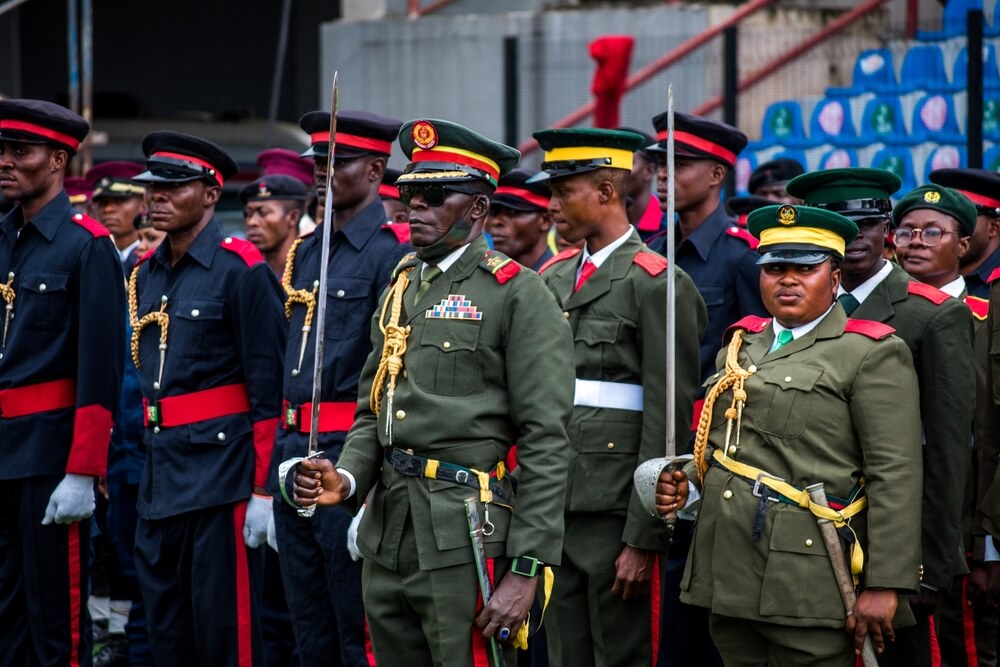 The belief that Nigeria can manage this crisis alone does not take into account its actual institutional and security capacity
At the same time, the belief that Nigeria can manage this crisis alone does not take into account its actual institutional and security capacity.
The country’s size increases the scale of the problem but does not provide the ability to stabilise a conflict that crosses multiple borders without external support.
The problem is also incorrectly framed as primarily humanitarian. Humanitarian response is a consequence, not a means of resolution.
The key lies in the security organisation of territory, intelligence coordination, and the long-term strengthening of state capacities.
The attack in Guyaku did not alter the course of events; it confirms the direction in which the conflict is already heading.
