Greenland's Parliament, Inatsisartut, decided to bring forward its regular session from February to January to discuss statements by US President Donald Trump regarding the island's future status.
The session was rescheduled so that the parliament could respond to messages interpreted in Nuuk as direct political and security pressure.
The leaders of the five main political parties, including the ruling Inuit Ataqatigiit and key opposition parties, jointly supported the decision.
These are political actors who have disagreed for years over Greenland's most important strategic issue – whether, and at what pace, to move towards full independence from Denmark.
This joint action therefore carries additional significance. Greenland's political scene rarely demonstrates such unity, especially on long-term constitutional and security matters.
The reason for expediting the session was Trump's statements on 9 January, in which he reiterated that the United States "must control Greenland", adding that this would be achieved "the easy way or the hard way".
He cited the island's strategic position in the Arctic, US security interests, and the need to prevent increased Russian and Chinese presence in the region as reasons.
Although these statements were not accompanied by concrete political or military actions, they were taken seriously in Nuuk, primarily because of the context in which they were made.
As ice melts and routes open
Trump's interest in Greenland is not new. During his first term in 2019, he publicly proposed buying the island, which the Danish government at the time rejected as absurd and politically unacceptable.
However, the difference between then and now is fundamental. In the meantime, the Arctic has ceased to be an area for long-term projections and has become a zone of direct competition between the great powers.
Melting ice is accelerating the opening of new sea routes, including the Northwest Passage, which shortens trade routes between Asia, Europe, and North America.
Greenland’s parties rejected any suggestion of changing the island's status under external pressure
At the same time, growing demand for rare metals, essential for batteries, electric vehicles, and modern electronics, is increasing the importance of Arctic deposits.
Greenland, with its vast territory and relatively untouched resources, is acquiring strategic value that exceeds its demographic size.
In a joint statement, Greenland’s parties rejected any suggestion of changing the island's status under external pressure. The message was clear: Greenland is not for sale and does not wish to be subject to deals by the great powers.
Former Prime Minister Múte B. Egede stated that the accelerated parliamentary session would serve to define a common political line, aiming to strengthen Greenland's independence in decision-making, especially in areas directly related to security and the economy.
The limits of self-determination
Since 2009, the island has been an autonomous territory within the Kingdom of Denmark, with broad powers over internal affairs.
However, foreign policy, defence, and financial matters remain the responsibility of Copenhagen. It is this division of jurisdiction that is coming under pressure as Greenland becomes a focus of global security calculations.
There is increasing debate in Greenland over whether the current arrangement provides sufficient political space to protect its own interests
Denmark's reaction was swift and predictable. Prime Minister Mette Frederiksen described Trump's statements as unacceptable and reiterated that Greenland has the right to self-determination but remains part of the Kingdom of Denmark.
In doing so, Copenhagen sought to send a message of support to Nuuk while maintaining control over key state functions.
However, in Greenland, there is increasing debate over whether the current arrangement provides sufficient political space to protect its own interests.
Smaller protests in front of the parliament building in Nuuk, as well as statements by local leaders and intellectuals, indicate growing dissatisfaction that the island's future is being discussed without the direct participation of its institutions.
Small population, strategic significance
With about 57,000 inhabitants, Greenland is demographically small but strategically critical. The United States has maintained a military presence for decades through the Thule base, built during the Cold War as part of an early warning system.
In recent years, Russia has been intensively developing military and logistics infrastructure in the Arctic, while China, although without territorial access to the region, is investing in resource exploration and seeking to position itself as a significant economic actor.
Greenland finds itself entangled in the interests of major powers, yet unable to fully govern its own foreign policy
In this context, Greenland finds itself entangled in the interests of major powers, yet unable to fully govern its own foreign policy. Trump's statements made this problem more visible than ever.
Rather than intimidating or disciplining the local political elites, they had the opposite effect: they accelerated political consolidation and sparked a serious debate about the island's future constitutional status.
It is particularly significant that the current consensus is not built solely around the idea of independence but rather around the need for greater capacity for independent decision-making.
Even political forces, traditionally wary of complete separation from Denmark, acknowledge that the current model does not align with the new reality of the Arctic.
Limits of power politics
The forthcoming parliamentary session could result in formal requests to expand Greenland's powers, particularly in the management of natural resources, investment policy, and international economic relations.
This would lay the foundation for a deeper transformation of relations with Copenhagen, without requiring an immediate exit from the Kingdom of Denmark.
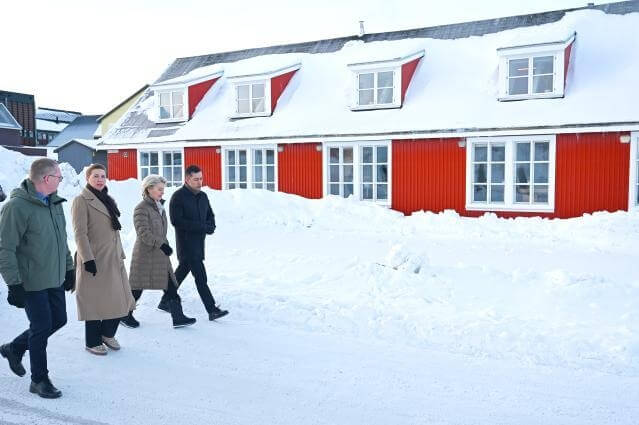 In the medium term the question of a referendum on independence will no longer be merely theoretical - PM Egede with Ursula Von der Leyen and Mette Frederiksen
In the medium term, however, the question of a referendum on independence will no longer be merely theoretical.
The idea of full statehood will take on a more concrete political form if external pressures persist and internal political unity remains intact. Denmark will then face a choice between a gradual transfer of authority and the risk of losing influence altogether.
For Washington, this development carries a clear lesson. The policy of open pressure does not strengthen the American position in the Arctic. On the contrary, it encourages distance and strengthens local political identities.
Instead of a reliable partner, the United States risks facing a territory that insists on neutrality and greater cooperation with other actors, including the European Union and regional structures.
Greenland's response to Trump's statements demonstrates the limits of power politics in contemporary international relations.
When small communities are institutionally organised and politically aware of their own interests, they do not retreat but consolidate.
Greenland does not seek confrontation but demands the right to decide. This demand becomes a key factor in shaping Arctic policy.
As the interests of the great powers increase, so does the willingness of local institutions to protect their own.
In a region that is becoming increasingly important to global security and the economy, ignoring local political will is no longer a viable strategy. Any power attempting to do so will encounter resistance, not cooperation.
