Don’t they know there’s a war on?
In recent days in which the escalating US-Israeli conflict with Iran eclipsed other concerns, UK politics were sidetracked into an argument over whether public prayers in London to mark the end of Ramadan were an act of domination by Islam.
Senior Conservative Nick Timothy ignited the quarrel, which the more strident elements of the British commentariat rapidly joined, by asserting that last week’s event was “straight from the Islamist playbook”.
Prime Minister Keir Starmer weighed in by calling on Conservative leader Kemi Badenoch to fire her justice spokesman for his "utterly appalling" comments that showed her party had a problem with Muslims.
But Badenoch stood by her man, suggesting segregated prayers during which she alleged women were “pushed to the back” were disrespectful of British culture.
Right-wing responses to London prayers
As church leaders and some fellow Conservatives hastened to criticise Timothy, anti-immigration figures on the right jumped on the bandwagon to endorse his views.
Nigel Farage, leader of Reform UK, said he would ban mass Muslim prayers at historic British sites if he were elected prime minister.
Tommy Robinson praised Timothy’s comments while claiming the Conservative Party would have kicked him out had he made them just two years ago
He said the London event was an attempt to "overtake, intimidate and dominate”.
Tommy Robinson, the far-right, anti-Islam agitator who last year led a 100,000 “Unite the Kingdom” march through central London, praised Timothy’s comments, while claiming the Conservative Party would have kicked him out had he made them just two years ago.
Why the controversy now?
The furore left the organisers of the event in London’s Trafalgar Square somewhat bemused. The Ramadan Tent Project charity, which uncontroversially organised the annual event in previous years, says its mission is to promote harmony between communities.
Public prayers were just part of the London celebrations to mark the end of the Ramadan fast, attended this year by around 3,000 Muslims and non-Muslims.
So why has the controversy erupted now at a time of conflict in the Gulf and the wider Middle East?
Other events the charity has organised in the past included an open Iftar meal hosted at Windsor Castle last year by King Charles III.
So why has the controversy erupted now at a time of conflict in the Gulf and the wider Middle East that risks minorities in the UK and beyond being targeted for events beyond their control?
Rising antisemitic attacks
British Jews were this week reeling from an antisemitic hate crime after unknown perpetrators attacked a Jewish health charity in north London, destroying four of its ambulances. Police are investigating whether the attackers were linked to the Iranian state.
It was the latest of a rising number of antisemitic attacks in the UK since two people died in an attack on a Manchester synagogue last year.
Despite the threats to the Jewish community from Islamist extremists and hostile states, some Jewish voices were raised in defence of the Muslim prayer gathering in Trafalgar Square.
Jewish News said the central London square also provided a gathering point for other religious festivals, including those of Christians, Hindus and Jews
An editorial in the widely circulated Jewish News said the central London square also provided a gathering point for other religious festivals, including those of Christians, Hindus and Jews. It said the uproar over the Muslim event was notably ugly in tone.
It cautioned its readers that attempts in Western countries to circumscribe the Islamic way of life almost always end up doing the same to Jews. The editorial invited sceptics to look across the Atlantic.
“A number of the most influential right wing voices in the United States were railing against Muslims a few years ago,” the paper wrote. “Now they have switched their sights to target Jews.”
The government’s attorney general, Richard Hermer, made a related point when he asked: “Timothy and Badenoch’s comments beg the question - would they have a problem if I as a Jewish man, were praying in public? Or is it just Muslim prayer they find offensive, and contrary to ‘British values’?”
The debate over Islamophobia
Timothy expanded on his theme in an article for The Telegraph in which he claimed that the Muslim adhan, or call to prayer, which asserts that there is no god but Allah, explicitly rejects the Christian belief in Jesus and the Holy Trinity.
“Indeed, historically the adhan was not only a communal call to prayer, but a declaration of Islamic control over a territory,” he wrote.
He thereby, whether unconsciously or unintentionally, echoed myths shared among others by Donald Trump, who has claimed that London has no-go areas governed by Sharia law.
The government issued a new non-statutory definition of anti-Muslim hostility as part of its social cohesion strategy
Timothy was an active campaigner against Labour government plans to redefine Islamophobia in a way he said would crush free speech by acting as a blasphemy law to protect Islam from criticism.
The government this month issued a new non-statutory definition of anti-Muslim hostility as part of its social cohesion strategy, citing criminal acts, both verbal and physical, directed at Muslims because of their religion.
The government said it was responding to the growing hostility, discrimination, and hate confronting Muslim communities, with the nearly 5,000 offences reported in the year to March 2025 representing almost half of all religious hate crimes.
Dominic Grieve, a former Conservative attorney general who worked on the definition, defended its publication, comparing it to a “useful” definition of antisemitism adopted by the previous government.
The furore over Trafalgar Square
Timothy’s critics, meanwhile, reflected that the furore over Trafalgar Square had further shifted the so-called Overton window that refers to the limits of acceptable political discourse at a given time.
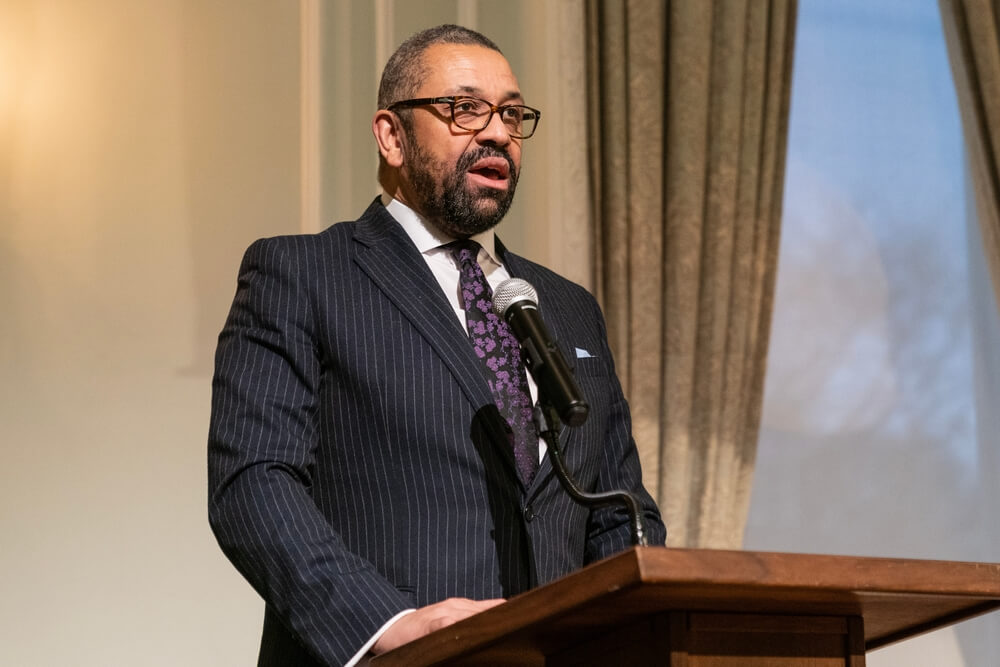 Asked whether he agreed with the view that the public prayers had been an act of domination, James Cleverly replied: “That wouldn’t be my personal take”
That was a view also endorsed by the far-right Robinson, who congratulated “every patriot” for shifting the Overton window so far that a Conservative member of parliament now “feels comfortable to state these facts”.
Such comments present a challenge to more centrist Conservatives who tentatively distanced themselves from Timothy’s views.
Conservative justice spokesman James Cleverly, asked by an interviewer whether he agreed with the view that the public prayers had been an act of domination, replied: “That wouldn’t be my personal take.”
Perhaps the Conservatives at large, and indeed Reform’s Farage, can at least thank Timothy for having diverted a smidgen of national attention from their initial calls for the UK to participate in what, among the British public, is President Trump’s increasingly unpopular war in Iran.
