At the UN General Assembly last month, US President Donald Trump delivered a victory speech.
A decade after telling his supporters that he’d stack so many victories that “you may even get tired of winning,” he offered a list of successes, including the settlement of eight wars, action against “the bully of the Middle East” in Iran, a deal with Denmark on Greenland, and the arrest of Venezuela’s “outlaw dictator,” Nicolás Maduro.
To Trump’s credit, some of these wins are significant. He has presided over a fragile but important ceasefire in Gaza, and his intervention in Venezuela, while in contravention of international law and now framed primarily around the “spoils” of the country’s resources, did remove a longstanding US adversary and created the possibility (even if far off) of free and fair elections for the first time in more than ten years.
But his speech also revealed something else: the growing limits on his power as he enters the lame-duck stage of his presidency, experiences collapsing approval ratings, and interacts with leaders whose tenures will extend far beyond his own.
Previously the most powerful, unpredictable force on the international stage, Trump has now passed the peak of his ability to disrupt the international order.
Top priorities
The evidence of Trump’s fading influence can be found across his top priorities: tariffs, the Iran war, and immigration enforcement.
Earlier this year, the Supreme Court struck down his use of emergency powers to institute tariffs, and even before that decision, Trump was confronted with the limits of his power in his brief trade war with China, which responded to his 145% tariff rate with a 125% rate of its own and a halt on critical mineral exports.
As a result, Trump has not only moderated his policies on China; he has almost entirely reversed his position, rolling out the red carpet for Chinese President Xi Jinping during his recent visit to Washington.
Trump even greeted Xi at the airport—the first time an American leader has offered such a welcome for a state visit since 1962—and offered to sell China weapons (in violation of US law).
Trump underestimated the power imbalance between himself and Carney, whose 60%-plus approval could keep him in office for years to come
Similarly, when Trump attempted to ratchet up trade pressure on Canada, Canadian Prime Minister Mark Carney responded with retaliatory tariffs and a new “middle-power” strategy.
Although Trump correctly saw that he held economic leverage over Canada (with over 70% of Canadian exports going to the US), he underestimated the power imbalance between himself, as an unpopular leader with only two years left in his term, and Carney, whose 60%-plus approval could keep him in office for years to come.
Now, Canada is thinking even bigger, forging a closer connection with the European Union and attempting to bring other countries, such as Australia and the United Kingdom, along with it.
Iran war
Trump has run into similar limits in the Iran war. After attempting to engineer a rapid regime change without the boots on the ground required to do so, his administration was surprised by the Iranian seizure of the Strait of Hormuz and has found itself unable to reach a durable agreement to reopen it.
Worse, Trump’s task in resolving the war has been further complicated by the fact that the Iranians no longer trust American agreements.
It was Trump, after all, who ripped up US President Barack Obama’s original nuclear deal and then attacked Iran while it was actively negotiating a new one.
Iran’s strategy now is to wait Trump out
Iran’s strategy now is to wait Trump out, hoping that the economic pressure from closing the Strait and his fading political capital will eventually force him to offer greater concessions.
Trump has tried to signal that he will not back down—by threatening to “annihilate” the country, emphasizing that a loss in the midterms will not alter his strategy, and dispatching new forces to the Middle East—but Iran remains unmoved .
Immigration policy
Domestically, Trump’s flagship immigration policies are facing pushback as well.
Earlier this year, Operation Metro Surge in Minnesota triggered such widespread unrest that Border Czar Tom Homan had to end the initiative.
Even Jim Justice, a longtime Trump ally in the Senate, is arguing that the administration is doing something wrong with its immigration policy
Now, congressional Republicans, many of whom are running for re-election this November and facing long odds as a result of Trump’s sagging approval ratings, are breaking from him.
Even Jim Justice, a longtime Trump ally in the Senate who is considering a run for governor of West Virginia, is arguing that the administration is “doing something wrong” with its immigration policy.
Regulation of AI
Trump of course remains a consequential figure on the global stage, since he is in charge of the world’s most powerful military, and can point to a dynamic domestic economy.
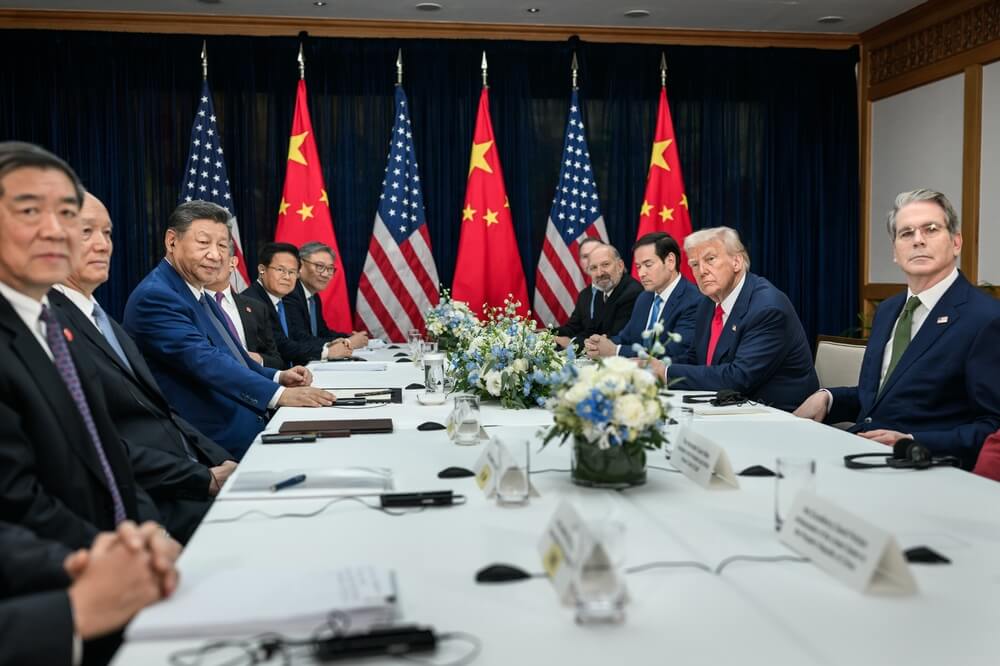 Trump remains a consequential figure on the global stage, since he is in charge of the world’s most powerful military, and can point to a dynamic domestic economy
But with the gulf between his ambitions and capabilities widening, the level of global risk associated with him is declining in all areas except for one: AI, where his capacity to disrupt the global order is growing.
Trump has ruled out regulation on AI in order to “win” the race against China, despite increasingly frequent safety incidents (from users’ attempts to develop bioweapons to hacking sprees) documented by US companies like OpenAI and Anthropic.
In doing so, he has created a near certainty that an AI-fueled crisis will emerge sooner or later.
Like his actions on trade, Iran, and immigration enforcement, such a development will spiral in ways that are currently unforeseeable, ultimately offering still more proof of the limits of his power in the final years of his presidency.
Ian Bremmer, Founder and President of Eurasia Group and GZERO Media, is a member of the Executive Committee of the UN High-level Advisory Body on Artificial Intelligence.
