On 8 October, the Malaysian prime minister, Anwar Ibrahim, vowed that his government would do everything it could to make Myanmar an equal member of the Association of Southeast Asian Nations (ASEAN).
He made that promise after talks with Min Aung Hlaing, the general who led a military coup in 2021 and who became president in April this year, following elections that Western governments and human rights organisations deemed rigged.
On the same day, Reuters reported that in mid-September the US administration had opened direct talks with Myanmar’s military government for the first time since the coup.
Malaysia is asking the generals to take back refugees, and the United States is seeking help to tackle internet fraud and gain access to rare metal deposits.
Both governments have accepted high-level contacts to pursue their own interests, while the generals have not yet agreed to end the war or negotiate with their opponents.
An official visit as the price for the return of refugees
In mid-September, Prime Minister Anwar stated that he would invite Min Aung Hlaing for an official visit if Myanmar took back thousands of refugees from Malaysia.
He explained that Malaysia, like the other ASEAN members, does not recognise the new government in Nay Pyi Taw, the Myanmar capital, but that it has to negotiate with someone about the refugees.
By that time, Myanmar had already agreed to receive 5,000 people, with Malaysia covering the transport costs.
The Malaysian government is under pressure from a public that is taking an increasingly harsh view of refugees
The Malaysian government reiterates that the meeting does not amount to recognition, but Min Aung Hlaing will almost certainly present a ceremonial reception with an honour guard in Putrajaya, the seat of the Malaysian government, as recognition at home.
The Malaysian government is under pressure from a public that, after a wave of hate on social media, is taking an increasingly harsh view of refugees.
The authorities describe them as a financial burden and a security risk. According to data from the UN High Commissioner for Refugees, about 193,000 refugees from Myanmar live in Malaysia, of whom around two-thirds are Rohingya, a predominantly Muslim ethnic minority originating from Rakhine in the west of the country, and Prime Minister Anwar has spoken of a plan to return up to 200,000 people in several stages.
The list of returnees
The first group of 1,476 people was returned on 29 September on two Myanmar Navy ships and one hospital ship, which were dispatched for the occasion by the Myanmar government.
According to the Malaysian Ministry of Home Affairs, the people to be returned were chosen by the Myanmar authorities, who sent a diplomatic note with a list of 3,524 names for the second phase, so it is the government from which the people fled that decides who will return.
The UN High Commissioner for Refugees warned that those returned were held in immigration detention before departure and that its officials could not speak to any of them, so it is questionable whether they genuinely agreed to return voluntarily.
Prime Minister Anwar made it a condition for return that Myanmar stop killing returnees and bombing Rakhine
The most sensitive part of this agreement concerns the Rohingya, who are not recognised as citizens by Myanmar and who, in 2017, fled in their hundreds of thousands from the western state of Rakhine to escape the army commanded by Min Aung Hlaing.
Prime Minister Anwar himself has said that the Rohingya do not have Myanmar citizenship, but his government has not explained where they should return to or with what rights, and it is not known whether they were in the first group.
Prime Minister Anwar made it a condition for return that Myanmar stop killing returnees and bombing Rakhine.
A day before the first group set sail, at least 50 people were killed in an air strike on a market in the Rakhine city of Kyauktaw.
The UN Independent Investigative Mechanism for Myanmar, a body that collects evidence of serious crimes for future trials, requested testimony about the attack and had warned days earlier that armed conflict and violence in Rakhine made safe return impossible.
An American’s freedom in exchange for a high-level meeting
Michael Vance, US Assistant Secretary of State for Intelligence, met Min Aung Hlaing in Nay Pyi Taw on 15 and 16 September.
It was the highest-level American contact with the military government since the coup, and the occasion was the release of the American businessman Adam Castillo, who had spent three months in a Myanmar prison.
Castillo was released on 16 September, and according to people familiar with the negotiations, Myanmar only asked that the US government maintain official contacts with it at an appropriate level.
Since then, talks have covered cooperation against internet fraud and access to Myanmar’s rare metal deposits, although Min Aung Hlaing remains under US sanctions and most US democracy-support programmes in Myanmar were shut down last year as part of major cuts to foreign aid.
In exchange for the freedom of one man, the generals obtained what mattered most to them
The US State Department states that the talks are intended to secure an end to violence and the release of political prisoners, but there is no indication that this has become a condition for continued contact.
In exchange for the freedom of one man, the generals therefore obtained what mattered most to them: a meeting with a high-ranking US official before Washington made any demands regarding the war.
Fraud centres under the protection of military allies
Washington expects the military authorities to help shut down centres that deceive people around the world via the internet, extracting billions of dollars from American citizens every year. The FBI is already in direct contact with the authorities in Nay Pyi Taw.
The difficulty is that major centres in Karen State, along the border with Thailand, are protected by armed militias linked to the military government.
In May 2025, the US Treasury designated one of them, the Karen National Army, as an international criminal organisation, and in November of the same year it imposed sanctions on the Democratic Karen Benevolent Army for supporting such centres.
By asking the generals for help against fraud, Washington is in fact asking them to turn against the people on whom they themselves rely
By asking the generals for help against fraud, Washington is in fact asking them to turn against the people on whom they themselves rely.
The most tangible American success in this area has come from the opposite side of the front line.
Shunda Park in Karen was captured in November 2025 by the Karen National Liberation Army, which is fighting the military government, and FBI agents in Thailand then examined thousands of seized phones and computers.
On the basis of that evidence, the US Department of Justice filed charges in April against the two Chinese nationals who ran the centre.
Mines beyond the generals’ control
Myanmar’s rare metals are attracting Washington as US industry seeks to reduce its dependence on China.
According to the International Energy Agency, in 2024 Myanmar supplied more than 40 per cent of global production of so-called heavy rare earths, the metals used to make powerful magnets for electric vehicles and wind turbines.
Most of that ore is mined in Kachin State in the north of the country, where the Kachin Independence Army, which is also fighting the military government, took over the main mining belt in October 2024.
Almost all the ore goes to China, which in 2024 carried out 91 per cent of global processing of metals for magnet production
Almost all the ore goes to China, which in 2024 carried out 91 per cent of global processing of these metals for magnet production.
China has influence on both sides of the war, backing the military while buying ore from rebel-held territory.
Last year, according to sources familiar with the talks, it threatened the Kachin Independence Army with a halt to purchases if it did not abandon its attack on Bhamo, a town in northern Kachin less than 100 kilometres from the Chinese border. Important road and river routes pass through Bhamo, supporting trade and supplying military bases.
If the town were lost, the generals’ presence in the north of the country, where China has major economic interests and relies on their authority to protect them, would be significantly weakened.
The only significant route for processing these metals outside China currently runs through Malaysia.
In May 2025, the plant operated by the Australian company Lynas in Malaysia became the first facility outside China to commercially process heavy rare earth elements, and Washington and Kuala Lumpur signed an agreement on cooperation in strategic minerals in October the same year.
A joint decision that ASEAN members are bypassing one by one
ASEAN has not invited Myanmar’s military leadership to leaders’ meetings since 2021, as the generals have failed to implement the peace plan adopted that year, which calls for an end to violence and dialogue among all parties to the conflict.
At the summit in May, the organisation’s leaders again concluded that progress in implementing the plan was minimal, and Myanmar was represented only by a senior official from the Ministry of Foreign Affairs.
Malaysia, however, is already the fifth member of the association to host Min Aung Hlaing since April, after Laos, Thailand, Cambodia and Vietnam, so the ASEAN joint decision is formally still valid, but individual governments are respecting it less and less.
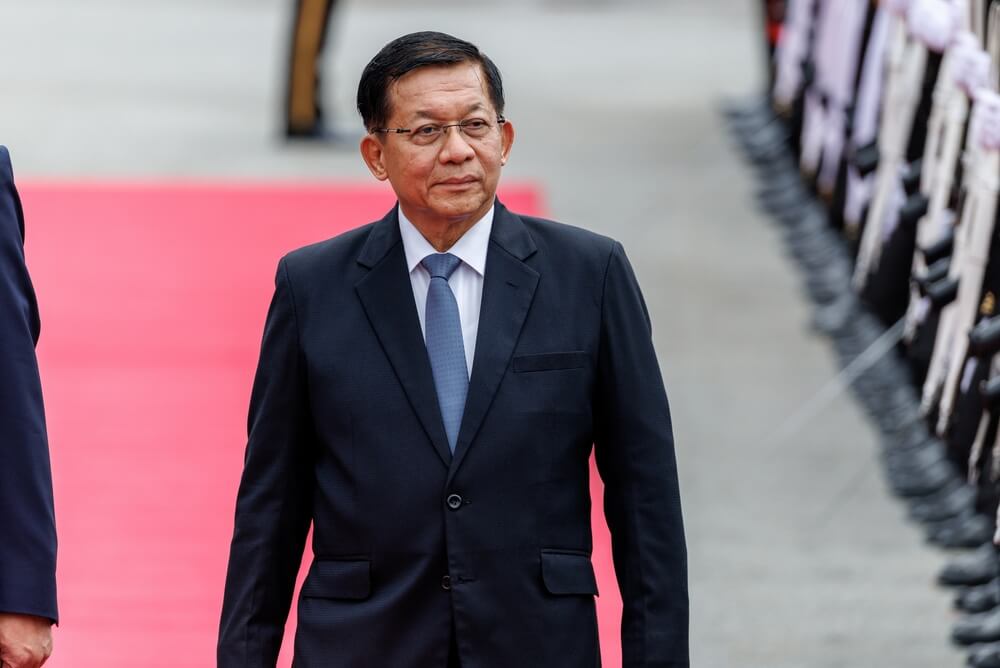 The first serious test will be the November ASEAN summit in the Philippines, as Myanmar’s return at the highest level requires the consent of all members - Min Aung Hlaing
The first serious test will be the November ASEAN summit in the Philippines, as Myanmar’s return at the highest level requires the consent of all members, and the Philippines, which presides over the association this year, continues to refer to the peace plan.
It is therefore unlikely that Min Aung Hlaing will sit down at the table with the other leaders this year.
It is much more likely that demands for Myanmar to be represented at a higher level will grow stronger from meeting to meeting, while the generals secure each new concession without making any progress in the war.
Malaysia and the United States brought the generals out of isolation independently, without any mutual agreement.
Both now have responsibilities that depend on Nay Pyi Taw’s goodwill: Malaysia on the return of refugees, and Washington on cooperation against fraud and hoped-for access to rare metals.
As a result, both will have less and less reason to impose conditions on the generals that could jeopardise those efforts.
By exploiting other people’s troubles and interests, the military government has thus obtained the reception that ASEAN denied it for five years, without having to make any concessions in the war it is waging against its own population.
