The American posture in the Middle East is undergoing what could be a significant change, but one that might not necessarily work out the way the current administration is envisaging.
In the Middle East, as elsewhere, the current American government’s brashness combined with the periodic abandonment of its allies might well end up further undermining the region’s stability.
The political reasons the administration and its circle variously put forward for the recent spate of decisions on the Middle East range from ending America’s ‘forever wars’ and prioritising scarce United States resources for US purposes to finally pivoting to Asia and forcing regional allies to become more self-reliant.
The above covers a seemingly modest list that includes the withdrawal from Syria’s Kurdish areas earlier this year, the more recent US refusal to aid Saudi Arabia against Yemen’s Houthis, and, this week, the withdrawal of the long-established US presence in Iraqi Kurdistan.
Weighed against the administration’s recent decision to extend the presence of thousands of American troops in the region in the context of the conflict with Iran, these moves in the opposite direction might seem modest.
Each can be justified in its specific context: The US is giving the new Syrian government a chance to establish itself.
The withdrawal from Iraq is a long-held goal and could strengthen the central authority in Baghdad, and refusing to attack the Houthis forestalls an escalation that nobody wants right now.
Yet these decisions also have a shadow side, which comes more to the fore if the manner in which they were taken and communicated is taken into account.
A highly questionable gamble
In Iraqi Kurdistan, the US has had a military footprint on and off since the end of the 1990-91 Gulf War.
In the aftermath, a no-fly zone kept out Saddam Hussein’s air force and helped the Kurds establish an autonomous region.
Now, the last American troops are not only leaving the Kurdish areas at a time when the war against Iran has exposed the Kurds to drone and missile attacks, the Pentagon is also cutting its direct aid to the Kurdish Regional Government that helped fund its Peshmerga forces.
The most credible explanation for this, besides the fight against ISIS being wound down and various agreements expiring, is that the Americans are betting on strengthening the central authority in Baghdad in order to help it bring other armed factions under control.
These are specifically the Shia elements of the formerly anti-ISIS Popular Mobilisation Forces that are controlled by Iran: the Badr Organisation, Asa'ib Ahl al-Haq (AAH), and Kata'ib Hezbollah. Removing the last American troops from Iraqi soil eliminates one argument from these factions for resisting full integration.
Yet, this would be a highly questionable gamble. As in Lebanon, the Iranian-supported Shia militias don’t need an excuse to resist government control and retain their freedom of action, at least partly in the service of Iran.
As in Lebanon, the Iraqi central government is unlikely to have the wherewithal to bring these factions under control unilaterally.
The United States is weakening its long-established Kurdish allies
What is quite certain is that the United States is weakening its long-established Kurdish allies, who have proven useful in the past and borne more than their fair share of the fight against ISIS.
In particular, the decision not to roll over the funding agreement that was last renewed in 2022 smacks of Washington pique at having been unable to use the Kurds to invade Iran at the beginning of the US-Israeli campaign earlier this year.
Even though the idea was so impractical that it should never have been entertained, this failure had several other components to it, chiefly among them Turkey’s strenuous opposition.
The limits of regional self-reliance
Turkey had also played a role in the American decision not to keep backing Kurdish forces in Northern Syria after the new Turkey-supported government in Damascus started to reassert control.
In the background, Turkey has thus been an influence in and beneficiary of several recent American decisions in the region.
On the one hand, it’s not strange that the administration takes into account the wishes of a key regional ally with the second-largest armed forces in NATO.
Turkey is playing an ever more active role in wider regional geostrategic calculations
Turkey is also playing an ever more active role in wider regional geostrategic calculations, as evidenced by the Mecca Joint Defence Agreement signed with Saudi Arabia and Pakistan in August.
The mutual defence pact between these conservative Sunni Muslim countries would appear to represent exactly the kind of regional self-reliance that the Trump administration is demanding from its allies. It can even be seen as something of a counterweight to Iran.
In practice, though, neither Turkey nor Pakistan will counterbalance Iran. Saudi Arabia has received no practical support from the Pact in the recent flare-up with the Houthis. Only the UK has in fact sent material support.
The timing and manner of the American refusal
Containing the Houthis and keeping the Red Sea route open seems almost glaringly to be in the American interest.
It is legitimate, though, to wonder whether the Saudis are capable of handling the Houthis, even with American support.
And it’s also true that the US is finding itself short of all kinds of defensive munitions at the moment.
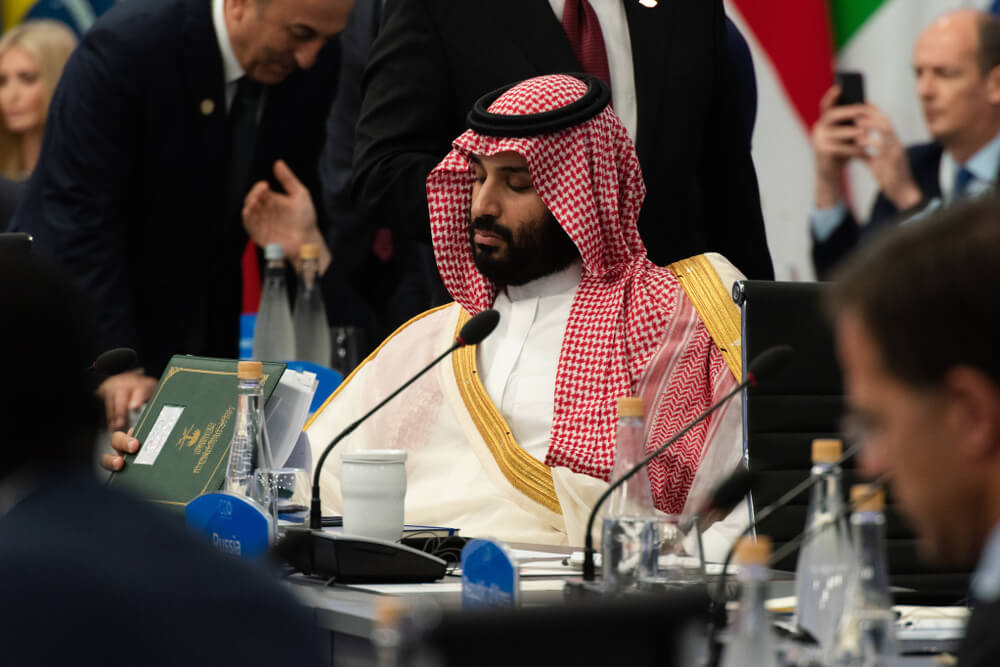 Saudi Arabia’s de facto leader, Crown Prince Mohammed bin Salman, was reported to have requested US action against the Houthis not once but twice and was rejected in a very public manner
Just as with the Kurds, though, the timing and manner in which the American refusal to aid Saudi Arabia was delivered matter more than the background.
Saudi Arabia’s de facto leader, Crown Prince Mohammed bin Salman, was reported to have requested US action against the Houthis not once but twice and was rejected in a very public manner.
Some form of support, even if it were only symbolic, could have been extended to Riyadh.
The Trump administration is constantly signalling to all of America’s long-established allies that they can no longer rely on previous expectations of support.
This holds true for the Kurds and the Saudis, but also further afield for America’s European and Asian allies, such as South Korea, Taiwan and Japan.
Cosplaying disruptor-type behaviour
Yet, only in the Middle East is there an ongoing military conflagration that the Trump administration itself initiated.
And despite decades of American talk of a pivot away from the region, the Middle East still dominates global energy markets and any reorientation away from it remains wishful thinking.
For any administration, it would require an enormous practical and intellectual effort to keep all the balls in the air in this volatile region
For any administration, it would require an enormous practical and intellectual effort to keep all the balls in the air in this volatile region.
The current US leadership seems averse to such effort and is much more inclined to let the pieces fall where they may, cosplaying disruptor-type behaviour on a global geopolitical scale.
That is a very dangerous approach to international affairs, especially for a region in turmoil.
