Another major Saudi-Houthi war is becoming inevitable. Riyadh has spent years trying to avoid precisely this outcome.
Saudi restraint reflected a decision to end the war in Yemen, focus on economic transformation, and prevent regional conflict from disrupting Vision 2030.
The problem is that the Houthis have used Yemeni territory to maintain an Iranian-aligned military capability directly on Saudi Arabia’s southern border, retaining ballistic missiles, drones and maritime-strike capabilities that threaten Saudi territory, energy infrastructure and shipping.
For Riyadh, the permanent presence of this military structure is strategically unsustainable.
The broader Iranian strategy has made the problem more urgent. Iran has mined the approaches to the Gulf and Hormuz, with Saudi tankers among the vessels struck, while the Houthis have attacked Saudi tankers in the Red Sea and energy infrastructure on the kingdom’s western coast.
The East-West Pipeline can move up to 7 million barrels of crude oil per day from the Eastern Province to Yanbu, with approximately 5 million barrels per day available for export after supplying Saudi Arabia’s western refineries.
This provides the kingdom with its principal means of bypassing Hormuz but ultimately depends on secure passage through Bab al-Mandab.
The global consequences of permanently losing that redundancy would be enormous.
Saudi Arabia is the world’s largest crude oil exporter and the principal holder of effective spare production capacity.
A prolonged interruption that removed several million barrels of Saudi exports each day would hit a market already severely disrupted by the war with Iran, while simultaneously eliminating the only “swing” producer normally capable of replacing lost supply.
The security of Yemen and its surrounding waterways has therefore become directly linked to the stability of the global economic order.
Iranian proxy threat from the north
Saudi Arabia also faces an Iranian proxy threat from the north. Iran-backed Shia militias in Iraq have launched drones against Saudi energy installations.
Riyadh warned Baghdad to bring those organisations under control and subsequently struck militia weapons storage, logistical and command-and-control facilities when the attacks continued.
The message was straightforward: Iraqi territory would not provide sanctuary for attacks against Saudi Arabia, and another failure by Baghdad to control these groups would trigger a substantially larger Saudi response.
Saudi Arabia can generate overwhelming local air superiority without concentrating its entire combat fleet in a single theatre
During the Iran war, the Royal Saudi Air Force shifted from territorial defence to sequenced offensive strikes against Iranian missile and drone infrastructure, IRGC military facilities, and coastal naval positions associated with attacks against the kingdom.
Its enormous fleet of 4.5-generation F-15SA Strike Eagles and Eurofighter Typhoons Tranches 2 and 3A allowed successive waves to apply increasing combat power while retaining substantial forces for operations elsewhere and for homeland defence.
Saudi Arabia can therefore generate overwhelming local air superiority without concentrating its entire combat fleet in a single theatre.
The kingdom is thus prepared to conduct major military campaigns on two fronts simultaneously while retaining sufficient forces to defend its territory against threats from a third.
The centre of the renewed war in Yemen
But the centre of the renewed war in Yemen will be the Saudi-led Joint Forces Command (JFC).
Since 2015, it has evolved enormously into the combat command structure through which Riyadh coordinates Saudi forces, the Yemeni Armed Forces, and affiliated Yemeni formations positioned around Houthi-held territory.
Allied contingents include Sudanese and Pakistani personnel, alongside small but symbolically important units from certain Arab Gulf states.
The Yemeni component is particularly important. Saudi-led restructuring has produced a more coherent Yemeni fighting force, and these formations have recently performed increasingly well in field engagements against Houthi units.
Together, the JFC, Saudi-led air operations and the maritime coalition provide the land, air and naval components of a coordinated campaign
The result is a substantially stronger ground component than at the beginning of the 2015 intervention, already positioned across several fronts around Houthi-held territory.
Recent Houthi attacks on JFC positions, Yemeni formations, military camps and assembly areas are intended to provoke premature responses, undermine planning and cohesion during force concentration, and disrupt the JFC campaign before Riyadh decides when it will begin.
The Saudi-led maritime coalition completes the operational structure. This 14-state coalition brings together regional and partner naval forces under Saudi leadership to protect commercial navigation and secure the Red Sea, Arabian Sea, and Gulf of Aden.
Together, the JFC, Saudi-led air operations and the maritime coalition provide the land, air and naval components of a coordinated campaign.
Interconnected strategic purposes
Saudi Arabia has also created strategic depth beyond the immediate theatre through the Makkah Joint Defence Agreement with Pakistan and Türkiye, linking Riyadh with the two most powerful armies in the Muslim world.
Pakistan contributes a large, combat-experienced military and the strategic weight of a nuclear-armed power.
Türkiye contributes NATO’s second-largest armed forces, extensive operational experience and a major defence industrial base.
The Makkah accords are more consequential than the trilateral agreement itself.
They provide the foundation for a new regional security architecture centred on Saudi Arabia, which will draw in most of the other Arab Gulf states, a large majority of Arab states and key Muslim countries in Africa and Asia.
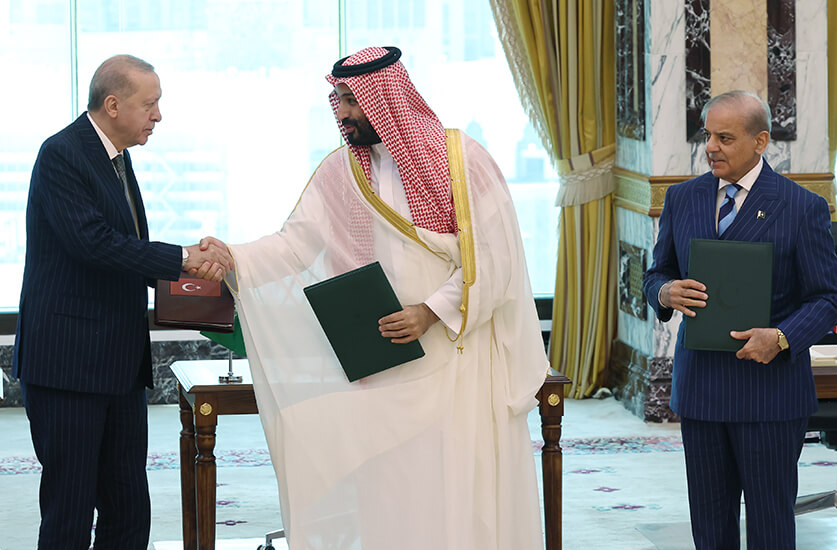 Saudi Arabia has created strategic depth beyond the immediate theatre through the Makkah Joint Defence Agreement with Pakistan and Türkiye
The attacks on Bahrain, Qatar and Kuwait show why this collective structure is necessary: continued attacks on individual Gulf states are unsustainable and will increasingly be dealt with within the wider security architecture emerging around the kingdom.
Yemen itself is equally central to the strategic objective. Years of conflict, fragmentation and economic collapse have prevented the country from beginning the sustained reconstruction required to restore functioning state institutions and economic life.
Ending the military conditions that perpetuate this conflict is therefore as much about giving Yemen the opportunity to finally rebuild as it is about securing Saudi Arabia.
Another Saudi-Houthi war is therefore becoming inevitable. The existing situation is no longer sustainable for Saudi Arabia, for Yemen or for a global economic system dependent on secure energy flows through the region.
Riyadh has spent years trying to avoid another war while building a fundamentally different military position as the strategic space for restraint has disappeared.
The next campaign will therefore have three interconnected strategic purposes: ending the Houthis’ ability to use Yemeni territory as a permanent military front against Saudi Arabia, opening the way for Yemen’s reconstruction, and protecting the energy and maritime arteries on which a significant part of the global economic order depends.
Dr Nawaf Obaid is a Senior Research Fellow at the Department of War Studies, King’s College London.
