The Lebanese state is entering a new round of talks with Israel at a time when the most important aspect of its security is increasingly being decided outside Beirut.
The talks in Washington are intended to pave the way for an end to the war in southern Lebanon, but their political significance lies in a much more uncomfortable issue for Lebanese institutions.
Can a country determine its own security if part of its territory is being negotiated with Israel, while the broader context of the war is being discussed simultaneously by the United States and Iran?
The Washington talks immediately revealed why Lebanon's position is weak. Beirut is seeking a deadline for the withdrawal of the Israeli army from southern Lebanon.
Israel seeks the disarmament of Hezbollah and an agreement to prevent another war. Hezbollah rejects complete disarmament and pressures the Lebanese government to abandon direct talks with Israel.
In parallel, the United States and Iran are negotiating to end fighting on all fronts, including in Lebanon.
This arrangement of actors highlights the fundamental problem. Lebanon has a government, diplomatic channels, and the formal right to negotiate its own border.
Hezbollah possesses weapons, military infrastructure, and ties to Iran. Israel maintains military control over parts of the south and insists that, without resolving Hezbollah's status, there can be no stable agreement.
The United States leads the negotiation process, while Iran, through Hezbollah, maintains direct influence over any arrangement concerning Lebanese territory.
Negotiations that reveal the weakness of the state
The Lebanese government is attempting to show that direct talks with Israel are the only realistic way to achieve the withdrawal of Israeli forces and pacify the southern front. It is a rational effort to restore political decision-making to state institutions.
The problem arises because the need to prove the state's authority through negotiations in Washington demonstrates how much that authority has already been weakened.
Since the war began on 2 March, when Hezbollah attacked Israel in support of Iran, Lebanon has found itself in a conflict that the Lebanese state neither independently initiated nor can independently end.
Israeli strikes and ground operations have had severe consequences in southern Lebanon, while previous rounds of talks since April have failed to produce a lasting solution.
Any Lebanese agreement with Israel that does not address Hezbollah's weapons will be insufficient for Israel
The longest ceasefire occurred only after the US-Iran agreement, which poses a serious political problem for Beirut.
If peace on Lebanese territory is achieved through an agreement between Washington and Tehran, the Lebanese state remains at the table, but without its main leverage.
This is the central weakness of the Lebanese position. Beirut must negotiate with Israel to regain control of the south, but it must also consider Hezbollah, which bases its legitimacy on the claim that armed resistance is more effective than state diplomacy.
Any Lebanese agreement with Israel that does not address Hezbollah's weapons will be insufficient for Israel. Any agreement that directly affects Hezbollah's weapons could trigger an internal crisis in Lebanon.
Limits of Lebanese sovereignty
Israel's position in Washington follows a clear logic. If Hezbollah retains military capacity in southern Lebanon, Israel considers the issue merely postponed.
Israeli officials therefore link any serious agreement to the disarmament of Hezbollah and the establishment of a new relationship with the Lebanese state.
For Israel, the Lebanese government can only be an interlocutor if it demonstrates the ability to control the security situation within its own territory.
This is a demand that Beirut can hardly meet at present. The Lebanese state has operated for years within a system in which Hezbollah possesses political influence, military power, and external support that exceed the capacity of the central institutions.
Beirut has insisted for years that only state institutions have the right to decide on war and peace
A formal decision on disarmament would be much easier than its actual implementation. The Lebanese army lacks the political space for direct confrontation with Hezbollah, and any attempt to impose a solution by force could further weaken the state it is meant to strengthen.
That is why the Israeli demand, although understandable from an Israeli security perspective, strikes at the most sensitive point of the Lebanese state.
Beirut has insisted for years that only state institutions have the right to decide on war and peace, but it is precisely on this issue that its position remains weakest.
Israel assesses the Lebanese state’s ability by its capacity to control armed groups within its own territory, a problem Beirut has so far failed to resolve.
Hezbollah is waiting for the outcome from Tehran
Hezbollah has different interests from the Lebanese government. Its position depends not only on the outcome of talks in Washington, but also on the broader relationship between Iran and the United States.
If Tehran secures an Israeli withdrawal or a longer-term cessation of hostilities through talks with Washington, Hezbollah will be able to claim that its regional connections have achieved what the Lebanese state could not achieve alone.
This would further weaken Beirut's argument that Lebanon's security should be restored to state institutions.
If the US-Iran process fails or remains incomplete, Hezbollah will retain justification for maintaining an armed presence.
The Lebanese problem can no longer be described solely by the relationship between Israel and Hezbollah
In both cases, its position remains more closely aligned with Tehran than with the institutions in Beirut. This is precisely what gives the crisis regional depth.
The Lebanese problem can no longer be described solely by the relationship between Israel and Hezbollah, nor only by the weakness of the Lebanese state.
It is part of a broader mechanism in which Iran uses the Lebanese front as a bargaining chip, and the United States seeks to include this chip in a wider agreement to defuse the war.
For the Lebanese government, the scope for manoeuvre is very limited. If it accepts that key elements of the truce are being negotiated through the US-Iran channel, it risks appearing as a bystander to its own crisis.
If it tries to impose its own negotiating path, it must deliver results more quickly than Tehran and Washington. The four previous rounds of talks did not achieve this.
Washington between two processes
The United States is attempting to connect two negotiation processes that follow different logics. The Lebanon-Israel channel aims to resolve issues of withdrawal, security guarantees, and the future relationship along the border.
The US-Iran channel aims to defuse the wider war and prevent further escalation of the conflict. In practice, these two processes overlap, particularly in Lebanon.
This overlap gives Washington an important role, but also limits the scope of its mediation. US diplomacy can organise talks, pressure the parties to extend the ceasefire, and seek technical arrangements to prevent escalation.
The root cause of instability lies in the relationship between the Lebanese state, Hezbollah, Iran, and Israel's security doctrine
However, it is much more difficult to address the root cause of instability, which lies in the relationship between the Lebanese state, Hezbollah, Iran, and Israel's security doctrine.
As a result, Washington's success may be modest but politically significant. A ceasefire, an agreement on phased withdrawal, or a mechanism to prevent incidents in southern Lebanon would represent a real achievement after months of fighting.
Such an outcome would not resolve the issue of Hezbollah's weapons, nor would it restore full control to Lebanese institutions, but it would reduce pressure on the population and allow for a longer political process.
The country after the war
Today, Lebanon is not the only country in the Middle East seeking to restore authority after years of war, foreign influence, and armed groups.
Iraq faces similar challenges, Syria faces even more difficult ones, while Yemen represents the most extreme example of the breakdown of a state's monopoly on force.
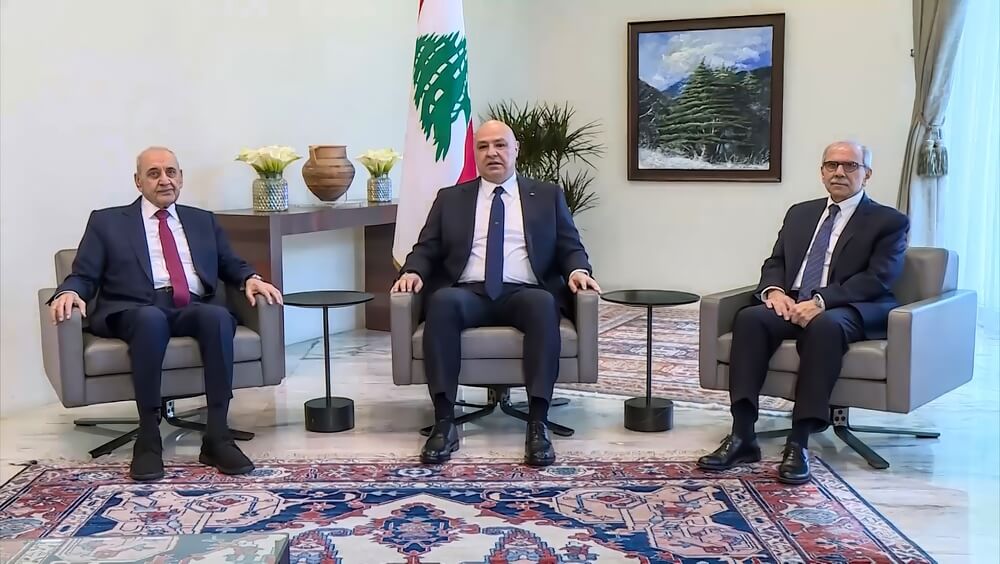 If Lebanon fails to return the issue of war and peace to the framework of the state, no future agreement will provide a lasting solution - President Aoun, PM Salam, Speaker of the Parliament Berri
Therefore, the success of the negotiations in Washington will be measured by more than the duration of the ceasefire or the speed of the Israeli withdrawal.
The real question is whether, after the war, decisions on security will once again belong to state institutions or remain divided among the government, armed organisations, and regional powers.
If Lebanon fails to return the issue of war and peace to the framework of the state, no future agreement will provide a lasting solution. Each ceasefire will simply become a new phase of the same crisis.
The Lebanese drama is therefore not merely a story about Israel, Hezbollah, or Iran. It demonstrates how difficult it is to restore state authority once the monopoly on the use of force has been lost.
This is precisely why the true outcome of the Washington talks will be measured in years rather than weeks.
