The conflict between Saudi Arabia and the Ansar Allah movement, colloquially known as the Houthis, reignited from July 2026 onwards before escalating drastically from early September.
Often, though wrongly, described as an “Iranian proxy”, the Houthis managed to capture large swathes of Yemen in 2014, survived the onslaught of a large-scale intervention by a coalition led by Riyadh from 2015 to 2022, conducted a harassment campaign against maritime traffic in the Red Sea from November 2023 to early 2025, and fought the Americans as a result in March 2025 – all the while firing missiles and drones at Israel and being on the receiving end of Israeli air strikes in return.
Finally, in early September 2026, they managed to repulse a large-scale government offensive against Sanaa and then seized the Bab-el-Mandeb coastline.
All of this raises the question of what the Houthis' military capabilities are and why they represent such a challenge.
Merging guerrillas with technicians
The Houthis emerged in the early 2000s among Zaydi communities in northern Yemen.
From these mountainous areas, they fought a classic guerrilla war against the Yemeni government of then President Ali Abdullah Saleh between 2004 and 2009.
The Arab Spring, however, changed all that. Ali Abdullah Saleh lost his throne, and the resulting confusion allowed the Houthis to capture Sanaa, the capital, in September 2014. By then, Ansar Allah had entered an alliance with Saleh, who still controlled a large part of the Yemeni armed forces and their vast arsenal.
This proved a turning point: the movement, which had until then relied on small, lightly armed fighter detachments, suddenly gained access to large stocks of heavy, sophisticated weapons and, crucially, to personnel trained to operate and maintain them.
Of particular importance were the former president's Praetorian Guard and the three brigades equipped with ballistic missiles of Soviet, Russian and North Korean origin
Of particular importance were the former president's Praetorian Guard and the three brigades equipped with ballistic missiles of Soviet, Russian and North Korean origin.
Moreover, the rallying of a core group of Yemeni Navy personnel allowed the Houthis to build up an embryonic naval force capable of firing Chinese anti-ship missiles captured from naval inventories.
Similarly, former air force personnel allowed the movement to familiarise itself with the various, even though outdated, Soviet air defence systems it had inherited from the former armed forces.
Consequently, once the Saudi-led coalition intervened in Yemen from March 2015 onwards and successfully drove the Houthis out of Aden, which they had entered in the aftermath of their conquest of Sanaa, the movement gradually managed to retaliate by firing missiles at targets in Saudi Arabia, while harassing maritime traffic with a handful of anti-ship missiles and, above all, with small boats.
Where the IRGC factors in
It was only at this stage that Tehran increased its commitment through the IRGC's Quds Force, tasked with providing support to Iran's regional allies, while Lebanese Hezbollah also dispatched instructors.
The Quds Force then applied, albeit on a much larger scale, the modus operandi it had developed to support other allies such as Hamas or Hezbollah.
Rather than simply supplying weapons and ammunition, the Iranians organised the transfer of know-how
Rather than simply supplying weapons and ammunition, the Iranians organised the transfer of know-how by training hundreds of Houthi specialists in Iran or Lebanon, covering everything from drone assembly to air defence tactics.
They also supported the movement in setting up its own training infrastructure and academies, such as the naval college in al-Hudaydah, and in building up its own workshops to assemble equipment such as drones and missiles using components sourced from a wide range of origins, with Tehran providing only the most critical or sophisticated elements.
This enabled the Houthis to build a substantial arsenal of drones and missiles despite their isolation and the embargo targeting them.
Moreover, the IRGC had spent decades developing and acquiring tactics and equipment designed specifically to fight a militarily superior opponent, and it provided Ansar Allah with part of this knowledge and these designs.
The Iranians also helped the Houthis set up a resilient, decentralised command-and-control architecture, as well as several underground sites to protect their most valuable assets, foremost among them their ballistic missile force and drone assembly workshops.
The Houthi military in 2026
The Houthi military is led by a Jihad Council, which keeps direct control over several elite units as well as the navy and long-range strike forces.
The bulk of the military is, however, organised into semi-autonomous military zones.
These can be compared to semi-autonomous fiefdoms, as each commander receives combined military, security and administrative authority over their zone.
Abdulmalik al-Houthi, the leader of the movement, also directly appoints commanders, several of whom are blood relatives or in-laws.
Most of the movement's combatants are embedded in its ground forces, which are organised into dozens of small, partly motorised light infantry brigades
Most of the movement's combatants are embedded in its ground forces, which are organised into dozens of small, partly motorised light infantry brigades.
These can in turn be supported by heavier brigades, which include a core of artillery and tanks, by elite brigades that act as shock troops, and by smaller drone units.
The movement has also raised part-time militias, similar to the Iranian Basij, to support the other units.
The key to the Houthis' effectiveness is their promotion system, which is far more meritocratic than that of their adversaries.
This, in turn, allows Houthi field forces to function within a flexible command architecture, which makes it possible to routinely assemble and disband ad hoc task forces to meet specific objectives, and, above all, to operate in a dispersed fashion to reduce their exposure to enemy air power.
While excelling in mountain warfare, their ground forces have demonstrated the ability to conduct more complex operations combining drones, heavy weaponry and light infantry, and even to launch sudden, large-scale motorised raids to exploit breakthroughs, as seen in early September 2026.
Aerospace and naval forces
While the ability of Ansar Allah to launch long-range strikes with ballistic missiles and drones against targets in Israel, the United Arab Emirates and Saudi Arabia is well documented, it has also demonstrated the ability to coordinate highly precise attacks that combine observation drones with shorter-range ballistic missiles and attack drones, with the former guiding the latter on to their targets.
This combination has proved devastating on several occasions, allowing the Houthis to target key logistical hubs and command posts well behind the front lines.
Similarly, the movement operates a crude but effective air defence network, combining dozens of observation posts positioned on ridges and mountains with passive, optically guided – and thus very discreet – air defence systems such as the “358” drone-missile, while several of its older Soviet-era systems have been adapted to fire more modern, Iranian-produced surface-to-air missiles such as the “Taer-2”.
This air defence architecture has proved to be a challenge even for the Americans, who nearly lost a fighter jet to Houthi air defences in 2025, while numerous MQ-9 Reaper drones were shot down.
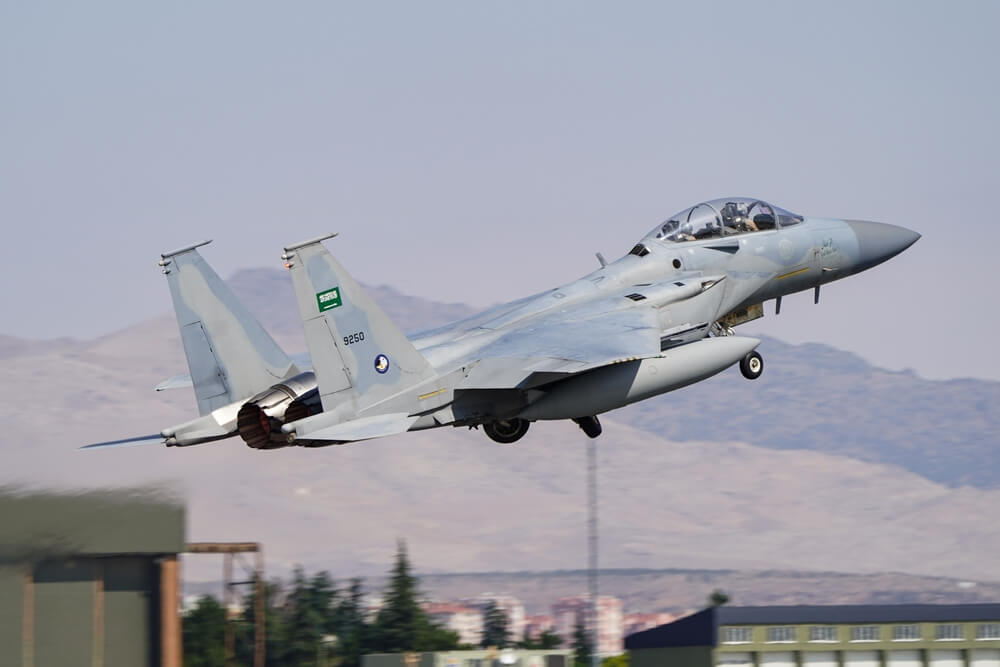 Since July 2026, this network has managed to shoot down a dozen Saudi drones as well as an F-15SA fighter-bomber
Since July 2026, this network has managed to shoot down a dozen Saudi drones as well as an F-15SA fighter-bomber.
Even more crucial for the movement are its naval capabilities, which enable it to exercise significant control over the southern Red Sea and the Bab-el-Mandeb Strait through an architecture that combines coastal observation posts and radars with a wide array of anti-ship weapons.
These include aerial suicide drones, anti-ship cruise and ballistic missiles, small lightly armed speedboats, sea mines, and unmanned kamikaze surface boats.
With this array, Ansar Allah has managed to damage dozens of merchant ships since 2023, and even sink a few, despite the continuous presence in the area of American, European and Asian warships.
In early 2025, the Houthis even managed to engage an American carrier group and forced its aircraft carrier to make evasive manoeuvres.
The challenge of asymmetric warfare
The Houthis' military capabilities remain far from sufficient to defeat the Saudi-led coalition outright, prevent enemy air power from operating over their sanctuaries, or put out of commission the air bases from which it operates.
Despite their resounding success in early September 2026, Ansar Allah's ground forces are now engaged in a series of attritional battles against Saudi-backed Yemeni government forces and are unlikely to secure further major victories in the short term.
The war is highly likely to be protracted, with dire consequences for the world economy
On the other hand, over more than a decade they have demonstrated their ability to continue operating despite sustaining continuous heavy blows, and to defend their territory fiercely, all while keeping both maritime traffic and the Saudi oil industry under pressure with their long-range fire.
The war is therefore highly likely to be protracted, with dire consequences for the world economy.
Adrien Fontanellaz is a military historian and analyst specialising in contemporary warfare. He is a member of the scientific committee of the Centre d’Histoire et de Prospective Militaires (Pully, Switzerland).
