The 52nd G7 Summit will take place on June 15–17 in France, hosted by President Emmanuel Macron. Established during the 1970s global oil crisis, the G7 brings advanced industrialized economies together to foster cooperation on global economic and political challenges.
Six of its seven members (excluding Japan) also belong to NATO, and despite US President Donald Trump’s many attacks on America’s closest allies, it looks as though the United States will participate in the meeting.
But the US will do so on its own terms. It has demanded restrictions on who will participate, the topics to be discussed, and the concluding statement.
Unlike final communiqués from previous meetings, this one will include no binding recommendations, only “shared diagnoses” of current policy challenges.
The US has already rejected even non-binding recommendations for “European-style” regulation of American AI companies.
So, what will G7 leaders discuss? As on several previous occasions, global macroeconomic imbalances will be a major topic, but Trump will resist the G7’s diagnosis.
According to a memo prepared for the French government by four renowned economists, G7 leaders should focus on large and growing current-account imbalances that threaten economic growth and financial stability.
In 2025, the US current-account deficit rose to 4.6% of GDP, a level not reached since 2006 (just prior to the global financial crisis); China’s current-account surplus reached an estimated 3.5% of GDP; and the European Union’s surplus hit 2%.
These imbalances—which the International Monetary Fund characterizes as excessive, large, and persistent—are rooted in saving and investment behavior, which in turn fuels net capital inflows or outflows and trade frictions.
China’s current-account surplus
Though China is not a G7 member, its current-account surplus poses a shared economic challenge for everyone.
It is funneling investment into manufacturing and high-tech sectors (electric vehicles, green technologies, and critical minerals), and thus relying on external demand to absorb a significant share of its production.
Its economy is obviously too large to keep relying on exports as its main growth engine, but its domestic consumption has been chronically low, accounting for a mere 56.6% of its GDP in 2024, far below the US consumption share of 82.9%.
China’s new five-year plan does signal a possible pro-consumption shift
China’s new five-year plan does signal a possible pro-consumption shift, emphasizing public support for health care, safety nets, and repairing balance sheets damaged by the country’s property-market crisis.
But it also promises additional pro-innovation and pro-manufacturing policies.
In any case, whether China actually pivots from its longstanding export-led model depends on Chinese President Xi Jinping, not on G7 leaders.
For now, the renminbi remains significantly undervalued, which functions as a “macro industrial policy” that bolsters its micro industrial policies.
The US is running a growing federal budget
The US, by contrast, has an unprecedented savings shortfall, which forces it to rely on the rest of the world to fill the gap and finance both government spending and investment.
Even at full employment, the US is running a huge and growing federal budget deficit that is sucking savings from the EU and the rest of the world to finance tax cuts for the rich, massive spending on the military and immigration enforcement, and a foolish war in the Middle East.
Why is the rest of the world letting the US government get away with this? To be sure, US government assets are liquid, they offer attractive real (inflation-adjusted) interest rates, and they have been perceived as free of default risk.
All three major US credit-rating agencies have downgraded US federal government debt over the last three years
And yet, all three major US credit-rating agencies have downgraded US federal government debt over the last three years.
The US government now issues public debt totaling 6% of the country’s GDP every year.
The debt-to-GDP ratio, an indicator of default risk, has climbed to 101%, and it is on course to hit 120% by 2036.
Meanwhile, interest payments on existing federal debt are already exceeding 3% of GDP, necessitating cuts to government spending on health and other programs favored by most voters.
That will stoke political discontent, and the government’s restricted fiscal space will limit its ability to respond to future shocks.
European G7 leaders are behaving like responsible adults
For the EU, the challenge is weak investment demand, which is reflected in a persistent current-account surplus.
With a significant share of EU savings being invested in US financial assets (both private and public), Europeans are unwittingly helping to finance Trump’s Iran war, which itself has caused a sharp increase in their energy costs.
What, then, should the EU do to reduce its current-account surplus and redirect its savings toward productive investment and growth at home?
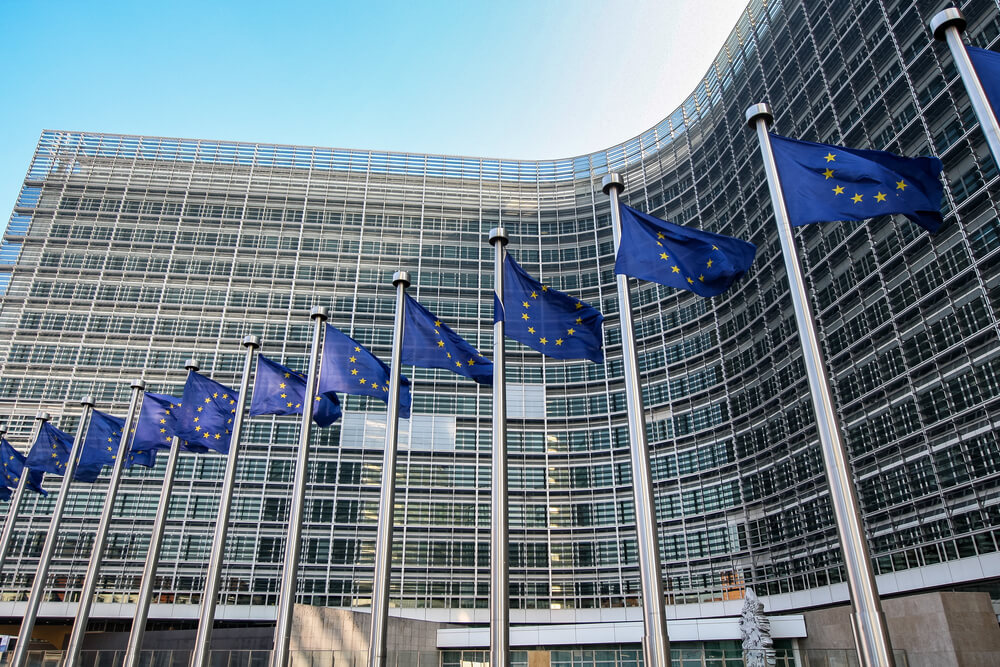 The EU must create safe EU government bonds to serve as an alternative to US government bonds
First, it must adopt policies to deepen the integration of its goods, services, and capital markets, following both the recommendations of former European Central Bank President Mario Draghi in his major report on European competitiveness and the recommendations of a recent report by Enrico Letta, former prime minister of Italy, on strengthening the EU single market.
To that end, the EU recently passed an ambitious new law, known as “the 28th regime,” that allows companies to incorporate and operate across all 27 EU member states under a single set of rules.
While not without flaws, this is an important step in the right direction, and further progress is expected.
To address capital-market fragmentation, the EU is developing policies to strengthen its Savings and Investment Union (which would reduce dependence on bank financing for investment); to reform national pension systems whose assets are currently locked in bank deposits, and thus locked out of financial assets offering higher risk-adjusted returns; and to create a single EU supervisory authority along the lines of the US Securities and Exchange Commission.
Looking ahead, the EU also must create safe EU government bonds to serve as an alternative to US government bonds.
Since the EU has committed to increasing spending on its defense-industrial base and its energy security, revenues from new EU bond issuances could be linked to one of these priorities.
Slowly but surely, the EU is taking steps to reduce its current-account surplus and direct more of its substantial savings into its own investment and growth.
European G7 leaders are behaving like responsible adults. When this summit fails to offer any meaningful solutions to some of the global economy’s biggest problems, they will not be the ones to blame.
Laura Tyson, a former chair of the President’s Council of Economic Advisers during the Clinton administration, is a professor at the Haas School of Business at the University of California, Berkeley, and a member of the Board of Advisers at Angeleno Group.
George Papaconstantinou, a former finance minister of Greece who negotiated the country’s first bailout, is Professor of International Political Economy at the European University Institute.
