I recently launched a new policy platform (with Gemma Cheng’er Deng) to promote closer cooperation between the West and the BRICS+ group (Brazil, Russia, India, China, South Africa, plus a half-dozen other emerging economies).
Our goal is to make the case that problems like infectious disease, antimicrobial resistance, climate change, AI governance, and global economic imbalances cannot be tackled by countries acting on their own.
But a common refrain I have heard is that “the West” and the BRICS+ do not really matter; only the United States and China do. Most others will follow the two superpowers wherever they lead. Is this true?
No one can deny that in terms of economic scale, the US and China dominate.
America’s current GDP is in the vicinity of $30 trillion, and China’s is about $20 trillion, whereas the Japanese, German, and Indian economies are about one-fourth the size of China’s and one-sixth the size of the US.
That said, if the European Union is considered a single economy, it does compare with the two giants, with a GDP of $21 trillion in 2025.
In fact, the US economy is larger than the rest of the G7 combined, and China’s is nearly twice the size of the other BRICS+.
Over half the increase in global nominal GDP this century has come from these two countries.
Economic developments and policies in either one therefore have an outsize influence on the rest of the world, and their ability to find common ground in critical areas of policymaking has far-reaching implications for everyone.
Population
Nonetheless, three factors complicate this framing. First, in terms of population, India is now bigger than China.
In a world of more than eight billion people, China and America represent less than one-quarter of humanity.
Europe has a larger population than the US, and only a few BRICS+ countries have populations smaller than 100 million.
Second, current nominal GDP figures are greatly affected by the value of the dollar, whose strength against other currencies has been somewhat excessive in recent years.
If you adjust for purchasing power parity (PPP), the Chinese economy doubles in size, reaching around $44 trillion.
Does anyone think that you can address climate change or pandemic prevention without India and its 1.4 billion people?
Similarly, India’s GDP in PPP terms is around $18 trillion, and Indonesia’s exceeds $5 trillion—putting it among the world’s ten largest economies.
Put another way, if the dollar were 30% weaker and everything else remained constant, the magnitude of US dominance—either globally or within the G7—would be far less impressive.
Although China’s economy would be essentially on par with the US, it would no longer be two times larger than the rest of the BRICS+.
India’s GDP has already nearly doubled in size this decade, and its favorable demographics and strong growth rate suggest that this trend will continue.
Such scale raises obvious questions when it comes to tackling global challenges.
Does anyone think that you can address climate change or pandemic prevention without India and its 1.4 billion people?
And, of course, the same applies to Europe and many other populous emerging and middle powers.
Political force
The third factor is even more substantial. While you can argue that the BRICS never would have survived if not for China’s economic growth and importance, the fact is that it has not only survived but has grown into a political force.
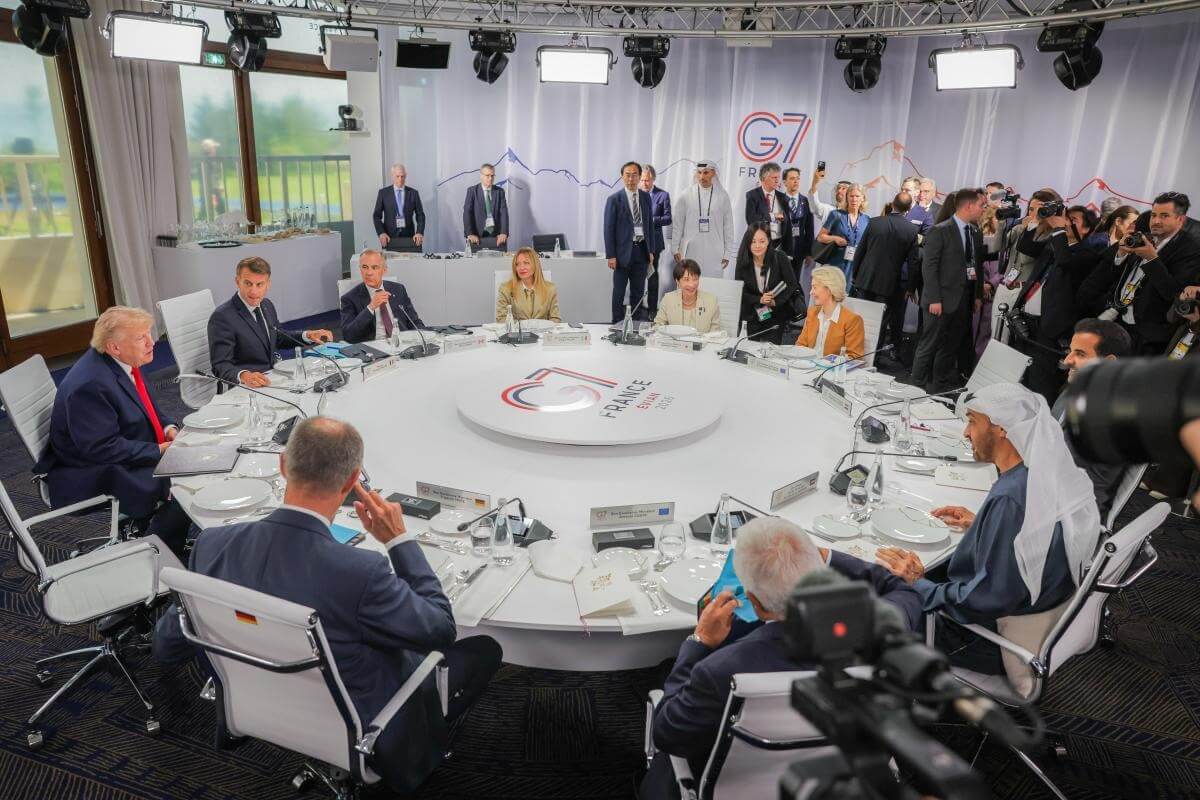 As with G7 members and other countries across the West, BRICS+ members can make themselves even more relevant through economic success and leadership to promote ideas that benefit everyone
Moreover, the idea that the group could function as a political club was initially promoted by the Brazilian and Russian finance ministries, which contradicts the claim that China calls all the shots and determines how the others think.
As University of Hong Kong professors Heiwai Tang and Brian Wong Yue Shun show in an insightful new book on BRICS+, each member is driven by complex motives, and the roles played by China, India, and others are not necessarily what you might think.
As with G7 members and other countries across the West, BRICS+ members can make themselves even more relevant through economic success and leadership to promote ideas that benefit everyone.
Advocacy on behalf of the global public good
For the West, one obvious implication is that governments should rethink how they engage with the BRICS+.
Europeans, in particular, will need to do more to make themselves relevant, both by implementing lasting reforms within their own economies and by spearheading global initiatives that the BRICS+ and others will be willing to join.
Effective advocacy on behalf of the global public good can come from anywhere, but only if others are persuaded to listen
I saw what this looks like firsthand in 2014–16, when I chaired the United Kingdom’s independent review on antimicrobial resistance.
In raising awareness about this global threat, Britain was punching far above its economic weight.
Effective advocacy on behalf of the global public good can come from anywhere, but only if others are persuaded to listen.
Jim O’Neill is a former UK Treasury minister and a former chairman of Goldman Sachs Asset Management.
