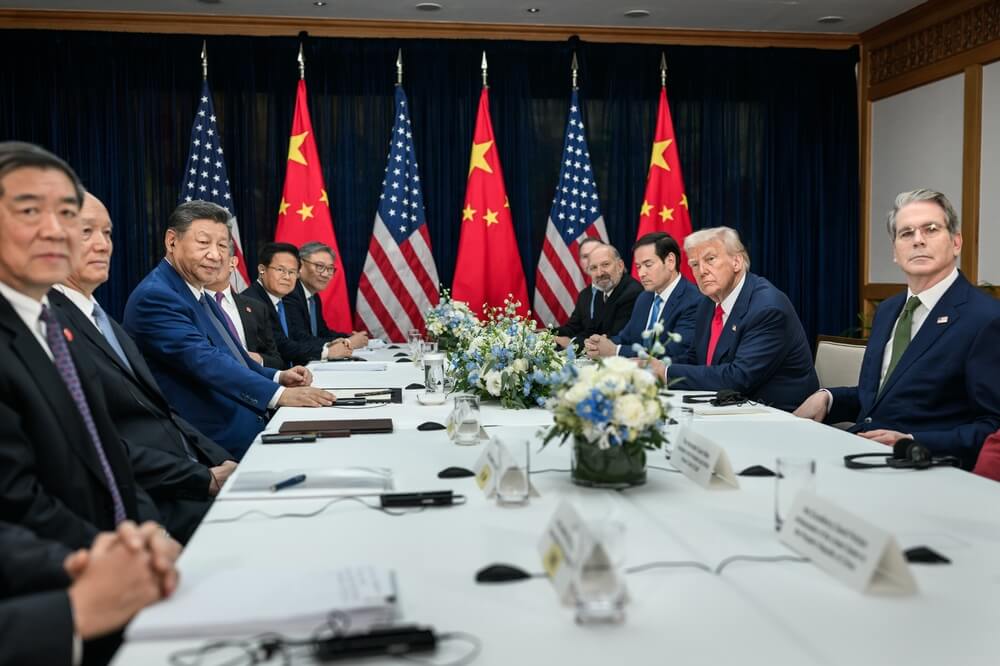
The recent summit between Donald Trump and Xi Jinping in Beijing produced no major breakthroughs on tariffs, Taiwan, or ongoing geopolitical conflicts like the Iran war, prompting many observers to dismiss it as inconsequential.
Yet its restrained and cordial tone suggested a new, more pragmatic approach that implicitly acknowledges the two countries’ deep economic interdependence.
The American and Chinese presidents were not viewing the bilateral relationship solely through the lens of geopolitical competition.
Recognizing China as a formidable economic competitor is not a concession; it is simply an acknowledgment of reality.
Over the years, the debate in the United States over China’s rise has followed a familiar pattern: denial, anger, and eventual acceptance.
During the era of double-digit Chinese growth, many US analysts dismissed official Chinese statistics as unreliable or inflated.
As China’s economic transformation became difficult to ignore, its success was often attributed to industrial policy, imitation, and unfair practices, including intellectual-property theft and currency manipulation.
Technological frontier
But those narratives are harder to sustain now that China has reached the technological frontier in several strategic industries.
Most notably, Chinese electric-vehicle manufacturers have emerged as major global competitors across a broad range of market segments, from low-cost models to increasingly sophisticated premium brands.
In pharmaceuticals, Chinese firms have evolved from imitators into innovators, shedding the old “free rider” label.
The US should accept that Chinese competition is here to stay
And in semiconductors, China has made significant strides in producing advanced chips, though it still trails behind global leaders like TSMC.
These advances are the product of a sweeping transformation rather than any single policy or industrial strategy.
Instead of focusing primarily on slowing China’s technological progress, the US should accept that Chinese competition is here to stay and establish frameworks for economic coexistence and limited cooperation.
Avoiding escalation
One key priority should be securing US firms’ access to Chinese markets. The prominent American CEOs and business leaders that accompanied Trump to Beijing underscored the message that, although the era of deep economic integration may be ending, complete decoupling is neither realistic nor desirable.
A more plausible path lies in selective interdependence and continued engagement in sectors where mutual gains remain substantial.
Xi, for his part, has characterized the bilateral relationship by invoking the “Thucydides trap,” a term coined by the political scientist Graham Allison to describe the risk of conflict when a rising power (in Thucydides’s case, Athens) threatens to displace an established one (Sparta).
But the analogy is imperfect. Despite the many challenges the US faces—some of them resulting from its own decisions—it is far too early to describe it as a declining power.
America remains the world’s leading center of innovation and entrepreneurship, producing many of the transformative technologies of the past century, from computing and the internet to smartphones and AI.
While talent exists everywhere, no other country matches its combination of scientific leadership, deep capital markets, entrepreneurial culture, and institutional flexibility.
As billionaire investor Warren Buffett once observed, “no one has ever been a success betting against America since 1776.”
China’s technological prowess should not obscure the fact that it remains a middle-income country in per capita terms
Moreover, China’s technological prowess should not obscure the fact that it remains a middle-income country in per capita terms.
Despite its vast economic scale, average living standards remain well below those of advanced economies.
The country also faces powerful structural and demographic headwinds as it seeks to sustain long-term growth.
Still, the Athens-Sparta analogy offers an important lesson, as the Peloponnesian War ultimately weakened both sides.
Today’s economic competition between the US and China need not lead to the same outcome, provided the two powers avoid escalation and preserve channels for cooperation in areas where they have a mutual interest.
Neither side can afford a zero-sum race for supremacy
While a more cooperative US-China relationship may appear unrealistic to many, history offers numerous examples of former rivals eventually reaching a lasting political accommodation.
In the fifth century BCE, the idea that Athens and Sparta might one day coexist peacefully would likely have been laughed off as naive, if not fantastical.
 Neither side can afford a zero-sum race for supremacy
But the bitter rivalry that once divided ancient Greece is now part of a shared national history.
Likewise, in the aftermath of World War II, few could have imagined the degree of political and economic integration Western Europe would achieve after centuries of devastating conflict.
Ultimately, what matters is not which country sits at the top of the global order, but whether political and economic systems improve their citizens’ well-being.
In this respect, the US and China face a set of common challenges: managing rapid technological change, adapting labor markets to AI, maintaining financial stability, addressing persistent and emerging inequalities that threaten social cohesion, and tackling climate change.
Progress on these issues will require greater cooperation between the world’s two largest economies. Neither side can afford a zero-sum race for supremacy.
Pinelopi Koujianou Goldberg, a former World Bank Group chief economist and editor-in-chief of the American Economic Review, is Professor of Economics at Yale University.
