A popular British television series of the 1980s titled ‘Do they mean us?’ used to take a wry look at how the foreign media reported on the country and often got it wrong.
Its patriotic humour was aimed at the foreigners’ comic failure to understand the loveable eccentricities of the British, their attitudes, their habits and their politics.
It also showed that out of date national stereotypes can be false friends when it comes to interpreting events and trends in another country.
For decades, outside observers may indeed have maintained a clichéd view of British good sense and political moderation despite frequent evidence to the contrary. That may have helped to foster flattering misconceptions.
The père de famille in a French home where I stayed in the sixties liked to praise the stability of a British system in which he mistakenly believed the two main parties had a formal deal to take turns in office.
He may have got the details wrong. But, with the chaotic revolving door politics of the recently departed Fourth Republic still fresh in his mind, it was intended as a tribute to the sensible British.
Whatever happened to Keep Calm and Carry On?
What would he think of British good sense now as the UK faces a long summer of political uncertainty or ‘psychodrama’, as the domestic headlines have labelled it?
And what do today’s outsiders think of it, including the nearest neighbours?
Whatever happened to Keep Calm and Carry On? asked Agence France-Presse, citing Britain’s apocryphal World War II slogan to suggest the country was losing its legendary sang froid.
“The seams are still holding, but the strain on them is growing”
Germany’s Deutsche Welle, surveying the Labour party’s local election rout that sparked its leadership crisis, judged: “Looming over all of this is the long shadow of Brexit.” It said the vote 10 years ago to leave the European Union was crucial in explaining the fragmentation and current instability of British politics.
DW’s veteran UK correspondent, Birgit Maass, concluded that the UK was undeniably more volatile, fragmented and harder to govern than it was a decade ago. “The seams are still holding, but the strain on them is growing.”
Perhaps it sometimes requires an informed outsider to spell out the reality that is not always obvious to the natives.
A calm and civilised affair no more
In 2019, the year the Conservatives’ Boris Johnson won a landslide victory on the promise to deliver a deal on the UK’s EU departure, a British publisher borrowed the title of that eighties TV show to present the foreign correspondents’ view of Brexit.
In an introduction, Deborah Bonetti, the Italian director of the Foreign Press Association in London, reflected that Europeans used to be in awe of Britain as the mother of all democracies, the biggest ‘melting pot’ in Europe, a champion of tolerance, respect, organisation and democracy.
“Politics in Westminster was considered a calm and civilised affair compared to the general feeling of chaos, particularly in my own country,” she wrote.
She and her colleagues went on to report that the facade had been shattered by Brexit. Many contributors expressed a continuing affection for Britain along with a sense of alienation that reflected post-Brexit anger in the rest of Europe.
UK’s long-term problems will not be resolved merely by deciding who leads the struggling Labour party
Contributors justifiably blamed successive governments for having long failed to highlight the benefits of EU membership while correctly predicting that many leave voters would come to regret their decision.
Today’s foreign commentators tend to agree with the assessment of local colleagues that the UK’s long-term problems will not be resolved merely by deciding who leads the struggling Labour party.
Ahmed Najar, a London-based Palestinian analyst, wrote for Al Jazeera that Labour’s existential crisis was a sign that what he called the UK’s centrist settlement was starting to fracture.
Until now, in Najar’s view, the political centre had largely kept control of the steering wheel, despite years of repeated shocks and volatility, reinforcing the view abroad that the UK was largely insulated from the destructive polarisation reshaping other Western democracies.
How a Labour leader succeeds in reconstructing the centrist narrative in a fragmented political environment might determine not only the future of the present government but the shape of UK politics in the years ahead, Najar concluded.
Europe’s beacon of stability
Meanwhile, the Labour leadership circus continues. With Keir Starmer pledging to soldier on as party leader and prime minister, the rank and file’s current favourite, the left of centre Greater Manchester mayor Andy Burnham, faces a parliamentary by-election to win a seat from which to trigger a leadership challenge.
The UK’s political fate may thereby hang on the decision of the 76,000 electorate of the Manchester district of Makerfield, a traditional northern Labour stronghold that includes areas where right-wing Reform swept the board in the recent local elections.
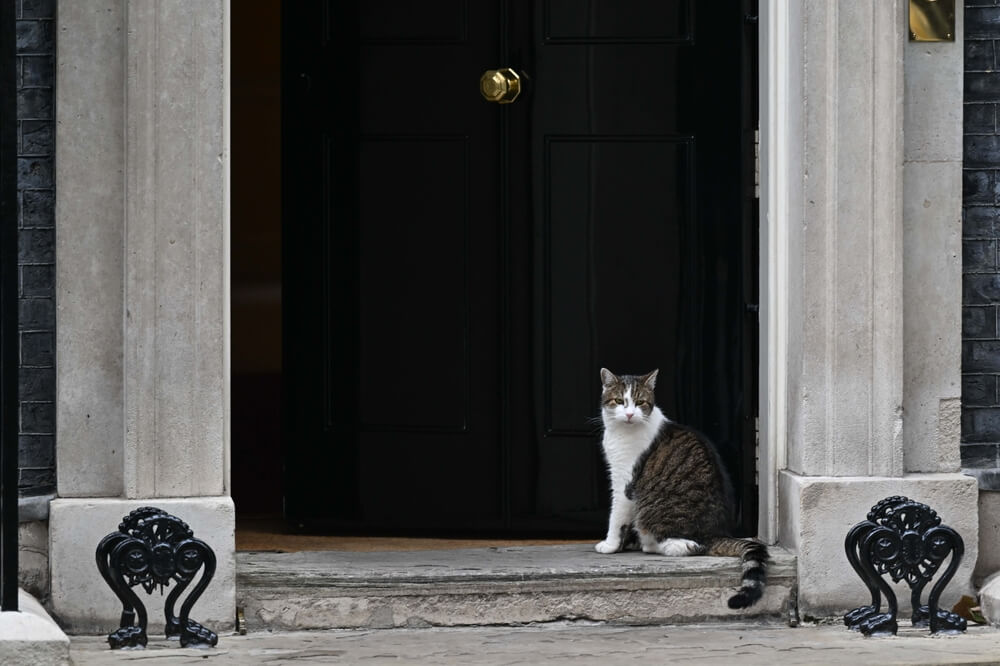 The longest surviving inhabitant of the prime minister’s residence is currently Larry, the Downing Street cat
With the prospect of a close fight with Nigel Farage’s erstwhile Brexit party, Burnham has promised not to rerun the arguments of what he calls a “damaging” departure from the EU.
But in a pledge that might cut across other left-right divisions, he promised to reverse privatisation, austerity and deregulation without scrapping the present leadership’s tough fiscal rules.
If he loses the by-election vote, that would only prolong the agony for Labour and for a country facing the prospect of a seventh prime minister in the 10 years since Brexit.
The UK’s friends and neighbours will continue to look on with exasperation at how Europe’s beacon of stability sank so low, while their media continue to insist that the divisions unleashed by Brexit were the turning point.
The British may already have definitely lost their stiff upper lip reputation for moderation, good sense, tolerance and making do.
At least there is hope that the ironic British sense of humour is not quite dead.
The domestic media have been reminding the public that the longest surviving inhabitant of the prime minister’s residence is currently Larry, the Downing Street cat.
