The past seventy-two hours on Yemen’s southern Red Sea coast have produced an extraordinary operational debacle, all the more remarkable given the level of preparation.
The principal Houthi axes had been identified, Saudi air and intelligence assets were in place, and the Royal Saudi Air Force (RSAF) had already prepared elaborate strike packages as part of the broader offensive campaign, with the Saudi-led Joint Forces Command (JFC) integrating those packages into the wider war plan.
Yet micro-operational failures within that structure allowed a battle that should have been contained from the outset to unravel with astonishing speed.
The clearest breakdown occurred around Mokha, the strategic south-western Yemeni port anchoring the government-held coastal corridor immediately north of Bab al-Mandab.
In one critical sector, a commander acknowledged an engagement order but withdrew rather than holding the designated blocking position, opening an avenue for the Houthi advance.
Inaccurate reporting on friendly dispositions simultaneously denied Saudi aircraft the verified common operating picture required for immediate interdiction, while a separate false report concerning a military base directly contributed to Yemeni casualties.
The Houthis recognised the vulnerability
The underlying failure lay not in organisation but in mobilisation. The JFC had spent months registering units, consolidating salary systems and creating biometric personnel records, including for soldiers left unpaid during the final period of Emirati involvement. Once restored to the payroll, many temporarily returned to civilian employment in Yemen, Saudi Arabia or other Gulf states, pending activation for the anticipated campaign.
When mobilisation began, 50 to 60 per cent of registered manpower in some brigades failed to report, depending on factional affiliation, creating an enormous gap between nominal and deployable strength.
This discrepancy was particularly serious along the western coast, where there were already concerns about Houthi intelligence penetration, compromised reporting and possible assets inside certain formations.
The Houthis recognised the vulnerability and struck precisely where readiness and command reliability no longer matched the official record
The Houthis recognised the vulnerability and struck precisely where readiness and command reliability no longer matched the official record.
What appeared on paper as an established force structure was therefore substantially weaker at the point of contact.
No additional headquarters is required
The contrast with the earlier Saudi-led campaign against the secessionist Southern Transitional Council (STC), backed by Abu Dhabi, is instructive.
Operational Mentoring and Liaison Teams (OMLTs) and Joint Terminal Attack Controllers (JTACs) then functioned as intended after the JFC reorganised the relevant formations and established dependable liaison, reporting and ground–air coordination.
Saudi-led forces retook the south within a few days, demonstrating what the architecture can achieve when units are fully manned and operating from an accurate, shared picture.
OMLTs maintained direct connectivity between field formations and higher command, while JTACs provided the ground–air interface needed to employ airpower rapidly and safely in a fluid battlespace.
The existing command needs reliable information from every formation on which its operations depend
Mokha demonstrated the cost of distributing that connective tissue unevenly: a JTAC cannot compensate for a brigade missing half its assigned strength, and an OMLT cannot manufacture battlefield truth when reporting is false or negligent.
Both therefore need to be embedded systematically across every major Yemeni formation, with readiness, location and combat strength continuously verified through the JFC.
No additional headquarters is required. The existing command needs reliable information from every formation on which its operations depend, because the problem exposed on the western coast was not strategic conception but tactical fidelity.
Correct that layer and the same structure that succeeded in the south can function as intended elsewhere.
Tehran would fundamentally alter the confrontation
The setback has nevertheless damaged Saudi military prestige just as allies and adversaries are assessing whether Riyadh can shoulder an expanding strategic burden.
One nominal partner – a small Arab Gulf state, to begin with – is already presenting the episode as evidence of structural weakness.
That conclusion disregards both what actually failed and the scale of force the Kingdom can employ once the tactical deficiencies are corrected.
The RSAF fields 84 new-build F-15SA aircraft at 4.5-generation standard and 68 former F-15S airframes upgraded to the F-15SR/SA-equivalent 4.5+ configuration, providing 152 advanced F-15SA/SRs.
It retains another 43 F-15Cs and 20 F-15Ds at approximately 4+ generation, alongside 72 Eurofighter Typhoons at 4.5 generation and approximately 81 legacy fourth-generation Tornado Interdictor/Strike (IDS) aircraft.
This constitutes the region’s largest advanced 4.5-generation combat aircraft fleet, and one of the largest in the world.
Its precision inventory gives that fleet corresponding depth. Publicly documented United States packages and approvals cover 36,944 precision-guided or precision-capable bombs, with another 10,004 Joint Direct Attack Munition–Extended Range (JDAM-ER) weapons approved; Saudi stocks also include roughly 450 Storm Shadow cruise missiles and 1,000 Brimstone missiles.
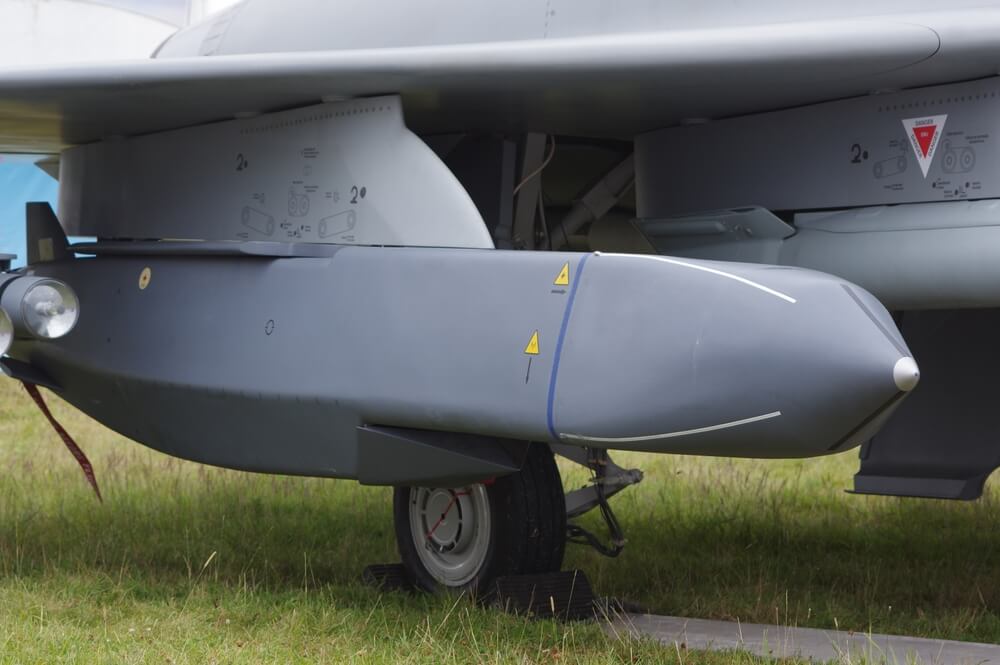 Saudi stocks include roughly 450 Storm Shadow cruise missiles and 1,000 Brimstone missiles
These holdings are designed to sustain a prolonged precision campaign rather than episodic punitive strikes.
The Royal Saudi Strategic Missile Force (RSSMF) provides an independent land-based component of this national strike architecture.
Public records confirm the presence of Chinese-supplied DF-3A Intermediate-Range Ballistic Missiles (IRBMs) in a Saudi-specific conventional configuration, carrying an exceptionally large high-explosive warhead of approximately two tonnes, and widely report the subsequent acquisition of mobile, solid-fuel DF-21 Medium-Range Ballistic Missiles (MRBMs).
Higher estimates identify at least one additional advanced Chinese variant, alongside a growing indigenous strategic-missile industry that includes domestic cruise-missile capabilities, although its precise composition remains undisclosed.
Further Iranian escalation would provide the threshold for activating this deterrent.
Tehran would fundamentally alter the confrontation by authorising militias to strike Saudi cities or other targets inside the Kingdom, transferring higher-end systems, including hypersonic glide weapons, to those groups, or employing such missiles directly.
In a conflict already capable of extending across multiple theatres, the RSSMF provides Riyadh with a substantial strategic counterweight.
Saudi land power completes the spectrum. It includes specialised mechanised brigades from the Saudi Land Forces, infantry formations from the Saudi National Guard, and dedicated Border Guard brigades structured around Yemeni terrain after a decade of deployment in that environment.
These units are adapted to the mountainous, semi-urban and frontier warfare increasingly relevant on the approaches to Sana’a and Saada.
Riyadh’s request to Washington has been misunderstood
Riyadh’s request to Washington has also been consistently misunderstood. In July 2026, Saudi defence minister Prince Khalid bin Salman told his American counterpart directly that U.S. kinetic assistance was unnecessary, and instead sought battlefield Geospatial Intelligence (GEOINT), logistics support, greater spare-parts depth, and, potentially, specific ammunition replenishment.
The Kingdom can conduct the fighting itself; what it requires from a strategic partner is the enabling architecture needed to sustain high-tempo operations over time.
That requirement has become more urgent because the war is no longer confined to Yemen.
Saudi strategic patience has consequently reached its limit
Iranian-aligned Shia militias operating from Iraq have struck the East–West Pipeline, and Saudi Arabia’s emerging GEOINT architecture traced the attacking drones to their precise launch site in Maysan Province.
Weeks earlier, the Kingdom had already demonstrated, through major airstrikes against militia command and control (C2) centres and bases across two Iraqi provinces, that it was prepared to use force on the northern front.
Saudi strategic patience has consequently reached its limit. The JFC’s longstanding caution was designed to minimise civilian casualties, collateral damage and unnecessary enemy losses, but restraint cannot become hesitation when adversaries simultaneously attack the Kingdom, critical infrastructure and international commerce.
Professional discrimination is essential; paralysis at the decisive moment is not.
A single strategic problem rather than two disconnected crises
Iran’s strategy places Saudi Arabia at the centre because Tehran cannot inflict maximum global economic pain without constraining the world’s largest crude exporter, the central power within the Organization of the Petroleum Exporting Countries (OPEC), and the holder of the largest meaningful spare production capacity.
Those attributes make the Kingdom the principal stabiliser of the global energy system.
The East–West Pipeline fulfils that role by transporting crude from the Eastern Province to the Red Sea, reducing dependence on the Strait of Hormuz and preserving an alternative export route during a crisis.
Striking that pipeline from Iraq while the Houthis threaten the southern Red Sea therefore creates a single strategic problem rather than two separate crises.
One Iranian proxy pressures Saudi Arabia from the north while another threatens its southern approaches and Bab al-Mandab.
Riyadh must be prepared to withstand military pressure in both theatres simultaneously.
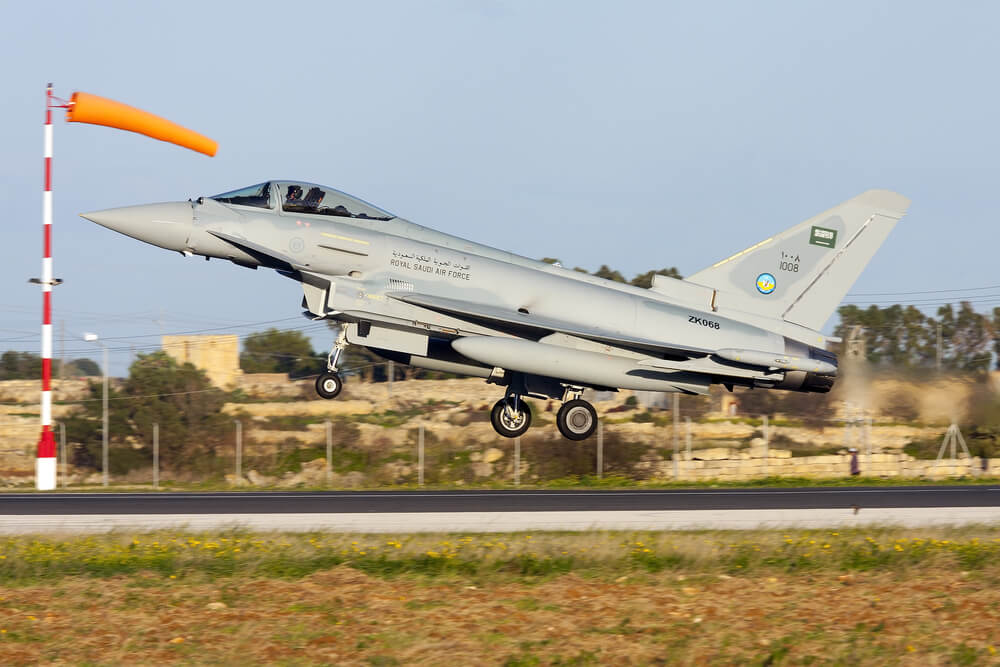 Saudi Arabia now confronts a defining test: whether it can dismantle the encirclement that Tehran has spent decades constructing around it
Germany’s Schlieffen Plan has been studied for more than a century because multi-front warfare punishes rigid sequencing, overstretched logistics, and the assumption that one theatre can be settled before another becomes decisive. Riyadh understands these lessons.
If a modern Saudi version of simultaneous two-front operations is required, the Kingdom must structure the campaign around that reality from the outset rather than treat either front as secondary.
Its objective in Yemen must remain precise. Saudi Arabia cannot eradicate the Houthi movement or eliminate an ideology rooted in north-western Yemen, nor should it attempt to do so.
It can, however, degrade Houthi kinetic power so extensively that the movement can no longer launch strategic missile and drone attacks, dominate Yemen through armed coercion, threaten Bab al-Mandab or hold Saudi Arabia and international commerce hostage.
Defeat would engulf the Arab world. The Gulf states would be exposed immediately, while Jordan, Syria, Lebanon and North Africa would face weakened Arab deterrence; Egypt would suffer the greatest consequences outside the Gulf because its Red Sea security, energy flows, economic links and regional position depend directly on the strategic balance maintained by Saudi Arabia.
A Saudi defeat would therefore constitute a systemic Arab reversal, sharply shifting power towards Iran and leaving every weaker Arab state more vulnerable to coercion.
Saudi Arabia now confronts a defining test: whether it can dismantle the encirclement that Tehran has spent decades constructing around it.
The stakes encompass the security of the Arab Gulf, the Middle East, the Red Sea, the Arab balance of power, and the stability of the global energy system.
A Saudi failure would reorder the region in Iran’s favour; a Saudi victory would dismantle the last effective pillars of that failing strategy. The Kingdom cannot lose this war, and it will not.
Dr Nawaf Obaid is a Senior Research Fellow at the Department of War Studies, King’s College London.
