During March and April, the Royal Saudi Air Force (RSAF) carried out air strikes on Iranian military and strategic targets, alongside infrastructure affiliated with the Islamic Revolutionary Guard Corps (IRGC) operating from Iraqi territory.
The intelligence picture, which was obtained through Project AURORAH GeoSignal MASINT System — the geospatial and signals intelligence platform I founded, pointed not toward isolated retaliatory strikes.
It pointed to structured military architecture designed around escalation management, calibrated force, restoration of dissuasion, and the reestablishment of deterrence.
What emerged was not a simple exchange of strikes. It was a carefully managed military campaign intended to alter strategic calculations while preventing the confrontation from evolving into a broader regional war.
The issue itself was never retaliation for its own sake. Repeated Iranian-linked missile and drone attacks against Saudi energy facilities, airports, military infrastructure, civilian nodes, and strategic assets had increasingly blurred retaliatory thresholds and introduced growing uncertainty into the regional battlespace.
Significant elements of these attacks originated not directly from Iranian territory but from dispersed IRGC-affiliated infrastructure operating from southern Iraq and adjacent operational corridors.
Riyadh’s objective therefore became restoring predictability and operational boundaries before escalation acquired a self-sustaining momentum.
Equally important, Saudi signaling made clear that continued attacks against Gulf states would not be accepted and that expansion of the confrontation beyond Saudi territory risked generating a broader regional response architecture.
Saudi responses were tied not to emotion
The Saudi response was calibrated from the outset. The objective was neither strategic collapse inside Iran nor participation in the parallel American Israeli war effort.
Saudi authorities repeatedly communicated that civilian areas and civilian populations would not be targeted and that retaliatory operations would remain confined to military infrastructure, missile-launch architecture, IRGC operational facilities, coastal military sites, and selected energy-linked targets corresponding to categories previously attacked by Iranian-linked operational structures.
Saudi responses were tied not to emotion or automatic retaliation but to strategic significance, escalation thresholds, and operational meaning
Saudi responses were tied not to emotion or automatic retaliation but to strategic significance, escalation thresholds, and operational meaning.
This distinction became visible through the warning structure itself. Tehran was repeatedly informed that retaliatory operations were coming, not because Iranian military structures possessed the ability to stop them once launched, but because Riyadh sought escalation control rather than escalation momentum.
The objective was to communicate military consequences while preserving strategic space for de-escalation.
The message remained straightforward throughout: sustained attacks against Saudi Arabia and broader Gulf infrastructure would produce immediate and increasingly costly military consequences, but those responses would remain measured, sequenced, and controlled.
Two operational theaters
By late March and into the first days of April 2026, the confrontation had moved significantly closer to a broader regional conflict than was publicly understood at the time.
RSAF had already prepared for sustained kinetic operations across 2 active operational theaters: the Iraqi theater and the Iranian theater.
Had northern Yemen fully transitioned into an active launch front through continued missile and drone activity, the confrontation could have evolved into a simultaneous 3-front air campaign unprecedented in modern military history.
The scale itself was substantial. RSAF operational planning had already prepared for more than 150 combat aircraft conducting sustained retaliatory operations against Iranian and Iraqi targets.
Planning extended significantly further than that. Had northern Yemen entered the battlespace fully, total force-generation planning approached approximately 250–300 combat aircraft operating simultaneously across 3 theaters, with an additional 100 fighters available under contingency sequencing and emergency support structures.
The Royal Saudi Air Force today fields by far the largest fleet of 4.5-generation combat aircraft in the Middle East
Those numbers matter because airpower is not measured by inventory alone. Airpower is measured through simultaneous force generation, survivability, sustainment, command architecture, and the ability to manage multiple operational environments at once.
The Royal Saudi Air Force today fields by far the largest fleet of 4.5-generation combat aircraft in the Middle East and what is assessed as the world’s 5th-largest advanced 4.5-generation combat fleet overall.
Saudi Arabia also operates the world’s 2nd-largest F-15 fleet and remains the largest customer globally of the advanced F-15 variant family and associated platforms.
Multiple squadrons of F-15SA (Saudi Advanced) and F-15SR (Saudi Retrofit) aircraft formed the core of the strike architecture alongside Eurofighter Typhoon Tranche 2 and Tranche 3 squadrons configured for strike and air-superiority operations.
Lower-scale bombing and secondary strike missions were supported through upgraded 4.0+ generation Tornado aircraft.
The command structure
Yet the aircraft themselves represented only one component of the architecture. The more consequential development sat behind the fighters themselves and involved the command structure governing the campaign.
RSAF planners had already matured an increasingly fused C6ISR architecture integrating command, control, communications, computing, combat systems, cyber capabilities, intelligence, surveillance, and reconnaissance into one operational environment.
The Iraqi and Iranian theaters operated under a broader fused command structure, while multiple airborne C2 nodes accompanied Saudi squadrons throughout operations.
These airborne command-and-control structures remained integrated into the wider C6ISR environment and functioned similarly to 2 simultaneous air campaigns operating under one strategic architecture.
One campaign focused on Iranian targets. The second focused on IRGC-affiliated infrastructure operating from Iraq.
Different strike packages, target architectures, and operational priorities existed, but all remained fused into a common battlespace picture.
The Yemeni front remained comparatively limited relative to the Iraqi and Iranian theaters
The Iraqi theater became particularly important because substantial elements of attacks directed against Saudi Arabia and broader Arab Gulf infrastructure originated from IRGC-linked militia structures operating there.
Unlike Tehran itself, militia organizations received no advance warning. Saudi authorities treated them as hostile operational entities and terrorist structures rather than sovereign interlocutors.
Missile sequencing infrastructure, drone facilities, command structures, and operational coordination nodes subsequently became targets.
The same principle extended toward northern Yemen. Saudi authorities communicated directly that if IRGC-linked officers embedded within Houthi structures continued facilitating missile and drone operations against Saudi territory, northern Yemen would become integrated into the broader retaliatory architecture.
Houthi leadership subsequently communicated that they did not seek active involvement and did not consider the confrontation their war.
As a result, the Yemeni front remained comparatively limited relative to the Iraqi and Iranian theaters.
Saudi operations never fused into the American Israeli war architecture
One distinction remained central throughout the confrontation. RSAF operations never fused into the broader American Israeli war architecture.
The Saudis communicated explicitly that there would be no integrated campaign sequencing, no joint strike architecture, and no combined targeting process.
 CENTCOM remained informed solely for deconfliction and operational awareness purposes
CENTCOM remained informed solely for deconfliction and operational awareness purposes.
Beyond that, Saudi operations remained sovereign, compartmentalized, and independent.
This point mattered because the Kingdom viewed the confrontation as a Saudi Iranian escalation cycle requiring its own deterrence logic rather than as a component of a larger regional coalition campaign.
That distinction acquired additional significance because by that stage senior Israeli political, intelligence, and military leadership had undertaken so called "secret" visits to Abu Dhabi.
The Iranians interpreted these developments as evidence of deeper Israeli operational integration inside Emirati structures.
Unlike Saudi Arabia, which maintained deliberate operational separation and sovereign command sequencing, the UAE occupied a different category: a small Gulf state possessing a technologically advanced but comparatively very small air force and a different strategic trajectory over the last decade.
During later discussions, Iran consequently treated that file separately and resisted folding Abu Dhabi into broader de-escalatory frameworks.
Pakistani mediation
The confrontation then entered what proved to be its most consequential phase.
The issue was no longer simply military activity inside Iran or retaliatory strikes against IRGC-linked infrastructure in Iraq.
The issue increasingly became whether escalation could continue without crossing into a sustained regional air war.
By the first days of April 2026, RSAF force generation had become sufficiently mature and visible that military realities themselves began altering strategic calculations.
Pakistan's Military High Command ultimately became the central intermediary because it provided more than diplomatic channels.
It became the mechanism through which military realities were translated directly into strategic understanding.
The Saudi High Command had prepared not only for retaliation, but for campaign continuity
Through Pakistani mediation, Tehran was confronted with the scale of RSAF force generation, strike sequencing depth, survivability, operational endurance, and broader C6ISR integration.
This included the possibility of expanded combat operations and potential Royal Saudi Strategic Missile Force (RSSMF) involvement should strategic hypersonic missile attacks occur.
At that point, it increasingly became evident that senior IRGC leadership had underestimated the scale of military power that RSAF and potentially RSSMF could generate once fully mobilized under a fused C6ISR architecture.
The issue was not merely aircraft numbers. The issue was the ability to sustain simultaneous campaigns across multiple theaters while preserving centralized command structures, airborne command-and-control nodes, ISR sequencing, and operational flexibility.
The Saudi High Command had prepared not only for retaliation, but for campaign continuity.
The effects became visible almost immediately. During the first four days of April 2026, and before the American Iranian ceasefire announcement of 7 April 2026, following direct Pakistani engagement, the tempo of attacks declined sharply.
Missile and drone activity directed against Saudi Arabia and broader Arab Gulf infrastructure dropped substantially.
Escalation sequencing slowed and reciprocal de-escalatory behavior emerged. Saudi signaling regarding continuous attacks on Arab Gulf states had also become increasingly clear by this stage: expansion of the conflict beyond defined thresholds would not remain compartmentalized and would trigger broader military consequences.
Controlling escalation boundaries
Pakistan's Military High Command therefore emerged as the principal intermediary and guarantor of the eventual Saudi Iranian de-escalatory framework.
The later deployment of a Pakistani squadron to the RSAF King Abdulaziz Aiirbase in Dhahran carried primarily symbolic and political significance.
It represented visible support for the settlement architecture Pakistan had helped facilitate and reinforced its position as guarantor of the de-escalatory arrangement.
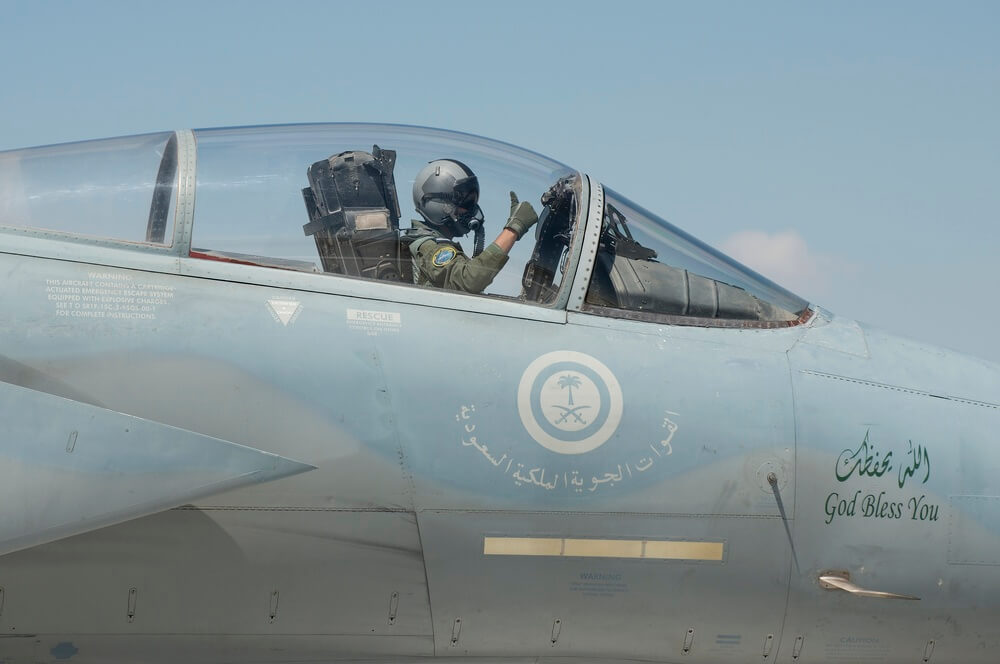 The broader significance of March and April 2026 may ultimately lie not in the retaliatory strikes themselves, but in what they revealed regarding the evolution of Saudi military power
Militarily, however, the deployment altered neither force balances nor operational realities.
The confrontation had already been decided through deterrence restoration, force generation, and strategic recalculation.
The broader significance of March and April 2026 may ultimately lie not in the retaliatory strikes themselves, but in what they revealed regarding the evolution of Saudi military power.
The traditional assumption has long been that Saudi Arabia either absorb attacks or escalate uncontrollably.
What emerged instead was something different: calibrated force designed to restore dissuasion and deterrence while simultaneously controlling escalation boundaries.
Saudi Arabia demonstrated not simply an ability to retaliate, but an ability to generate large-scale, multi-theater combat operations while preserving sovereign operational control and preventing the confrontation from becoming another open-ended Middle Eastern war.
States regularly understand how to initiate wars. Far fewer understand how to control them once they begin.
Dr Nawaf Obaid is a Senior Research Fellow at the Department of War Studies, King’s College London.
