Even more than usual, it has been difficult lately to get a straight answer from Donald Trump’s administration.
Since the debacle of the U.S. midterms earlier this month, the White House has faced a series of crises and challenges: the nationwide air ground stop, the tech woes striking major companies such as Microsoft, the Nvidia Chinese spy scandal, tumbling stocks on Wall Street and a high-stakes summit with China and Russia in which both powers tried to use the meeting to their geopolitical advantage.
Compounding all of it has been a swirl of misinformation, disinformation and often contradictory statements from the U.S. government at a time when Americans are on edge.
The ground stop, which paralyzed air traffic for hours, and the Microsoft outage, which had businesses across the country scrambling, was enough to fray the average person’s nerves.
But then the subsequent tech hiccups experienced by companies such as United, Workday, and JPMorgan Chase as well as other government entities such as the U.S. National Security Agency sparked speculation that the country was under a large-scale cyberattack. (Delta was the latest company to report troubles on Sunday.)
The Jensen Huang drama at chipmaker Nvidia helped trigger a massive sell-off of AI stocks on Wall Street. Meanwhile, Trump’s flirtations with China and Russia left friendly nations such as Taiwan and Ukraine scratching their heads, wondering if U.S. foreign policy was flipping on a dime.
This is a White House that even on its best days has sometimes struggled to deliver a consistent message – or deliver a message at all. There remains no press secretary.
Trump’s chief of staff, Susie Wiles, credited with helping to bring order to Trump’s particular brand of chaos, departed after the midterms left the administration at the mercy of a Democratic Congress.
That has left it to the president to be the messenger-in-chief, a role he relishes. The problem has been that the messenger hasn’t always gotten the message himself. Rather than try to soothe the nerves of a jittery public, he has often been dismissive or contrary.
Here’s a breakdown:
Going full “X-Files”
The tech outages: Trump’s primary response was to blame his Democratic predecessor, Joe Biden, for the Federal Aviation Administration’s outdated systems, even though the issues extend far back across several decades and presidencies, including Trump’s first term.
“I don’t take any responsibility,” the president said.
After the Chase outage, he said, basically, that’s the way it goes.
“When you're big and powerful and you have all the money, things like that happen. It's fine,” Trump said.
Meanwhile, the cabinet official charged with explaining the tech troubles to the public, Homeland Security Secretary Markwayne Mullin, first couldn’t seem to align his story on the ground stop with that of Transportation Secretary Sean Duffy.
Then Mullin contradicted himself (and Trump) in the space of a day when he first assured Americans that the incidents weren’t connected but then intimated that perhaps they were linked to AI. (Which, of course, people were freaked out about already.)
Former Trump press secretary Karoline Leavitt told Fox News the White House needed to do better
Going full “X-Files” got Mullin sidelined, according to media reports. But several days later, Trump fired his top cybersecurity official, Sean Cairncross, with little explanation, suggesting that perhaps someone indeed had dropped the ball.
Despite – or because of – the White House’s efforts, conspiracy theories ran wild.
Trump ally Laura Loomer declared on social media that the U.S. was under attack. “Our leaders are lying to us,” she wrote on X for her close to two million followers. Republican Senator Josh Hawley said it was “hard to believe” Duffy’s explanation for the ground stop and said if the tech outages weren’t related, it would be "the greatest coincidence in the history of the world."
Axios reported allegations of a cyber-strike were amplified by bots, allowing them to reach even more people.
Former Trump press secretary Karoline Leavitt told Fox News the White House needed to do better.
“Send whomever is the best spokesperson on whatever is happening to the podium to speak on it, to answer questions directly and to provide that transparency to the public,” Leavitt said.
“Where the buck stops”
Nvidia: After reports linking CEO Huang to a Chinese spy, Trump maintained that he didn’t know about the allegations when Huang accompanied him on a trip to China earlier this year. The New York Times subsequently reported that he was briefed by Secretary of State Marco Rubio on Air Force One before Huang joined the trip, something the White House has denied.
Trump was first told of the affair late last year and chose to do nothing, the Times reported. He has publicly raised doubts about his own intelligence agencies’ finding that Huang’s paramour, Alice Huang, was a Chinese operative.
The drama, which saw Jensen Huang resign and helped prompt a tech sell-off, also shone a light on infighting within Trump’s cabinet over the export of advanced AI chips between Treasury Secretary Scott Bessent, who is in favor of greater restrictions, and Commerce Secretary Howard Lutnick, who reportedly feared blowback in Chinese trade talks if the chips were further limited.
On Friday, a fellow Republican in the Senate, Tom Cotton, accused Lutnick of repeatedly ignoring warnings that Nvidia chips were being smuggled into China. Trump immediately defended Lutnick and said he was doing “a good job.”
Trump acknowledged that he personally pressured the company to bring Huang back
Despite the scandal, Trump remained supportive of Huang, a leading advocate for expanding chip shipments to China, and called for him to return to the company, even going as far as to discuss the situation with Xi Jinping in Shenzhen, China last week.
Unlike his boss, Bessent wasn’t ready to invite Huang back. Last week, he said Nvidia needed to find a CEO who was outside the company. But by the weekend, he was hedging, saying the administration was in the midst of a probe of the matter.
"I think we have to see where the buck stops," Bessent said on the news program Face the Nation.
The buck got as far as Monday when Nvidia’s board reinstated Huang. Trump acknowledged that he personally pressured the company to bring him back, even if it remains unclear whether doing so could amount to a national security threat.
Friend or foe, a frenemy, and deal or no deal?
China. Friend or foe? Trump was openly delighted with the reception given to him by Xi in Shenzhen even as critics said he was playing into China’s hands by enhancing its global credibility by allowing it to host the three-way summit with the U.S. and Russia.
The summit itself produced little in the way of headlines, but Trump by his own admission did not press Xi on the espionage allegations at the heart of the Nvidia affair. He also took no steps to publicly reassure Taiwan that the U.S. has its back in case of a Chinese effort to take the island.
Xi has been pushing for the U.S. to limit arms sales to Taiwan, including a proposed $14 billion deal that would include American missiles, anti-drone weapons and air-defense systems. The package remains on hold.
State Department officials have insisted the deal isn’t tied to China talks, but Trump has called it a bargaining chip.
Russia, a frenemy? Trump was all hugs and handshakes with Vladimir Putin, who had pushed for the three-way summit in the first place. After the president returned home, he posted a photo of Putin and himself online with the caption “My friend.”
European leaders were troubled. Polish Prime Minister Donald Tusk told reporters: “Mr Putin is not our friend and will never be.”
Russia on Friday rejected NATO-style security guarantees for Ukraine
Ukrainian President Volodymyr Zelenskyy had a stronger reaction. “To us,” he told CNN, “(Putin) is a killer.”
Asked on Friday whether Putin is a friend to the U.S., Trump said, “I can’t speak to America” but said he has a good personal relationship with the Russian autocratic leader.
Jay Clayton, the director of national intelligence, went on a Sunday morning TV show and clarified that Putin was a friend in the context of nuclear arms talks but was “not America’s friend in Ukraine.”
Following the summit, Trump asserted, as he has before, that Putin wants to negotiate to end the war, but Russia on Friday rejected NATO-style security guarantees for Ukraine, leaving it uncertain exactly what the president was talking about.
Iran: Deal or no deal? The conflict has been a delicate issue within the administration since Vice President JD Vance went rogue and blamed the midterm losses on Trump’s decision to go to war.
In the wake of those comments, Trump said the U.S. would seek a negotiated end to the fighting. A few days later, he told Vance to focus on other priorities, saying, “We don’t need a deal.”
On Friday, the president told reporters that it was Iran that wants a deal but hasn’t offered satisfactory terms. Negotiations over a resolution continue with Qatar acting as an intermediary.
“Are we being told the truth?”
The midterms were a sign that a large segment of the public has turned its back on Trump and his Republican colleagues.
The danger now appears to be whether the public pays little attention to what they say or tunes them out completely, something experts say could be problematic in the event of a national disaster or other calamity.
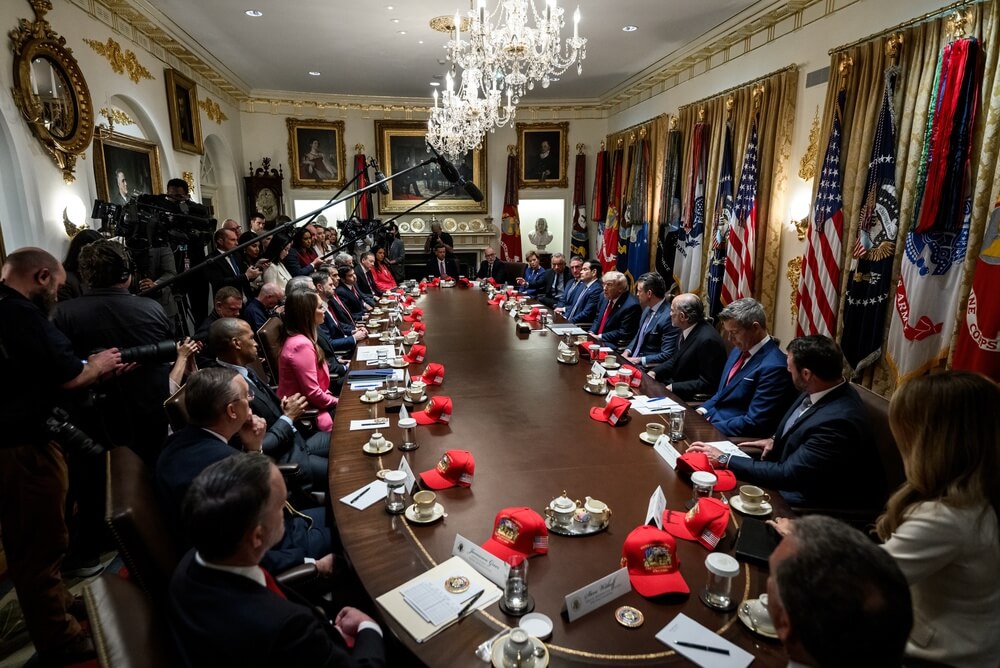 The midterms were a sign that a large segment of the public has turned its back on Trump and his Republican colleagues
In an Economist/YouGov poll taken earlier this month, nearly 60% of Americans said they don’t believe Trump is honest and trustworthy.
But suspicion and skepticism extend far beyond him to both political parties, as the activism a few years ago surrounding COVID restrictions and school curricula demonstrated.
On Nov. 17, at the height of the outages, longtime TV host Michael Smerconish conducted a poll on his website that asked whether the Microsoft, FAA, bank and United outages were a coincidence.
Unsurprisingly, 68% of roughly 33,600 votes said no. The next day, when the site asked, “Are we being told the truth?”, 93% of roughly 35,300 votes said no.
Of course, an internet poll isn’t scientific, but you needn’t be a scientist to see that Americans are bothered and probably a bit bewildered. Whiplash can have that effect.
