This is not a moment to gloat about Europe’s relative democratic resilience compared to the United States. But there is a case to be made that the venerable American system is showing more signs of vulnerability than even some young European democracies.
While this year two long-serving Eastern European strongmen were not only ousted but even conceded their defeat with alacrity, in the US, the Trump Department of Justice is pre-emptively filing lawsuits to challenge potential Republican midterm losses.
So why not gloat? Well, it would be hard to with France in the throes of violent protests and awaiting a far-right presidency, Germany preparing for its first far-right state government since WWII and a slew of other, not-so-favourable developments.
One of the surest signs of anti-democratic tendencies is whether politicians support Russia’s Vladimir Putin. Regardless of how we view Russia, Putin cannot be seen as anything other than a stone-cold dictator who seeks to subvert his perceived enemies.
Both Serbia’s Aleksandar Vučić and Hungary’s Viktor Orbán were in the Putin camp, as is Donald Trump, a self-proclaimed admirer of Russia’s new Tsar. Germany’s far-right AfD and its far-left collaborationist partner, BSW, are in the same corner, as are a slew of Central European populists.
Marine Le Pen, currently the odds-on favourite for next year’s French presidential elections, is Putin-adjacent, recently distancing herself from him, but retaining policies that favour him.
Still, last weekend’s speedy concession by Vučić, who until then had appeared increasingly autocratic, and the one in April this year by Orbán, point to a certain resilience of democratic mechanisms in these European countries, even when much of the state has been co-opted by rulers with authoritarian tendencies.
Straight from the playbook of Donald Trump
Compare this to another Trump ally, Brazil’s Flávio Bolsonaro, who has not acknowledged his second-round defeat to President Luiz Inácio Lula da Silva.
Granted, Bolsonaro was not the incumbent and the levers of power during the election were in the hands of Lula.
Flávio Bolsonaro has now been offered refuge in the US while Brazil seeks to indict him on corruption and money laundering charges
Still, the unwillingness to accept a certified election result is taken straight from the playbook of Donald Trump and his continued denial of his 2020 defeat and the subsequent attempt to overturn that outcome on 6 January 2021.
Bolsonaro’s father, former president Jair Bolsonaro, tried to emulate that and has been convicted of plotting a coup after Brazil’s 2022 elections.
The younger Bolsonaro, Flávio, has now been offered refuge in the US while Brazil seeks to indict him on corruption and money laundering charges.
An established pattern to intimidate and restrict the vote
Which brings us back to the United States and next week’s midterms: As signs of a Democratic wave have increased, signs of strong-arm tactics to counter it, from the White House down, have proliferated.
One of the most eye-catching moments came last weekend, when a visibly flustered Todd Blanche, the US attorney general, took exception to a CNN interviewer’s query about the DOJ filing a pre-emptive lawsuit against a possible Republican Senate loss in Alaska.
Both Trump and Blanche confirmed that this was at the president’s urging, opening up a line of questioning about undue White House influence on both the Justice Department and electoral mechanisms.
At issue is an admittedly confusing Alaska ballot on which a candidate is listed who has the same name as the incumbent Republican senator running for re-election.
Still, the case has already been settled in Alaska’s courts and federal interference is widely seen as unwarranted.
Alaska is not an isolated case; the DOJ has also attempted last-minute interventions in California and Washington State and has issued subpoenas in Nevada and Utah.
The DOJ and its supporters argue that election-related lawsuits are standard under any president, including Joe Biden most recently
In California, a federal judge threw out the DOJ’s attempt to bar 20,000 mail-in ballots from being counted unless their citizenship status was re-verified. And in Washington a smaller but similar effort was blocked by the state’s secretary of state.
The DOJ and its supporters argue that election-related lawsuits are standard under any president, including Joe Biden most recently.
Yet, critics point out that there’s a vast difference between the timing of these cases, with the Trump DOJ filing them at the last minute in ways that could have them interfere with the imminent elections, whereas previously the filings happened months, if not years prior to elections in the past.
The aims of the lawsuits are widely different as well: previously, administrations sued states over infringements of voting rights laws that would have unduly restricted voters. The Trump administration is, on the contrary, suing to restrict voting, and in very partisan locations at that.
While these efforts might not have a huge direct impact on the outcome, in very tight races they could confuse or put off just enough voters to make a difference.
They also fit a now-established pattern of mostly MAGA-driven attempts to intimidate and restrict the vote and GOP-initiated egregious redistricting battles.
A precipitous fall in the world Democracy Index
In its Democracy Report 2026, the Swedish V-Dem Institute warned this March that “there are signs of threats to the integrity of the 2026 midterm elections.”
It signalled a precipitous fall in the United States’ rank on the world democracy index, from 20th in 2024 to 51st out of 179 nations in 2025.
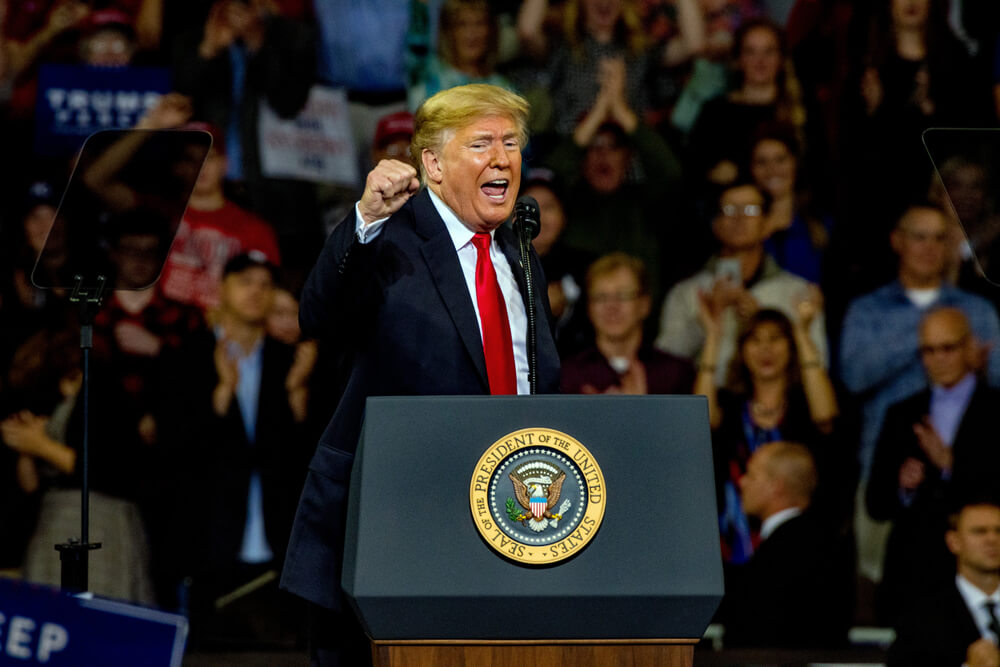 Trump is not on the ballot in the midterms but in many ways, his rule is
This is far beyond what any major European country has experienced, although the United Kingdom, for different reasons, also dropped down the ladder.
While the report’s categorisations and methodology could certainly be debated, the relative decline in the US position remains shocking. It noted: “The speed with which American democracy is currently dismantled is unprecedented in modern history.”
The 2026 report had no change in the American electoral health ranking, but only because that is always adjusted after an election year. The country could thus be expected to tumble further down the list in next year’s report.
Trump is not on the ballot in the midterms but in many ways, his rule is. There have been a few more signs these last couple of weeks of a ‘blue wave’, but there appears to be nothing on the horizon like the momentum that swept away Vučić and Orbán.
In Hungary, Brazil and Serbia, large parts of the population felt that democracy itself was at stake and acted to throw it a lifeline. In Israel, a similar mobilisation seems to have worked only partly.
In the United States, conversely, voters in 2024 disregarded the threat to democracy. They voted in Trump, with a Republican majority in Congress, in full knowledge of what he was capable of.
The question is whether now, after two years of polarisation and a steep fall in the country’s freedom indices, they will act to halt further democratic backsliding.
