Drones of every kind are now seen as the epitome of modern warfare and cutting-edge technology, yet they are almost as old as aviation itself.
Today, the largest of them are going through a rough patch, being shot down in growing numbers wherever they encounter modern air defences.
According to the Congressional Research Service, the United States alone has lost no fewer than 45 MQ-9 Reapers in its war against Iran. Writing big drones off, however, would be a mistake.
As early as the First World War, engineers were experimenting with “aerial torpedoes”: unmanned aircraft packed with explosives and designed to dive onto enemy lines at predetermined points.
In the 1930s, the Royal Air Force used recoverable, remote-controlled aircraft to train its gunners.
In 1944, the Americans sent drones, steered by a bomber flying alongside, to strike Japanese positions in the Solomon Islands.
During the 1960s, the United States flew hundreds of reconnaissance drones rather than risk its pilots against Soviet, Chinese and Vietnamese air defences.
Israel followed in the early 1980s, using drones over Lebanon both to scout enemy positions and to lure out enemy air defences.
Over the following decades, it built one of the most sophisticated drone industries in the world.
Drone technology also proliferated swiftly. By the end of the 2010s, Turkey had joined the club.
Its best-known product, the Bayraktar TB2, can carry its own munitions and strike targets directly, and it proved itself in Syria, Nagorno-Karabakh and Ukraine.
Meanwhile, Iran has built up a fully fledged drone industry of its own, producing comparable multirole models such as the Mohajer-6, capable of both reconnaissance and strike missions.
The Predator revolution
The decisive breakthrough came in the 1990s with the American RQ-1 Predator. Until then, drones had relied either on inertial navigation systems, which confined them to routes programmed before take-off, or on radio control, whose line-of-sight data links drastically limited their operating radius, however great their endurance.
Even today, drones such as the Bayraktar TB2 and the Mohajer-6, which depend on line-of-sight links, are generally assessed as unable to operate much more than 200 kilometres from their ground control station.
The reason is simple physics. Radio waves travel in straight lines and are blocked by terrain, while the Earth is curved.
The Predator, by contrast, carried a satellite data link that freed it from these constraints.
By bouncing its signal off satellites, it could be flown from bases thousands of kilometres away.
Over time, a new division of labour took shape. A local crew would launch the drone from a runway close to the target area using a line-of-sight link, then hand it over to a crew in the United States, who would fly the mission via satellite before handing it back for landing.
At the turn of the millennium, the Americans took the Predator a step further
Basing the drones near the theatre of operations maximised the time they could spend over their areas of interest.
This mattered: although they could stay aloft for more than a day, they were far slower than manned combat aircraft, and every hour spent in transit was an hour lost on station.
Then, at the turn of the millennium, the Americans took the Predator a step further.
It was first fitted with a laser designator, allowing it to “paint” targets for other aircraft, and then armed with laser-guided Hellfire missiles. It could now not only detect and identify a target, but destroy it itself.
Engineers even tested short-range air-to-air missiles to give it a chance against enemy aircraft.
The experiment had a memorable outcome. On 23 December 2002, a Stinger-armed Predator patrolling the no-fly zone over southern Iraq was intercepted by an Iraqi MiG-25. The drone fired first and missed, and the MiG then shot it down. It was the first air-to-air engagement between a drone and a manned fighter. By then, the RQ-1 Predator, “R” for reconnaissance, had become the MQ-1, “M” for multirole.
It was followed by the MQ-9 Reaper, built on the same concept but larger, faster and able to carry a much heavier payload, including laser-guided bombs.
Proliferation
Over the next two decades, the MQ-1 and MQ-9 proved their worth over Iraq and Afghanistan.
They logged millions of flight hours and struck thousands of targets, at a fraction of what the same missions would have cost with manned combat aircraft.
Armed drones soon became standard, and it was not long before other nations developed their own satellite-linked UCAVs (unmanned combat aerial vehicles) to complement their shorter-range, line-of-sight models.
Washington’s reluctance to export the technology to anyone but a handful of trusted allies, such as Britain and France, only encouraged them.
Israel designed the Hermes 900, China the Wing Loong and Cai Hong series, and Turkey the Bayraktar Akıncı, a twin-engine drone capable of carrying 1,500 kilograms of sensors and munitions.
Ethiopia was able to turn the tables on the Tigray People’s Liberation Front (TPLF), largely thanks to a small fleet of Mohajer-6 and Wing Loong drones
From the 2010s onwards, dozens of countries acquired armed drones, sometimes with decisive effect.
In 2021, Ethiopia was able to turn the tables on the Tigray People’s Liberation Front (TPLF), largely thanks to a small fleet of Mohajer-6 and Wing Loong drones.
Fledgling air forces, such as those of Nigeria and Mali, could likewise acquire capabilities that would otherwise have remained far beyond their reach.
In Sudan, both the Rapid Support Forces (RSF) and the Sudanese Armed Forces (SAF) have deployed a wide array of UCAVs against each other since the civil war broke out in April 2023, using them to carry out hundreds of long-range strikes.
The SAF’s Akıncı drones have even become formidable drone killers, shooting down several RSF drones with air-to-air munitions in recent months, as footage released by the SAF shows.
From wonder weapons to turkeys
Yet UCAVs have proved extremely vulnerable in contested airspace. In the chaotic opening weeks of the war in Ukraine, in February and March 2022, Ukrainian Bayraktar TB2s destroyed dozens of Russian armoured vehicles.
But once Russian air defences were fully up and running, the Turkish-made drones were shot down one after another and were soon forced to stay out of their reach.
On the other side of the front line, the Russians mostly use their large Orion UCAVs to launch Banderol small cruise missiles from beyond the range of Ukrainian air defences.
Even the mighty US Air Force lost seven MQ-9s to the Houthis during Operation Rough Rider, between 15 March and 6 May 2025
The same pattern emerged in Sudan, where both sides began to lose drones regularly as soon as they strengthened their air defences.
The RSF, in particular, shot down several SAF drones with modern Chinese-made FK-2000 short-range air defence systems, although at least one of these was tracked down and destroyed by an Akıncı.
Even the mighty US Air Force lost seven MQ-9s to the Houthis during Operation Rough Rider, between 15 March and 6 May 2025.
Between 28 February and mid-September 2026, the Americans lost at least a further three MQ-1Cs and 45 MQ-9s in their war against Iran, mostly to enemy air defences.
Vulnerable, but indispensable
These losses made it clear that large UCAVs are no panacea. They also dealt a heavy blow to those who claimed that manned combat aircraft were already obsolete.
Yet they do not negate the unique advantages such drones offer their owners. First, because they are unmanned, they can be sent into high-threat areas without risking highly trained and costly professionals, such as combat pilots.
Second, they are comparatively cheap: between a third and a tenth of the price of a manned combat aircraft to acquire, and cheaper still to operate.
Third, they can loiter over an area of interest for a day or more at a time, offering a persistence that no other system can match.
Moreover, MQ-9-class drones are not the be-all and end-all of large UCAVs. On the one hand, one of the lessons American airmen have drawn from the war against Iran is the need for new drones with capabilities similar to the MQ-9’s, but at a far lower acquisition cost, reflecting their expendable nature.
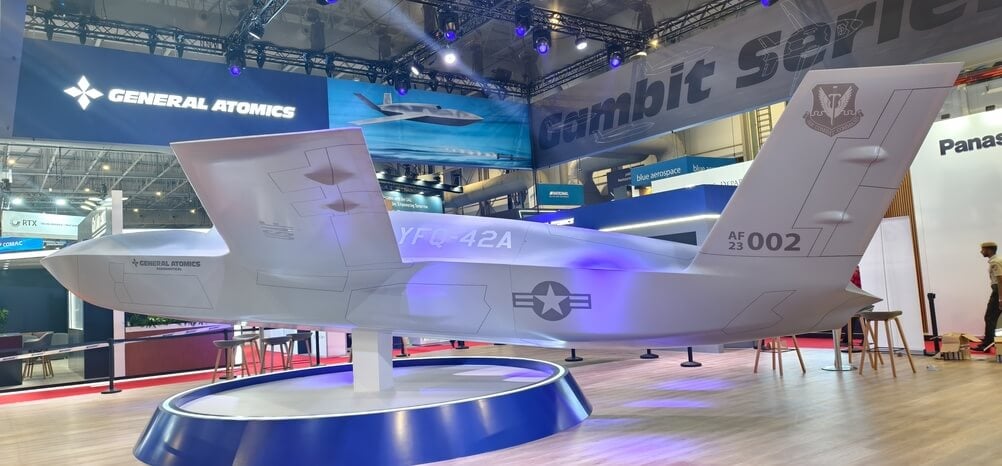 A new generation of jet-powered UCAVs has already been designed and prototyped - YFQ-42A
On the other hand, a new generation of jet-powered UCAVs has already been designed and prototyped.
These are much more expensive, but also far more survivable, thanks to their much higher speed and, often, stealth features.
Literally dozens of models have been unveiled, from the US Air Force’s Collaborative Combat Aircraft (YFQ-42A and YFQ-44A) and Europe’s nEUROn demonstrator to Turkey’s Kızılelma and China’s GJ-11 Sharp Sword, and at least some of them are bound to enter production in significant numbers.
The future may therefore see a high-low mix of cheap, expendable UCAVs alongside high-end ones.
These, in turn, will operate alongside even larger numbers of one-way attack drones, as well as manned combat aircraft, which remain as indispensable as ever.
Moreover, the technologies behind these drones are spreading fast. High-bandwidth satellite datalinks, long the preserve of only the wealthiest states, are now available from commercial operators, with Starlink’s near-monopoly already being challenged by new competitors.
Yet, as Ukraine learned, relying on a privately or foreign-owned network is itself a strategic vulnerability, at a time when a growing number of regional powers consider such capabilities a must-have.
Not only the drones themselves, but also the architectures that make their deployment possible, are thus becoming a factor in the wider geopolitical landscape.
Adrien Fontanellaz is a military historian and analyst specialising in contemporary warfare. He is a member of the scientific committee of the Centre d’Histoire et de Prospective Militaires (Pully, Switzerland).
