European capitals have good reason to welcome the electoral defeat of long-time Serbian leader Aleksandar Vučić, but they still do not have sufficient grounds to claim that Serbia has turned towards the West.
The Student List won by promising to fight corruption and free the state from party control. On relations with Russia, it announced that it would maintain the policy of not imposing sanctions, one of the main obstacles in Belgrade’s relations with the European Union.
It is not yet known who will lead the new government or how its members will resolve internal disputes. A common adversary enabled people with different beliefs to unite on a single list.
They must now agree on the prime minister, public finances and relations with the major powers, without being able to postpone any disagreements until victory over Vučić has been secured.
Referendum-style victory and the fall of the old parties
According to morning data released by the Republic Electoral Commission on 26 October, the Student List took 52.33 per cent of the vote, while the Aleksandar Vučić – United Serbia list secured 39.44 per cent.
Projections indicate that the Student List will hold around 140 seats and Aleksandar Vučić’s list roughly 105 in the 250-seat parliament. The Student List would thus secure an absolute majority and be able to form a government.
Alongside the two main lists, representatives of the Hungarian, Albanian and Bosniak minorities will also enter parliament. The Socialist Party of Serbia, formerly led by Slobodan Milošević and now by Ivica Dačić, fell below the electoral threshold, leaving it without parliamentary representation for the first time since 1990.
Turnout of nearly 70 per cent highlighted how many voters were determined to have their say on the government’s survival.
Part of the traditional opposition backed the students’ list instead of fielding its own candidates.
The vote took on an almost referendum-like character, with Vučić’s departure as the central question and policy differences pushed to the margins of the campaign.
An absolute majority allows the victors to form an administration without coalition partners. Nevertheless, the government’s policy will have to be negotiated within the list itself, among MPs, their political allies, and student plenums – the assemblies through which students choose their candidates.
Without agreement on whose decisions bind the broader group, any serious dispute could undermine support for the government.
The result in Serbia echoes the defeat of long-serving Hungarian Prime Minister Viktor Orbán
After fourteen years of rule by Aleksandar Vučić’s Serbian Progressive Party, the deaths of sixteen people following the collapse of the canopy at Novi Sad railway station have come to symbolise corruption and impunity.
In its 2025 report on Serbia, the European Commission warned of persistent shortcomings in corruption investigations and trials involving senior officials, as well as the risk of political interference in judicial proceedings. The change of government offers a clear opportunity for these matters finally to be subjected to independent investigation.
Vučić conceded defeat at around 9.30 p.m., before counting concluded, stating that his political struggle would continue. This averted the immediate risk of a dispute over the result. With roughly two-fifths of the vote, his list retains a solid base from which to operate in opposition.
His resignation from the presidency in September and his failure to return as prime minister have not completely extinguished his political influence.
The result in Serbia echoes the defeat of long-serving Hungarian Prime Minister Viktor Orbán, where widespread public mobilisation led to the removal of an entrenched administration.
Péter Magyar, however, led an established party and presented a clear candidate to head the government. In Serbia, the winning list has yet to select the individuals who will lead the state administration.
Who makes decisions on behalf of the Student List?
The Student List is registered as a citizens’ group, and there are no students among its 250 parliamentary candidates. The movement decided in advance to nominate professors, doctors, artists and other public figures.
They gained the trust of students to represent them in the election and then the trust of voters to conduct state affairs.
One of the candidates, academic and chemistry professor Radomir Saičić, said during the campaign that the prime minister would be chosen by MPs in consultation with the student movement.
Such an agreement can determine the composition of the government, but its functioning also requires an answer to the question of who decides when conflicts arise.
MPs will be accountable to voters for the budget and the legislation they pass, even if they have previously coordinated their decisions with the student plenums.
The published 11-point plan includes establishing an independent judiciary, auditing state contracts and removing party political influence from public services
The published 11-point plan includes establishing an independent judiciary, auditing state contracts and removing party political influence from public services. Delivering on these pledges will quickly require decisions on specific appointments and positions.
It will then become clear how political differences among the candidates affect the selection of public officials, the allocation of public funds and the acceptance of responsibility for unpopular measures.
In cases of lustration and the dismissal of officials, the new government will have to abide by statutory limits and respect the right to a defence.
It will be difficult to rebuild public trust if independent accountability mechanisms are replaced by political decisions about who may remain in office.
Its pledge to secure judicial independence will be tested most sharply by its response to rulings that go against it.
Russian interests outlive Vučić’s defeat
On 30 September, the student movement announced that Serbia would maintain its stance of not imposing restrictive measures against the Russian Federation.
In doing so, the victors pledged to continue the policy under which Belgrade has for years refused to align with European sanctions against Moscow. That decision carries greater weight in assessing Serbia’s future relationship with the West than the symbolism of the students’ victory.
Saičić advocated “productive relations with Russia”, citing historical ties and energy needs. He argued that Moscow had defended the position that Kosovo is part of Serbia more consistently than Aleksandar Vučić’s government.
He described Kosovo, which declared independence in 2008, as “temporarily occupied territory”, asserting that Serbia would reclaim it one day.
Russian President Vladimir Putin backed Vučić during the campaign, and the Serbian leader's defeat deprives the Kremlin of a long-standing partner in power
His criticism of Vučić rests on the claim that the new government would better defend national interests.
Such rhetoric could make any subsequent compromise on Kosovo more difficult, as the victors would face accusations of reneging on campaign pledges. At the same time, praise for Russia’s stance helps Moscow preserve its standing among voters who have turned against its former ally.
Russian President Vladimir Putin backed Vučić during the campaign, and the Serbian leader's defeat deprives the Kremlin of a long-standing partner in power.
However, the stated policy of the new majority protects Russia’s primary interest in keeping Serbia outside the European sanctions regime. Moscow also benefits even when its relations with the new administration are overshadowed by distrust or disagreements on other fronts.
In a parliament dominated by two anti-sanctions blocs, any government seeking to change that policy would face fierce opposition from Vučić, as well as resistance within its own ranks.
For Russia, such parliamentary arithmetic offers a degree of reassurance that could never be guaranteed by personal ties with a single politician alone.
The continuation of European integration is no longer guaranteed
Jovo Bakić, professor of sociology at the Faculty of Philosophy, University of Belgrade, and candidate on the Student List, called for a referendum on European Union membership, following a public debate held under conditions of media freedom.
The campaign called for a referendum on the very continuation of European integration. In this way, the new decision-making process challenges the path that Serbia has formally pursued for years. European governments can no longer assume that the accession process will continue automatically once Vučić is removed.
Progress towards membership requires agreement on issues that cannot be resolved through domestic reforms alone. The European Commission is seeking alignment with the Union’s foreign policy, including sanctions, while the obligations arising from negotiations on the normalisation of relations with Kosovo are incorporated into negotiating Chapter 35.
The new majority will have to decide how far it is prepared to accept these conditions and how it will justify its decisions to voters.
European institutions will have to take their environmental objections seriously and maintain support for independent oversight even when industrial interests diverge
Relations with Europe will also be strained by opposition to lithium mining. Zlatko Kokanović, a candidate on the list and an opponent of the Jadar project, has proposed a permanent statutory ban on lithium exploration and mining.
Such a ban would preclude any possibility of reviving the project, which mining group Rio Tinto has already placed under care and maintenance. The 2024 EU–Serbia partnership covers raw materials, batteries and electric vehicles.
Under that agreement, Brussels committed itself to high environmental standards, transparency and respect for local communities. It must now negotiate its implementation with figures who reject a project that the previous administration presented as an essential link to the West.
European institutions will have to take their environmental objections seriously and maintain support for independent oversight even when industrial interests diverge.
A government backed by strong electoral support would have greater scope to reject European demands and appeal to popular will.
To secure an agreement, Brussels will have to win over disparate factions within the new majority instead of relying on the word of a single leader. The democratisation of Serbia may therefore lead to far more demanding negotiations with its European partners.
The government must determine where accountability lies
The choice of prime minister will provide the first indication of who can lead this majority. Subsequent agreements will concern state contracts with Chinese and other foreign partners, the funding of public services and the conditions set by the European Union.
Delaying these decisions could trigger conflict between MPs and student plenums, with each claiming to embody the electoral victory.
Credible investigations into corruption and the publication of contracts concealed by the previous administration could strengthen confidence in the new government. Any prolonged delay would give Vučić an opportunity to rally public discontent behind his party.
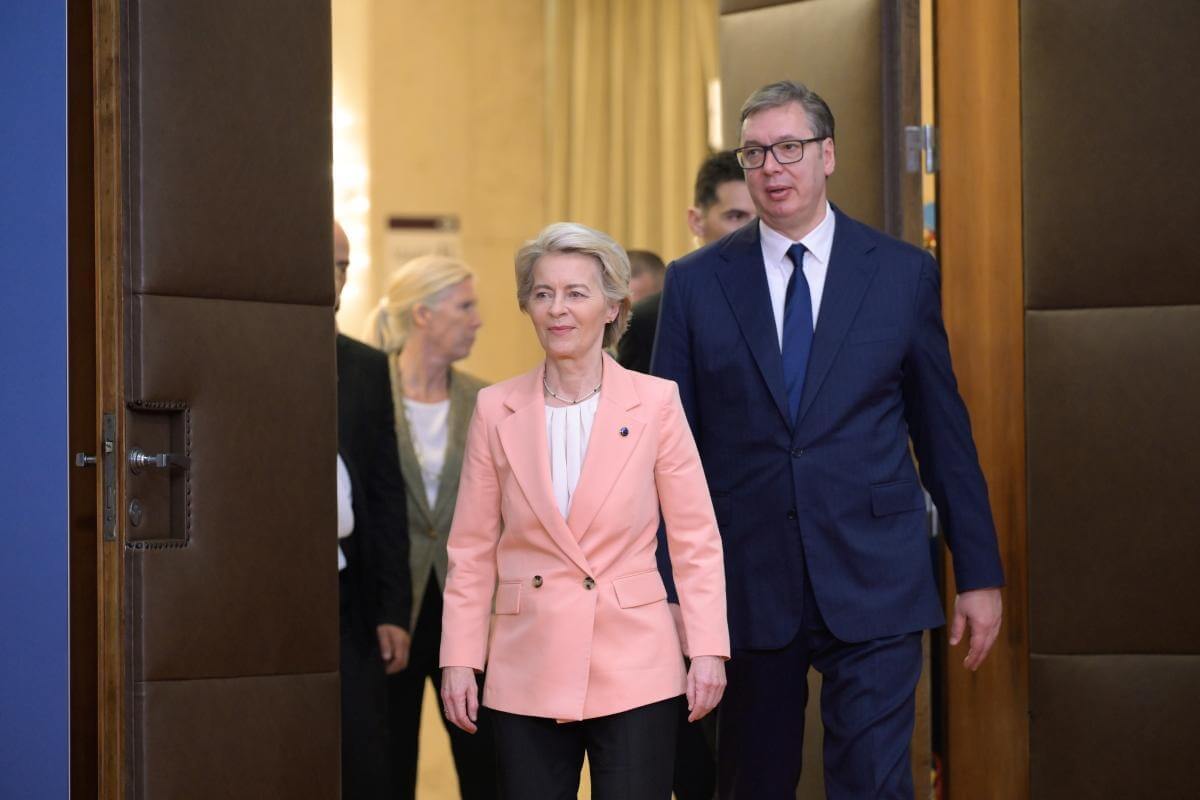 Western governments have an interest in supporting the restoration of independent institutions in Serbia - Ursula von der Leyen, Aleksandar Vučić
With nearly two-fifths of the vote and decades of experience running state and party machinery, he retains sufficient support to capitalise on any missteps by the victors.
Western governments have an interest in supporting the restoration of independent institutions in Serbia and in stating clearly what decisions they expect from its new leadership.
The election result creates space for such engagement, without guaranteeing closer alignment in foreign policy.
The mandate to remove Vučić leaves the new administration obliged to define its position on Europe, Russia and Kosovo – issues it was able to sidestep during the campaign.
The Student List is likely to splinter into several political organisations, meaning the contest over Serbia’s European path will ultimately be settled among those who joined forces to oust Vučić.
The pro-European wing of that alliance must decide how much ground it is prepared to concede to nationalist allies in order to retain power.
If it agrees to freezing accession talks, its presence in government will lend legitimacy to that decision, dragging along voters who sought closer integration with Europe.
Accountability for that choice will lie with those who make it, leaving no scope to pin the blame on Vučić.
