Gianni Infantino did not emerge from football’s dressing rooms. He was shaped by its bureaucracy. He learned not the emotion of the game, but the rules, money and power balances through which football is governed.
His appearances at Champions League draws made him a familiar public figure. Under Michel Platini, he became one of the principal officials responsible for UEFA’s legal affairs, commercial expansion and daily operations.
As he rose through the corridors of football administration, few expected him to become FIFA president. The man being prepared for that role was Platini.
The vacancy created: reaching the FIFA presidency
In 2015, corruption investigations that shook FIFA brought the Sepp Blatter era to an end. Platini emerged as the natural candidate to succeed him. But he was suspended from football over a payment of two million Swiss francs he had received from Blatter.
Once Platini was removed from the race, UEFA urgently needed another candidate and put forward Infantino on 26 October 2015.
The manner in which Infantino won already contained the first signs of the governing model he would later establish
Infantino later admitted openly that he would not have entered the race had Platini been able to stand. He therefore reached the FIFA presidency not through an independent project developed over many years, but through the vacancy created by the sudden elimination of his political patron.
At the extraordinary FIFA Congress on 26 February 2016, Infantino won the second round with 115 votes, defeating Sheikh Salman. There is no evidence that the ballot was manipulated or that the formal election procedure was violated.
Infantino won the election. Yet the manner in which he won already contained the first signs of the governing model he would later establish.
Development funding and political loyalty
During the campaign, he promised national federations development funding of five million dollars for each four-year cycle. He also pledged to increase the funds transferred to the confederations.
The recipients of these promises were the same federations that would vote for the FIFA President only days later.
Infantino made the system more effective by distributing more money through it
FIFA’s “one country, one vote” system appears democratic on paper. Germany has one vote, and so does a small island state. However, when the budgets of many smaller federations depend heavily on FIFA funding, the relationship between the president who distributes the money and the federations that elect him can hardly be regarded as equal or independent.
That is where the line between development funding and political loyalty begins to blur.
Infantino did not dismantle the system he inherited from the Blatter era. He made it more effective by distributing more money through it.
Knowing the rules vs respecting their purpose
At first, this was presented as a reform programme. Following the scandals of the Blatter years, FIFA was believed to need not another flamboyant football baron, but a serious technocrat: a calm, legally trained professional with command of the files. Infantino presented himself in precisely those terms – as a man who understood the rules and would restore football’s credibility.
It soon became clear, however, that knowing the rules well did not necessarily mean respecting their purpose.
During his first term, FIFA adopted reforms involving a separation between strategic and executive functions, term limits, financial oversight and independent committees. Yet by 2017, the people responsible for scrutinising the president were being removed one after another.
Infantino had entered office as a reformer, but he soon neutralised the part of the reform agenda that was supposed to restrain him
Cornel Borbély, head of the investigatory chamber of FIFA’s Ethics Committee, and Hans-Joachim Eckert, head of its adjudicatory chamber, were not reappointed.
Miguel Poiares Maduro, chairman of FIFA’s Governance Committee, was removed just eleven months into what was supposed to be a four-year term. Maduro later spoke before the British Parliament about political pressure within FIFA and interference with independent oversight.
FIFA defended these changes in the name of institutional renewal and geographical diversity. The outcome, however, was unmistakable: those expected to scrutinise the president were gone, and the president’s room for manoeuvre expanded.
When the tenure of an institution’s watchdogs depends on a political majority controlled by the person they are meant to supervise, independence exists only on paper. Infantino had entered office as a reformer, but he soon neutralised the part of the reform agenda that was supposed to restrain him.
Emptied out through technical interpretation
The debate over his term of office followed the same pattern. Infantino was elected in 2016 and re-elected unopposed in 2019 and 2023.
FIFA decided that the first three years, during which he completed Blatter’s unfinished term, would not count as a full presidential term. In practice, this extended what had been understood as a twelve-year limit to fifteen years in Infantino’s case.
Rather than directly violating a rule, its purpose was emptied out through technical interpretation
In May 2026, he announced that he intended to stand again in 2027. If re-elected, he could remain in charge of FIFA until 2031.
The rule was not openly broken. It was interpreted in the manner most favourable to keeping the president in office.
This became one of the defining characteristics of the Infantino era: rather than directly violating a rule, its purpose was emptied out through technical interpretation.
Take the decision first, construct the defence later
That style of governance became much more visible in the run-up to the Qatar World Cup.
During preparations for the tournament, there was sustained criticism of migrant workers’ conditions, unpaid wages, confiscated passports, worker deaths, laws targeting LGBT people and restrictions on freedom of expression. FIFA was expected to respond with concrete evidence, explain the chain of responsibility and create a credible compensation mechanism for those who had suffered.
Instead, Infantino delivered an almost hour-long speech in which he said that he felt Qatari, Arab, African, gay, disabled and like a migrant worker. He then accused European countries of hypocrisy and invoked their colonial past.
Europe’s historical crimes, double standards and selective approach to human rights can certainly be criticised. But none of them justifies the non-payment of a worker’s wages in Qatar, the failure to monitor working conditions or the lack of a proper investigation into a worker’s death.
The FIFA President’s responsibility was not to turn criticism into a clash of civilisations. His duty was to investigate and address the human cost of an event from which FIFA earned billions of dollars.
FIFA later created a legacy fund worth 50 million dollars. Yet the money was not paid directly as compensation to affected workers and their families. It was allocated instead to education, health, refugee assistance and other international programmes.
The tournament is awarded first, and the claim that football will transform society comes afterwards
All of these may be valuable causes, but aid and compensation are not the same. You do not remedy the specific harm suffered by one person by funding a different social project elsewhere.
The basic method used in the Qatar case was clear: take the decision first, then construct a political and cultural defence against the criticism. The same method was repeated in the process through which Saudi Arabia was awarded the 2034 World Cup.
FIFA approved the hosts of the 2030 and 2034 tournaments at the same virtual congress. Saudi Arabia was the only candidate for 2034. The bidding period was short, while FIFA’s continental rotation decision effectively prevented countries outside Asia and Oceania from competing. In the end, the hosting rights were approved by acclamation, without a genuinely competitive process.
Serious warnings were raised about migrant labour, women’s rights, freedom of expression, LGBT people and the risk of forced evictions. FIFA’s response was familiar: the World Cup, it said, could accelerate social change in the country.
The same argument had been used for Qatar. The tournament is awarded first, and the claim that football will transform society comes afterwards. Yet human rights should not be reduced to a communications document drafted after a decision has been made. They should be binding conditions assessed before hosting rights are granted.
Infantino’s FIFA did not make them binding. It placed human rights not at the centre of the decision, but in the subsequent defence of that decision.
Beyond ordinary institutional contact
Then came the increasingly close relationship with Donald Trump.
There is nothing unusual about a FIFA President meeting heads of state. Events on the scale of the World Cup require close cooperation with governments.
However, the relationship between Infantino and Trump began to appear to go well beyond ordinary institutional contact.
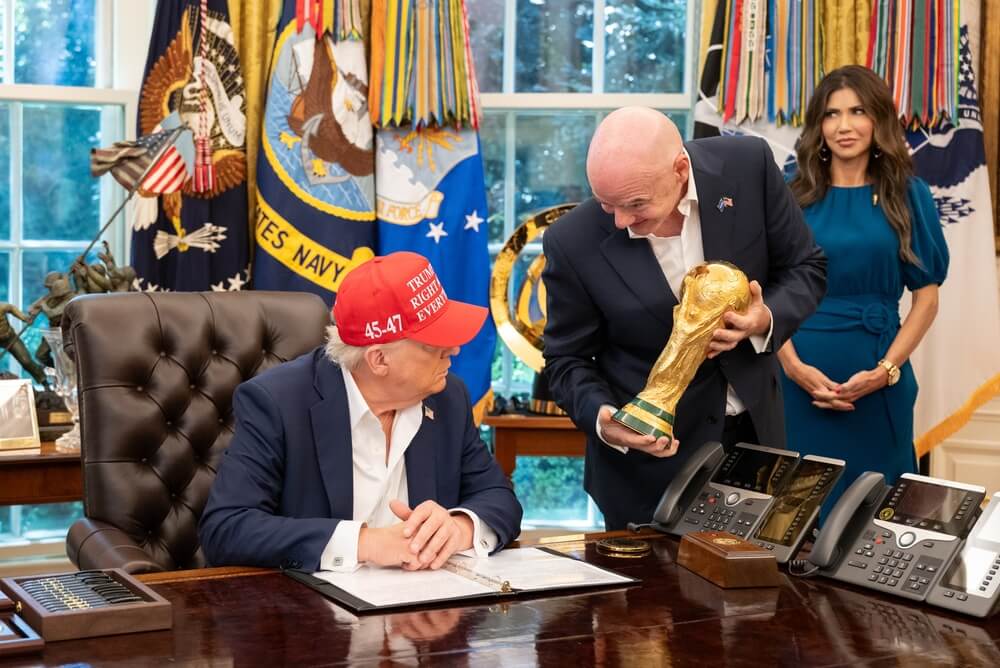 The relationship between Infantino and Trump began to appear to go well beyond ordinary institutional contact
In May 2025, Infantino arrived more than two hours late for the FIFA Congress in Paraguay because he had joined Trump on a tour of the Middle East. UEFA delegates walked out and accused the FIFA President of placing his personal political relationships above his institutional responsibilities.
FIFA later created a peace prize and awarded it to Donald Trump. It was never clearly explained which independent panel had selected him, according to what criteria or from among which candidates.
Presenting such an award to a serving political leader, while he maintained a close relationship with the FIFA President, seriously damaged FIFA’s claim to political neutrality.
An attempt to sell the World Cup
Then came Infantino’s most controversial project.
A new commercial entity called “FIFA Forward Enterprise” was to be established with an estimated valuation of around 20 billion dollars. Twenty per cent of FIFA’s commercial activities would be opened to private investors. Broadcasting, sponsorship, ticketing, licensing and organisational revenues from the World Cup and Club World Cup were to be placed under this structure.
Technically, the sporting ownership of the World Cup was not being sold. However, one fifth of the tournament’s principal revenue-generating assets would have been opened to private capital. It was therefore not unreasonable for the public to view the project as an attempt to sell the World Cup.
Private equity does not invest to serve football. It invests to increase the value of its capital and maximise returns. Once future World Cup revenues are tied to a private investor, new profit pressures are inevitably placed on the tournament’s schedule, format, sponsorship choices and commercial priorities. The claim that sporting control would remain with FIFA does not alter this economic reality.
Good governance requires more than simply avoiding an actual conflict of interest
One of the principal investors under consideration was Thrive Capital, founded by Joshua Kushner, the brother of Donald Trump’s son-in-law Jared Kushner.
Joshua Kushner’s personal political views are not the essential issue. The issue is why the FIFA President, after developing such a close relationship with Trump, was negotiating the commercial future of the World Cup with an investment group from Trump’s immediate family circle – and why this was not properly explained.
How was this investor selected? Who else was approached? How was the valuation calculated? What role did J.P. Morgan play? What advisory fees were involved? Would FIFA officials have received positions in the new company, either immediately or after leaving office?
No clear answers were provided.
Good governance requires more than simply avoiding an actual conflict of interest. Relationships that could reasonably give rise to a suspicion of conflict must also be managed transparently and subjected to scrutiny. Infantino failed to do this.
The Infantino model fully visible
The financial offer made to FIFA’s member associations made the situation even more troubling. If the project were approved, each of FIFA’s 211 member associations was to receive a one-off payment of 20 million dollars.
If the project were rejected, the federations would have to settle for the much lower amounts available under existing programmes.
The office distributing the money and the office whose proposal was being voted on were controlled by the same person
Without a court ruling, this cannot be called bribery. However, offering substantially more money to the federations that elect the president and would vote on his project cannot credibly be described as sound governance.
The office distributing the money and the office whose proposal was being voted on were controlled by the same person.
At that point, the Infantino model became fully visible: a system that made federations financially dependent on the centre, weakened independent oversight, interpreted term limits flexibly, prepared strategic decisions within a narrow circle and finally offered members significant financial incentives.
A balance of power outside the system
This time the system did not work – or, more accurately, it did not work in the way Infantino had become accustomed.
All 55 European federations united around the position that, if the proposal went ahead, they would boycott FIFA competitions. The opposition was not confined to major football countries such as England, Germany, France, Italy and Spain. European football as a whole adopted a common position.
The reaction spread to other regions. Football organisations in North and Central America and Asia stated that the process lacked transparency and proper procedure. Open objections also emerged from within FIFA.
FIFA’s chief operating officer, Kevin Lamour, said that employees had been misled about the process and described it as a “one-man project”. Carlos Cordeiro, one of Infantino’s senior advisers, resigned, arguing that the future of football was being mortgaged even though FIFA was already in a strong financial position.
Eventually, Europe’s boycott threat, objections from other confederations and internal resistance forced Infantino to retreat. The project was shelved on 1 August 2026.Europe’s boycott threat, objections from other confederations and internal resistance forced Infantino to retreat
 Europe’s boycott threat, objections from other confederations and internal resistance forced Infantino to retreat
Infantino later said that he had listened to all opinions and that the proposal had caused unnecessary division. But withdrawing the project did not demonstrate that the system was healthy. On the contrary, it showed that FIFA’s internal oversight mechanisms had failed.
A project of this magnitude was not stopped by independent committees, the FIFA Council or a transparent institutional debate. It was stopped only after Europe threatened a boycott, other confederations objected and Infantino’s own colleagues rebelled.
The system did not prevent the mistake. A balance of power outside the system did.
For that reason, it would be incomplete to view the European revolt merely as an attempt by Europe to preserve its influence over world football. Europe was undoubtedly defending its economic and sporting interests. But the central question raised by the dispute was more fundamental: who has the authority to decide the future of world football, under what mandate, and subject to what scrutiny?
Infantino’s practical answer had become clear: the president and the narrow circle around him.
Europe’s answer, on this occasion, was equally clear: no.
The cancellation cannot close the matter
The issue is not only the cancelled private equity project. The same governing philosophy can be identified across the full record – from Qatar to Saudi Arabia, from the ethics committees to the interpretation of term limits, from relations with Trump to the distribution of money among the federations.
Decisions are first shaped within a narrow circle. Institutional procedures are then adapted to fit the desired outcome. Financial incentives are offered to federations. Human rights criticism is politicised. Independent oversight is weakened. If resistance becomes sufficiently strong, the language changes, but the method remains intact.
The cancellation of the private equity project therefore cannot close the matter.
The discussions with Joshua Kushner’s investment group should be independently examined: when they began, how the investor was selected, which other funds were contacted, what role J.P. Morgan played, what advisory fees were involved and how the valuation was determined. It should also be disclosed whether Infantino or any other FIFA official was expected to receive a future role in the proposed company.
Allocations must be based on objective criteria, and no president should be able to use the distribution of FIFA money to generate political loyalty
Appointments and dismissals within FIFA’s Ethics Committee and Governance Committee should be removed from the president’s control. Members of these bodies must be granted genuine security of tenure.
Development funds distributed to federations should be completely separated from presidential elections and major strategic votes. Allocations must be based on objective criteria, and no president should be able to use the distribution of FIFA money to generate political loyalty.
Large commercial decisions involving the World Cup, broadcasting rights and private equity partnerships should be subject to independent financial and ethical review. The rules on presidential terms should be rewritten without room for interpretation, and every year spent in office should count towards the total limit.
Infantino must go immediately
Even if all these reforms were adopted, however, Infantino remaining in office would not solve the problem.
This is not about a single failed proposal. It is about FIFA having been governed for years around the relationships, preferences and power calculations of the same president. Infantino is no longer merely the manager of this structure. He has become the structure itself.
He may have increased FIFA’s revenues. He may have expanded tournaments, transferred more money to federations and strengthened the organisation commercially. But rising income is not proof of good governance.
 No criminal conviction is required to conclude that Infantino should step down from the FIFA presidency
Good governance is measured not by how much money is generated, but by how decisions are made, who scrutinises them and whether institutional interests are kept separate from personal relationships.
Infantino’s FIFA has failed that test.
It is important here not to confuse criminal law with institutional responsibility. Convicting Infantino of a crime would require evidence, a trial and a court judgment. No one should be declared criminally guilty by any other means.
But no criminal conviction is required to conclude that he should step down from the FIFA presidency.
The FIFA presidency is not a defendant’s dock. It is a position of trust. Merely avoiding criminal conviction is not enough. The office requires transparency, accountability, respect for independent scrutiny, political distance and a commitment to place the shared interests of world football above personal power.
Infantino inspires confidence in none of these respects.
There is no need to wait for further evidence. There is no need to wait for another scandal. From the weakening of the ethics committees to the manoeuvring over term limits, from his conduct over Qatar to the Saudi decision, from his relationship with Trump to the Joshua Kushner project and the European boycott threat, the record is already more than clear.
Evidence is required to impose a criminal penalty.
But to reach a political and institutional judgment, the record accumulated so far is more than sufficient.
Infantino must go immediately.
