China’s undervalued exchange rate is often read as a symptom of the imbalance that underlies its surpluses. This is the wrong metaphor.
The exchange rate is better understood as a price: by suppressing the renminbi’s value, the Chinese government not only obscures the underlying imbalance, but also disables the main mechanism for correcting it. The result is a deliberate policy of self-harm.
By the International Monetary Fund’s assessment, China’s real exchange rate fell by 14% in 2021–25, while the country’s officially reported current-account surplus rose to 3.8% of GDP.
China’s exchange-rate management is not just about keeping the currency at a particular level; it also offers exporters an implicit volatility guarantee.
With most exports still invoiced in dollars, a tightly controlled renminbi-dollar exchange rate reduces uncertainty over domestic-currency revenues. Competitors can hedge, but at a cost; Chinese manufacturers receive much of their insurance from the state.
The reasoning behind this policy lies in the framework within which it is devised, which does not aim primarily to maximize welfare or even growth.
Instead, President Xi Jinping’s government has, since 2012, pursued a “security-first” model, which emphasizes resilience alongside growth. Policymakers must plan for sanctions, while accounting for Xi’s ambition to secure control over Taiwan.
Policy mix that produces too much saving
As Harvard’s Gita Gopinath, Pierre-Olivier Gourinchas of the University of California, Berkeley, and the London Business School’s Hélène Rey recently noted, the “disease” underlying China’s surpluses is a policy mix that produces too much saving, including by suppressing household consumption.
But the cure is not a mystery: IMF staff estimate that stronger social spending and reform of the hukou household-registration system could lift consumption by as much as 3% of GDP.
For those who are concerned about the global imbalances China’s surpluses create, the question is how to make the costs of this preference untenable
The barrier to progress is not policy design; it is policy preference. For those who are concerned about the global imbalances China’s surpluses create, the question is how to make the costs of this preference untenable.
To treat the exchange rate as a mere symptom, as Gopinath, Gourinchas, and Rey advocate, would be to fail to recognize the power of prices to change behavior.
Gopinath, Gourinchas, and Rey are right that a currency’s role in trade invoicing and global finance is endogenous.
Excess saving from underconsumption and overinvestment generates appreciation pressure, which is absorbed through capital controls and state-asset accumulation.
But an endogenous variable can still be an instrument: by resisting appreciation, China’s government stops the real rate from correcting the imbalance and reinforces the profitability of the sector that produced it, thereby entrenching the distortions behind the surplus.
A weak renminbi does not repair the financial system
The costs end up on balance sheets—and they are mounting. The IMF estimates that China’s broad, augmented public-sector debt reached approximately 127% of GDP in 2025, while official data indicate that commercial bank net interest margins have compressed for six straight years, from 2.2% in 2019 to a record-low 1.4% last year.
China is not running out of money, but it is running out of painless ways to deploy it.
A weak, stable renminbi preserves exporters’ cash flows, sustains employment and tax revenue, and defers loss recognition across these balance sheets. It does not repair the financial system, but it does buy time.
Renminbi appreciation would not, on its own, rebalance the economy
Renminbi appreciation would not, on its own, rebalance the economy. But by increasing households’ purchasing power over imports and compressing tradable-sector margins, it would raise the cost of avoiding reform.
Dollar invoicing reinforces both channels: the prices in renminbi of dollar-priced imports fall roughly one-for-one as the renminbi’s value rises, while sticky foreign-currency export prices push the adjustment onto exporters’ domestic revenues.
To be sure, as Gopinath, Gourinchas, and Rey note, the initial effects of renminbi appreciation would be deflationary and, given the prevalence of dollar invoicing, the impact on export prices would be delayed.
Absent a change in the savings-investment balance, a forced appreciation could be matched by falling prices, returning the real exchange rate and the surplus to levels near where they began.
The tariff threat
But that reversion is not neutral: the deflation that reverses the appreciation is the same deflation that compounds the real debt burden across public and private balance sheets.
China can hold the real rate down only through a debt-deflation dynamic, the effects of which it cannot absorb indefinitely.
At some point, it will have to choose between a deepening slowdown and the reflation it has resisted.
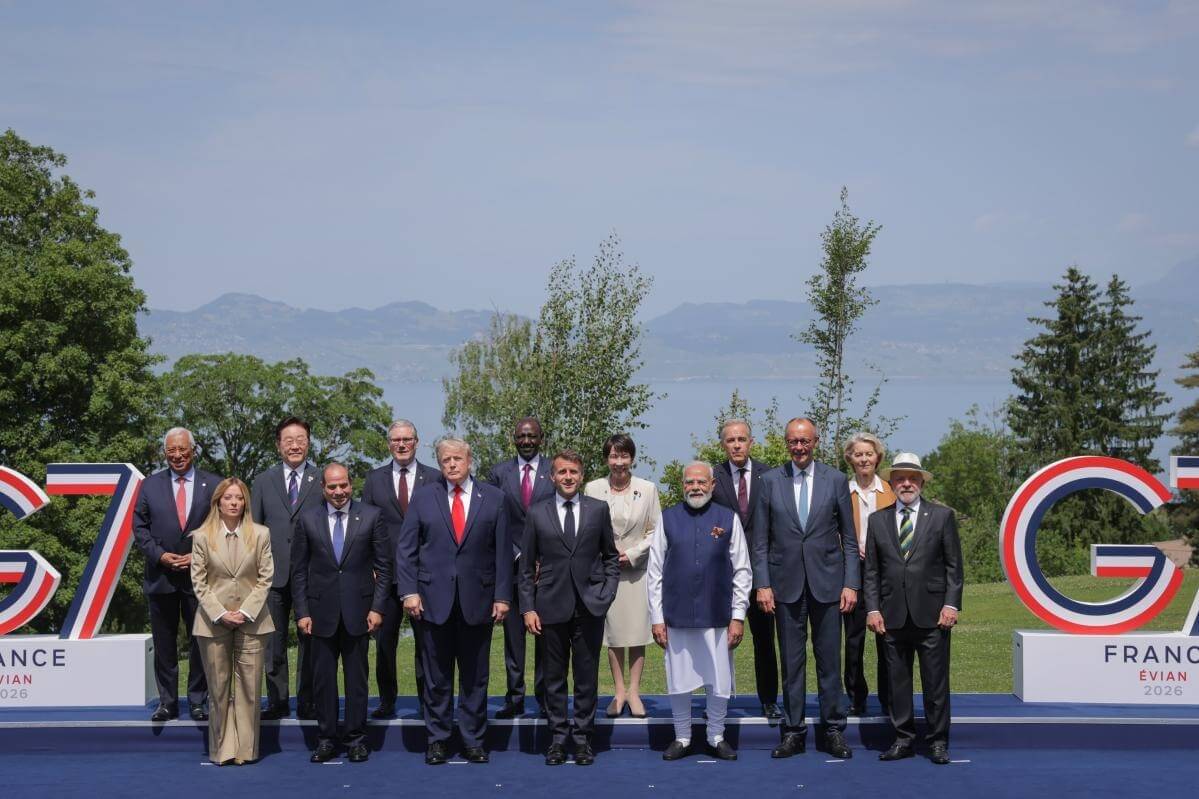 The tariff threat must be conditional and reversible, with reflation being framed as China’s own choice, not capitulation
The G7 can accelerate this process. As Brad W. Setser, a former deputy assistant US treasury secretary, and Shahin Vallée of the German Council on Foreign Relations, have observed, resistance to currency appreciation forces China and other Asian surplus economies to accumulate reserves, yet the scale and liquidity of those assets make diversification away from G7 currencies extraordinarily difficult.
This is an underappreciated source of G7 leverage, and in their view, the group should make use of it by issuing a joint, conditional tariff threat on Chinese exports.
To understand the scale of the appreciation pressure China faces, consider the amount of currency state institutions absorb: Setser estimates that forward-adjusted foreign-exchange intervention purchases reached $320 billion in 2025.
This is why Setser and Vallée’s proposal makes sense. The tariff would offset the price advantage created by an undervalued renminbi just as the cost of replacing that subsidy is rising, making reflation the least costly way of upholding the same model.
Crucially, the tariff threat must be conditional and reversible, with reflation being framed as China’s own choice, not capitulation. The conditionality is the face-saving off-ramp.
China’s imbalances create the surpluses, and exchange-rate management enables the country to externalize the adjustment.
This makes fiscal excess easier to sustain in deficit economies, particularly the United States, whose deficits attract the foreign savings that official demand helps sustain.
While currency adjustment is no substitute for structural reform, under present conditions, reform is unlikely without it.
Gene Frieda, a former global strategist at PIMCO, is a senior visiting fellow at the London School of Economics and a non-resident fellow at Bruegel.
