“We the peoples of the United Nations determined to save succeeding generations from the scourge of war.” So begins the UN Charter. Yet Russia’s war of aggression against Ukraine is well into its fourth year, confirming just how far the UN has strayed from its foundational promise.
The problem is not simply that the UN has failed to stop a major war. It is that the state waging the war exercises a veto within the very body that the Charter entrusts with preserving international peace and security.
Last month, the Security Council met once again to discuss Ukraine, and once again, the world saw how Russia has turned the Soviet Union’s permanent seat, which it usurped in 1991, into a license for impunity.
If ever the Council tries to respond to Russian aggression, the Kremlin blocks it from doing so.
This perverse arrangement is usually described as an unfortunate but unavoidable flaw of the system. But is it?
The UN has never examined how the Russian Soviet Federative Socialist Republic (RSFSR) or its successor, the Russian Federation, acquired membership in the organization and on the Security Council in the first place. Yet surely this matter warrants closer scrutiny. On the basis of which documents, exactly, did Russia inherit the Soviet Union’s veto-wielding position?
The answer is remarkably thin. Article 23 of the Charter still lists the “Union of Soviet Socialist Republics” as a permanent member of the Security Council.
The Soviet Union was a founding member of the UN in 1945, as were Ukraine (UkSSR) and Belarus (BSSR). The same cannot be said for the RSFSR or the Russian Federation.
Yeltsin’s letter
To be sure, on December 8, 1991, Belarus, Russia, and Ukraine declared that the Soviet Union was ceasing to exist “as a subject of international law and a geopolitical reality”; and on December 21, in Alma-Ata (now Almaty), the members of the new Commonwealth of Independent States, including Ukraine, expressed support for Soviet Russia’s continuation of the USSR’s UN membership, including its permanent seat on the Security Council.
But then no legal steps were taken to secure this status ever.
Instead, on December 24, RSFSR President Boris Yeltsin sent the UN secretary-general a letter stating that the Soviet Union’s membership was being “continued” by the Russian Federation.
But it is hard to assign legal weight to this letter, because no state called the Russian Federation existed when Yeltsin sent it.
The UN Charter explains clearly what membership requires
Moreover, the UN Charter explains clearly what membership requires: a formal application, Security Council consideration, an assessment of compliance with Article 2, a recommendation to the General Assembly, deliberation and a vote in the Assembly, parliamentary ratification of the Charter, and a deposit of the instrument of ratification with the designated authority.
There is no evidence that Russia completed this process, or even attempted to begin it.
Russia’s usurpation of the Soviet seat
Russia’s usurpation of the Soviet seat has no comparable precedent in UN history.
When the former Yugoslavia tried the same dubious maneuver in 1992, the Security Council (Resolution 777) unequivocally rejected its claim to be a continuing state.
Yet in December 2022, when Ukraine’s parliament and foreign ministry formally stated that Russia’s UN membership had never been properly established, the response was silence—a tacit admission that no one could offer a credible legal rebuttal.
Putting the political and legal question of Russia's membership on the agenda is crucial for upholding the UN’s core mission
The proper response is obvious. Russia should be stripped of the right to represent the Soviet Union, on the grounds that it came to its permanent membership on the Security Council illegitimately.
Now that its usurpation of the Soviet Union’s rights has enabled it to wage a war of aggression, putting the political and legal question of its membership on the agenda is crucial for upholding the UN’s core mission and securing punishment for the crimes against humanity that have been committed as part of an attack on a UN member state.
Two precedents
The UN has at least two precedents to draw on here. The first is China. In 1971, the General Assembly adopted Resolution 2758, recognizing the representatives of the People’s Republic of China as “the only legitimate representatives of China” and removing Chiang Kai-shek’s representatives.
The vote was 76 to 35, with 17 abstentions.
The PRC also assumed the permanent seat on the Security Council, though Article 23 was not amended (it still refers to the “Republic of China”).
The cases are not identical. In China’s case, two governments claimed to represent a state that continued to exist.
If deciding who represented an existing state required a vote, why was the question of who would inherit the seat of a vanished state settled by a letter?
But this distinction only strengthens the case for revisiting Russia’s status. If deciding who represented an existing state required a vote, why was the question of who would inherit the seat of a vanished state settled by a letter?
The second precedent is Yugoslavia. Here, a state had broken apart, its largest remnant declared itself the continuing state, and the UN Security Council plainly said no.
This answer was given to Belgrade but never to Moscow—not for legal reasons, but for political ones.
There were no arguments to support it, and the issue was simply never brought up for discussion. Yugoslavia had neither nuclear weapons nor designs on a permanent seat.
‘Uniting for Peace’
Against this backdrop, a third instrument has acquired renewed significance since 2022: Resolution 377 (V), known as “Uniting for Peace.”
Adopted in 1950, it addresses situations in which a disagreement among permanent members prevents the Security Council from fulfilling its responsibilities.
On February 27, 2022, the Council invoked this provision to adopt Resolution 2623 by 11 votes to one, with three abstentions, calling an emergency special session of the General Assembly. Since the decision was procedural, Russia could not veto it.
Russia retains the power to paralyze the body whose decisions are binding
But this instrument has its limits. It bypasses Russia’s veto without questioning its right to occupy the seat from which it is cast.
The General Assembly can identify Russia as an aggressor, reaffirm Ukraine’s territorial integrity, condemn annexation, and recommend mechanisms for accountability.
But those decisions are recommendations. Russia retains the power to paralyze the body whose decisions are binding, even though the legality of its presence in that body has never been established.
An empty seat is not a veto
The debate over Russia’s status must therefore be separated from the seemingly hopeless debate over Security Council reform.
There is no need to abolish the veto to challenge Russia’s use of it. There is no need to rewrite the Charter to ask whether Russia is entitled to powers the Charter assigns to the Soviet Union. There is not even a need for a separate resolution.
The General Assembly already has a Credentials Committee, the mechanism through which the South African delegation’s credentials were rejected in 1974.
What will happen to the Security Council if the seat is left empty? Nothing. When the Soviet Union boycotted the Council from January to August 1950, the Council adopted its resolutions on Korea. An empty seat is not a veto.
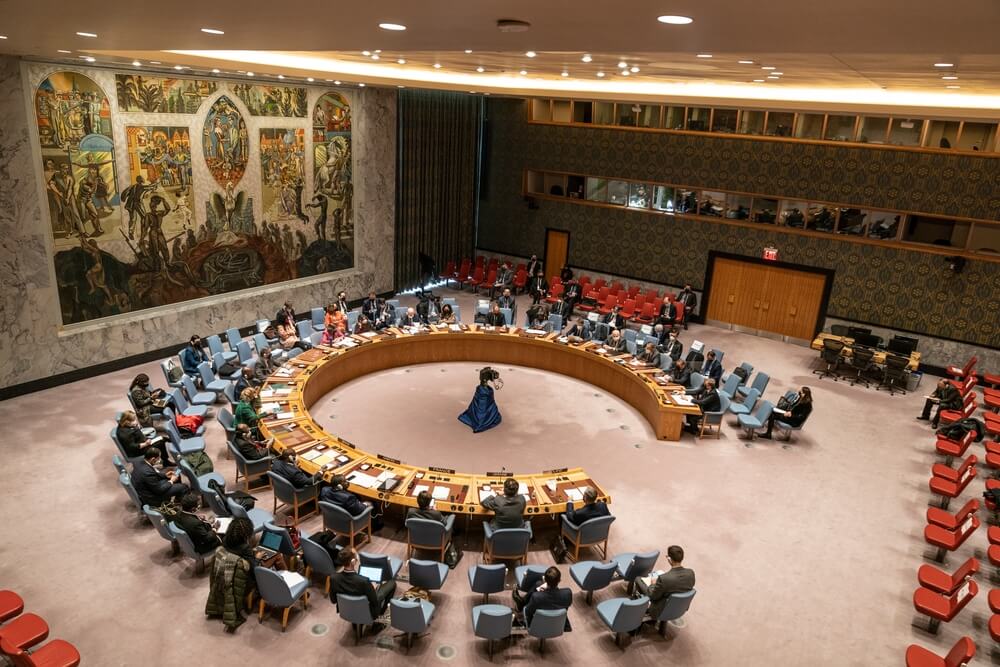 What will happen to the Security Council if the seat is left empty? Nothing
Some may argue that even raising the question is dangerous. Whatever Russia has done, they will say, a nuclear power must remain inside the UN, and a channel of communication must stay open.
But reviewing Russia’s status would neither end diplomacy nor invalidate every Security Council decision adopted with Russia’s participation.
The question is whether diplomacy should continue to rest on a legal fiction.
The General Assembly should do what it failed to do in 1991: formally examine the legality of the Russian Federation’s representation of the former Soviet Union.
The answer need not be predetermined, but the question must finally be raised.
Member states can examine Yeltsin’s letter, the Alma-Ata papers, the practice of state succession, the Charter, the precedents of China and Yugoslavia, and three decades of subsequent practice.
Russia can present its case, others can present theirs, and the General Assembly can vote.
That is how a rules-based international order should work. A nameplate does not confer the right to a seat at the table. The rules do.
Denys Shtilierman, Co-Owner and Chief Designer of Fire Point, is Co-Founder of #unrussiaUN, the initiative group for expelling Russia from the United Nations.
