Although one might be hard-pressed to find similarities between the wars in Ukraine and Iran, Donald Trump’s April Fools’ Day speech from the White House has brought the parallel into sharper focus.
To be sure, Ukraine is a democracy (however imperfect) aspiring to European integration, and posing no threat to its neighbors, whereas Iran is ruled by a murderous regime that has oppressed its population, fostered terrorism, and destabilized the Middle East for decades.
Ukraine and Iran also stand on opposite fronts globally. Iran’s government has supplied drone technology to Russia’s autocratic regime and receives intelligence support in return, and receives funding by selling sanctioned oil to China.
Ukraine, by contrast, receives intelligence support from the United States, as well as money and weapons from Europe and other democracies.
But look past these moral and strategic dimensions, and striking parallels begin to emerge.
The character of the leaders
Chief among them is the character of the leaders who started the wars. Both Trump and Russian President Vladimir Putin miscalculated how the conflict would play out, and each is now struggling to devise some face-saving way to escape the hole he has dug for himself.
Hence, Trump’s recent 15-point American plan for “peace” in the Gulf reads very much like the Kremlin’s 28-point Ukraine “peace” plan concocted last year for Trump’s amateur diplomats, Jared Kushner and Steve Witkoff.
Both documents, as well as Trump’s gibbering April Fools’ Day address, should be taken seriously but not literally. What they signal is an attempt to find a dignified exit.
Neither Ukraine nor Iran is in a hurry to accommodate its enemy by giving it an easy exit
Of course, each overture was swiftly dismissed by the other side. Iran will not renounce its uranium enrichment and ballistic-missile programs, and it remains determined to extract a pound of flesh from Trump by deciding who may and may not transit the Strait of Hormuz, and at what price.
And Ukraine, for understandable reasons, will not simply cede the Donbas region to Putin as a reward for his territorial aggression.
Instead, the Ukrainians remain determined to stand their ground and deter Russia by imposing an extraordinary death toll (now at least four times higher than US losses in Vietnam) on its army.
Neither Ukraine nor Iran is in a hurry to accommodate its enemy by giving it an easy exit, despite heavy bombing from the air.
The mechanics of the two wars
While there is no moral equivalence between Ukraine and Iran, there are intriguing similarities in the mechanics of the two wars.
Both were launched on the basis of wildly optimistic assumptions. Putin expected to take Kyiv within a few days; Russian servicemen were told to bring their parade uniforms for the imminent victory celebration. The Ukrainian government would be replaced by a Kremlin puppet.
Likewise, Trump assumed that Operation Epic Fury would lead immediately to regime change in Iran.
He thought he could shock and awe the ayatollahs and the Iranian Revolutionary Guard Corps into submission simply by assassinating the top leadership.
He, too, thought he could install a puppet—as in Venezuela—to carry out America’s wishes.
Why each aggressor was so catastrophically mistaken
It didn’t take long to see how fanciful both plans were. Ukraine was motivated to remain independent, and far better prepared and armed than in 2014, when it lost Crimea to Russia.
Equally, Iran’s complex, battle-hardened, and fanatical power structure was never going to behave like Venezuela’s ruling clan.
The relevant question is not whether either plan could stand the test of the battlefield (of course they couldn’t). It is why each aggressor was so catastrophically mistaken.
The same kind of mistake in going to war
Why didn’t Trump and Putin understand or anticipate that far smaller armies would respond with asymmetric warfare?
It should have been obvious that a state facing an existential threat would not pull any punches.
Moreover, the two countries under attack knew what to do. For four years, Iran had been supplying drones and drone technologies to Russia, and watching Ukraine perfect the use of aerial and maritime drones to wipe out Russian ships in the Black Sea and destroy Russian oil and gas infrastructure.
The Islamic Revolutionary Guard Corps simply applied the same lessons to Hormuz and the Persian Gulf, thereby taking the global economy hostage and piling pressure on the US.
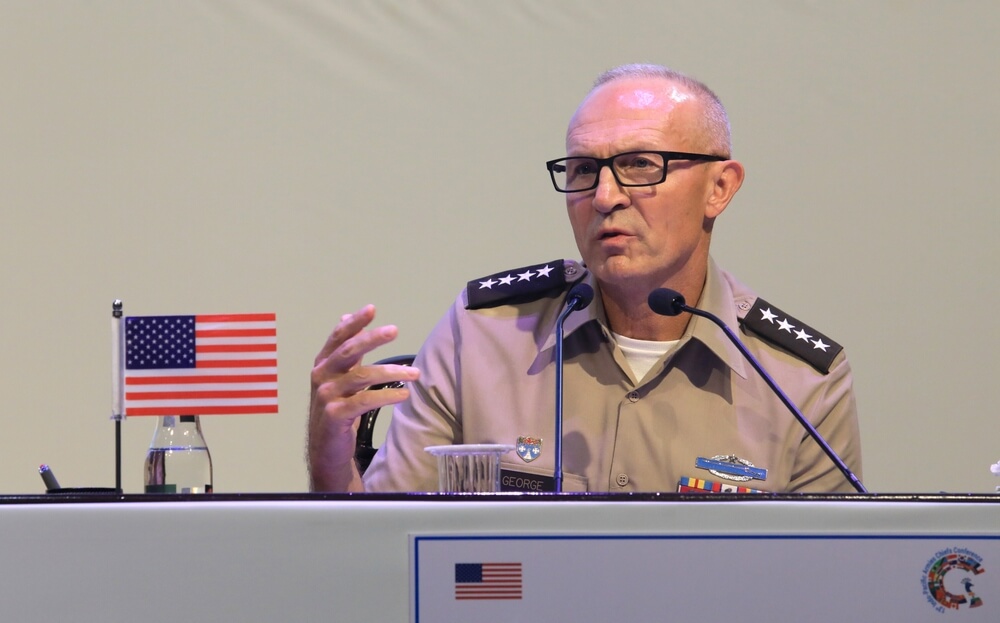 Trump seems to have been caught off guard. He ignored the chairman of the Joint Chiefs of Staff and failed to do the math - Gen. Randy George
Yet Trump seems to have been caught off guard. He ignored the chairman of the Joint Chiefs of Staff and failed to do the math.
Iran probably had ten times more new-generation light drones than the US had old-school interceptors, and the latter would cost ten times as much per unit.
Something similar happened in 2022. Putin and his generals somehow did not anticipate that a long line of tanks and armored vehicles on a single road leading to Kyiv could be easily blocked—and then decimated—by blowing up a single bridge north of the capital.
These disastrous decisions are symptomatic of a deeper pathology. A single person cannot drag an entire country to ruin unless its institutions are already broken.
Trump and Putin both relied on a narrow circle of yes-men and sycophants who would never alert them to the real risks of their actions.
It’s not difficult to see how an aging, isolated dictator in the Kremlin would become blind to reality.
But the fact that a US president can disregard expert advice from his own military and launch a major war without consulting Congress or the American people, much less longtime allies, reveals the depth of America’s institutional dysfunction.
Putin and Trump are different, to be sure. But they do share some personality traits—a lack of empathy, a seamless ability to lie, indifference to right and wrong, vengefulness when faced with unpleasant truths—and they made the same kind of mistake in going to war.
If the war with Iran leads to a global recession, the crisis of American democracy will be the cause.
Federico Fubini is an editor-at-large at Corriere della Sera.
