Chinese President Xi Jinping sent an unmistakably tough message on Taiwan to US President Donald Trump during their recent summit in Beijing.
Xi warned that if the issue was handled poorly, China and the United States would “collide or even clash,” creating an “extremely dangerous situation.” He stressed that Taiwan holds the key to Sino-American relations.
This is a classic example of the bright red lines that Xi has grown fond of drawing in recent years.
In 2022, on the sidelines of a G20 meeting in Bali, he warned US President Joe Biden of four red lines in US-China relations: Taiwan, democracy and human rights, China’s political system, and its right to development.
Thus, in addition to stressing China’s claim over Taiwan, Xi asserted the country’s strict control of Xinjiang, Hong Kong, and Tibet, as well as the Communist Party of China’s political monopoly, while rejecting any US efforts to contain China’s rise.
While Taiwan is always mentioned first in China’s red-line hierarchy, the increased emphasis on it at the Beijing summit was clearly intended to sharpen the distinction between this warning and the others. But the ranking of red lines produces more questions than answers.
Red-line inflation
If China successfully enforces the red line on Taiwan, would that allow the Chinese government to ease its vigilance on the others? If not, what’s the point of differentiating between them?
More than a messaging problem, this is a worrisome form of what I call “red-line inflation.”
To be sure, drawing a red line can be an effective tool of coercive diplomacy, so long as it satisfies four criteria: First, the behavior or action that crosses the line must be clearly defined.
Second, the person or agency determining whether it has been crossed should be specified.
Whoever determines whether the line has been crossed should have the political authority to carry out the stipulated response
Third, the consequences of crossing the line must be severe. Lastly, whoever determines whether the line has been crossed should have the political authority to carry out the stipulated response.
Former US President Barack Obama famously demonstrated how a red line can backfire when he explicitly warned Bashar al-Assad’s Syrian regime in August 2012 against the use of chemical weapons on civilians.
One year later, when evidence confirmed widespread deaths from sarin gas attacks near Damascus, Obama waffled, opting for congressional consultation instead of military action.
Ultimately, the US agreed to a Russian-brokered deal with Syria to dismantle the regime’s chemical-weapons arsenal. Obama’s red line turned into a failed test of US credibility rather than a forceful tool of restraint.
Multiple red lines send mixed signals
Notwithstanding the bombing of Iran as part of “Operation Epic Fury,” Trump’s threats suffer from a similar credibility problem, especially given his so-called TACO penchant for “always chickening out.”
America’s red lines typically pertain to foreign dominance of military-enabling technologies, countering nuclear threats, defending the security of allies, and standing up for democratic values.
Unlike China’s red lines, however, America’s are more loosely defined and often express the country’s aspirations more than concrete achievements.
That can lead to allegations of hypocrisy when the US demands that China respect a red line that its own officials have side-stepped.
Red-line inflation makes compromise on one issue, while remaining unyielding on others, look like surrender
For example, after then-US Secretary of State Antony Blinken made critical comments about China’s human-rights record at a high-level exchange in Anchorage, Alaska, in early 2021, senior Chinese officials called out the US for its own human-rights record in the aftermath of America’s Black Lives Matter protests.
Multiple red lines send mixed signals. Is the country drawing them determined to assert its global power, or is it in the grip of a national paranoia?
Red-line inflation makes compromise on one issue, while remaining unyielding on others, look like surrender.
Claiming a profusion of existential threats may not only weaken credibility, thereby incentivizing adversaries to call a country’s bluff, but may also raise the risk of accidental conflict.
Reducing the space for effective diplomacy
By increasing the number of non-negotiable positions, multiple red lines reduce the space for effective diplomacy, without which leader-to-leader dialogues become all but meaningless.
Focused on threats rather than conflict resolution, China’s red lines tend to concern sovereignty, territorial integrity, regime security, and national rejuvenation.
By contrast, in the pre-Trump era, America’s were related to rules, alliance credibility, deterrence, and non-coercion.
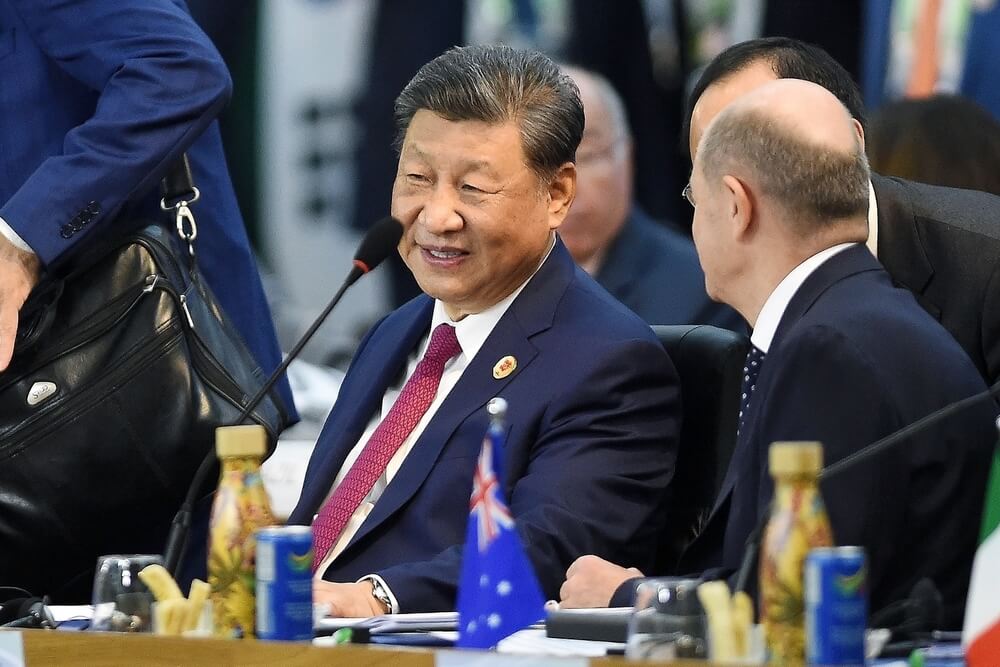 Without conceding any ground on its other perceived existential threats, China has a more serious problem with red-line inflation than the US does - Xi Jinping
As was the case in Anchorage five years ago, these different perspectives often result in the two sides talking past each other—and potentially misinterpreting strong rhetoric as something more dangerous.
Any effort to limit red-line inflation is complicated by an asymmetrical aspect of the problem:
While the US has increasingly emphasized the military threats posed by advanced technology, Xi’s recent blunt remarks in Beijing suggest that China has now gone much further in sharpening its focus on Taiwan.
Without conceding any ground on its other perceived existential threats, China, in my view, has a more serious problem with red-line inflation than the US does.
This phenomenon is at odds with Xi’s emphasis on “constructive strategic stability” at the Beijing summit. If left unaddressed, red-line inflation risks suffocating China’s aspirations to be seen as a responsible steward of global affairs.
Stephen S. Roach is a faculty member at Yale University and former chairman of Morgan Stanley Asia.
