The Vatican rarely enters open conflict with the governments of major powers.
The Roman Catholic Church's institutional memory surpasses that of any modern state, shaping its political reflexes accordingly. That reflex is caution.
Messages are typically formulated in broad, moral, and universal terms. Appeals are addressed to all. The tone is clear, yet it never closes the door to any side.
This pattern is not merely a matter of style but of strategy. In this way, the Vatican preserves its influence for when the time for negotiation arrives.
A firmer tone
In recent weeks, Leo XIV has partially deviated from this pattern. He has not changed doctrine or abandoned Vatican diplomacy, but he has altered his manner of address.
In a series of appearances during March and early April, he adopted a firmer tone regarding the war with Iran. Two actions stand out in particular.
Pope expressed hope that the American president was seeking an "off-ramp" to the conflict
First, on Palm Sunday, he declared that God rejects the prayers of leaders who start conflicts and carry "hands full of blood."
Then, on 31 March, in front of journalists at Castel Gandolfo, he publicly mentioned Donald Trump for the first time and expressed hope that the American president was seeking an "off-ramp" to the conflict.
Reuters rightly described this as a rare direct appeal from a pope to the president of the United States.
The Pope’s “off-ramp” for Washington
This detail is significant. It is not simply that the Pope called for peace – popes do so regularly. What matters is how he did it.
The term "off-ramp" is not the language of a traditional Vatican communiqué; it is the language of the American political and security elite.
Washington immediately recognises it as a call for controlled de-escalation, for an exit that does not appear to be capitulation.
Reuters noted that the Pope himself used an American colloquialism, and Cardinal Blase Cupich explained that Americans and the wider English-speaking world now hear the Pope's message "in an idiom familiar to them".
Leo XIV has deliberately changed his mode of address
This is not a random word; it is a consciously chosen channel.
This is not another Easter appeal with general messages of peace. Leo XIV has deliberately changed his mode of address. He has not altered the Church's position but has adapted the form of the message to those he wishes to influence.
Addressing the faithful and the political elite of the United States is not the same. The former can accept general formulations; the latter requires precision and language that Washington understands without interpretation.
Using an expression such as "off-ramp" is not a matter of style but a deliberate choice of communication channel.
The essence of the Vatican’s change
The Vatican has not abandoned its moral framework, but it has expressed itself in a way that enters the political arena, rather than remaining above it. That is the essence of this change.
Pope confirmed this at Easter. In the Urbi et Orbi message, he did not list the wars by name, which was often part of previous papal international addresses; instead, the message was short, direct, and strong. "Let those who have weapons lay them down! Let those who have the power to unleash wars choose peace."
The failure to list wars was not an omission but a deliberate choice
This speech was not shortened by accident. The failure to list wars was not an omission but a deliberate choice. In this way, he avoided the usual distribution of attention across several crises and shifted the focus to one clear message.
Such a form carries more weight than a broader but diluted address.
A moral challenge
This is not merely a matter of diplomatic tone but of substance. The Pentagon seeks to present the war as morally justified, making a direct appeal to Christian language and legitimacy.
This not only justifies violence but also frames it as part of a broader moral purpose.
The Pope avoided the controversy and did not name anyone. He said only this: God rejects the prayers of leaders who start conflicts. With that statement, he established a clear boundary.
He does not engage in a political discussion about the goals of the war but disputes the right to associate the war with Christian teachings at all.
The views of the American church hierarchy are also significant.
Cardinal Robert McElroy (Washington) openly questions the moral sustainability of war according to the criteria of a just war. This is not a political assessment but a theological judgement.
Archbishop Timothy Broglio (Archbishop of the Military Services USA) expresses a similar view. He goes further: he does not consider the war with Iran to be justified by the same criteria and clearly states that it is difficult to present it as something God could support.
This is an important shift. It does not come from academia or the margins but from the centre of the system that works directly with the military.
Vatican influences public opinion, especially as the war continues longer than promised and begins to affect everyday life
When such a message is delivered to men in uniform, it carries a weight that a theoretical discussion does not.
A broader political issue also arises here. The Vatican has no instruments of force: no army, no sanctions, and no market management.
However, it does influence public opinion, especially as the war continues longer than promised and begins to affect everyday life.
As the conflict enters this phase, the space for political support diminishes. In this context, the Pope's messages do not alter the decisions, but they change how these decisions are justified.
This means one thing: prolonging the war becomes politically more costly.
Morally clear, politically effective
It is precisely here that Leo XIV demonstrates political intelligence that goes beyond merely condemning war. He does not simply offer a moral objection; he also provides a solution.
The word "off-ramp" was therefore an offer to Trump and his entourage showing de-escalation does not have to appear as defeat but as a responsible decision to halt the spiral of violence.
This is what serious diplomacy does when it seeks to remain morally clear yet politically effective.
Leo XIV deviated from the standard Vatican approach
While it may not be entirely accurate to claim a complete precedent in the history of the modern papacy, it is certainly true that Leo XIV deviated from the standard Vatican approach.
For the first ten months of his pontificate, Pope Leo XIV did not publicly mention Trump and then did so precisely when he judged that the Church’s moral authority should be directed towards a specific address.
That is a shift – not in doctrine, but in method.
Not a general appeal
The White House could not ignore it. After the Pope’s remarks about the prayers of those leading the war, White House Press Secretary Karoline Leavitt responded, defending the right of the President and military leadership to call for prayers for the soldiers.
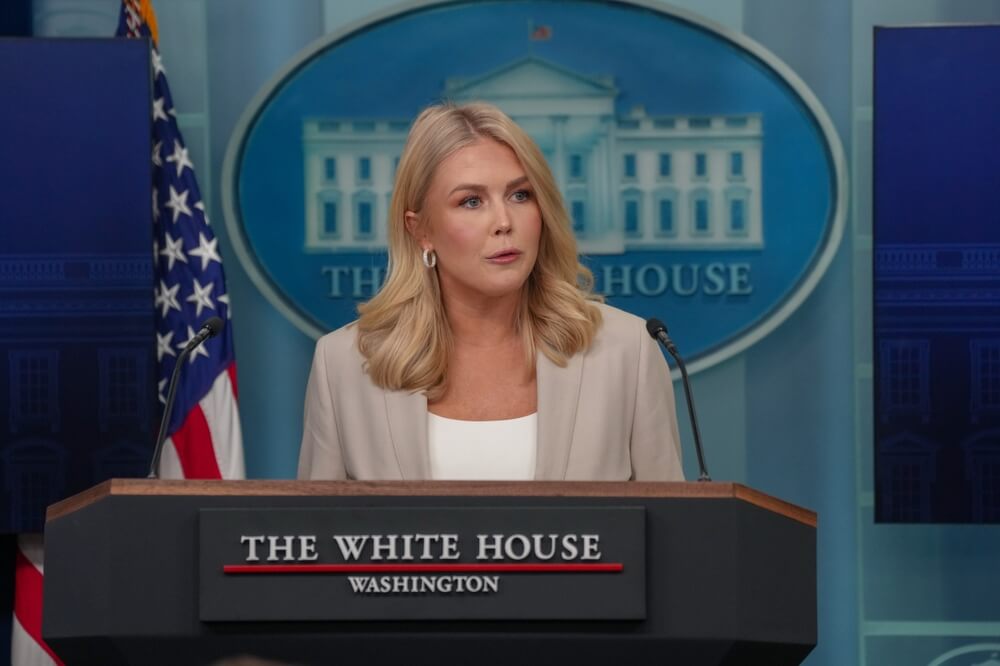 After the Pope’s remarks about the prayers of those leading the war, Karoline Leavitt responded, defending the right of the President and military leadership to call for prayers for the soldiers
The response itself shows how the message was understood. It was not treated as a general appeal but as a position that applied directly to them.
When the Pope speaks in general terms, it is noted and left unanswered. That was not the case here.
Leo XIV will not stop the war. No pope can do so alone. However, he can shape the political landscape, making the prospect of ending the war appear legitimate rather than weak.
If a serious channel for a truce or negotiations emerges in the coming weeks, the Vatican will not be a military or political actor in that process.
It will be something else and perhaps more important: an institution that, over time, has built the moral language of de-escalation and offered a politically acceptable way out to those who do not wish to end the war under the impression of defeat.
Therein lies the real significance of what Leo XIV is doing now. He has not merely condemned the war; he is preparing the ground to end it.
