US President Donald Trump is failing at fascism. This was clear in his State of the Union address, which was full of fascist atmospherics but ultimately painted a picture of an exhausted blowhard.
Trump’s problem is not with the idea of fascism, which suits him well. Fascism celebrates a leader who transcends law and aims to unite the people with their destiny.
It denies truth in favor of grand narratives about the struggle against a chosen enemy. It posits an imaginary golden age. All of that was in his speech.
In this case, the chosen enemy is the “crazy” Democratic Party, which Trump associated with illegal immigration and crime.
As for the chosen victims, the administration is engaged in a sweeping crackdown on immigrants in the United States, terrorizing cities across the country and creating a landscape of domination in the countryside with its huge concentration camps.
The murder of civilians in Minnesota was followed by big lies about the victims.
All of this is awful. But it is also stasis. Trump is unpopular, and the domestic economy is weak. When the government murdered US citizens, protesters were hardly deterred.
Trump needs another kind of conflict
To move beyond competitive authoritarianism to full-blown fascism, Trump needs another kind of conflict: a war that is bloody, popular, and victorious. And that is out of his reach.
Fascism demands a major foreign war to generate a reservoir of meaning that can be used to justify indefinite rule and further repression.
By casting the world as an endless struggle, fascism uses war to make submission to hierarchy seem like the only choice.
Trump senses that he needs such a war, but, characteristically, he wants a shortcut.
In the State of the Union, Trump portrayed Olympic hockey as a major international conflict, with the weird announcement that he would award Connor Hellebuyck, Team USA’s goaltender, the Presidential Medal of Freedom.
After US special forces extracted Nicolás Maduro from Venezuela, Trump compared the action, absurdly, to World War II.
Trump’s problem is that he does not know how to fight a war, leaving him to flounder
To complete the fascist transition, Trump must give America a war it does not want, and then win it.
He has brought the US to the brink of a major war with Iran, but when speaking about preparations in the State of the Union, he looked around hopelessly and waved his hands.
Americans do not want such a war, although that is not exactly Trump’s problem. Germans did not want a war with Poland in 1939, either. But Hitler fought one anyway, quickly winning it.
Trump’s problem is that he does not know how to fight a war, leaving him to flounder.
His administration has abolished the institutions and forsaken the tools required to launch a patient pressure campaign against Iran, which would combine sanctions and promises with demands for freedom of expression and support of civil society.
Two possible scenarios
That leaves only two possible scenarios. In the first, nothing much happens in Iran. Trump forgets about the tens of thousands of murdered protesters he claims to champion.
The US Navy sails away. Maybe some missiles are fired before the ships depart.
Either way, Trump claims an incredible victory, resulting in a miraculous peace. But this will have no effect on domestic politics.
In the other scenario, the US invades Iran. That is the only escalation that could possibly work to advance the fascist transition.
But war is hard, and Trump is incompetent, as are all his advisers. Americans will not be patient.
Perhaps they would change their minds if Trump could explain what he is doing, but he can’t, or if there were a rapid victory, which there won’t be.
The impact of an invasion of Iran on domestic politics would likely be so catastrophic that Trump would not see the end of his term
The impact of an invasion of Iran on domestic politics would likely be so catastrophic that Trump would not see the end of his term, or even the end of this year, as president.
Trump wants it both ways. He wants to be the warlord whom everyone fears, but he also wants to make lots of money.
The word “deal,” which he always uses in the context of Iran, means “we can be bribed” – the only common thread running through US foreign policy under Trump. Trump wants his corruption to be defined as peacemaking that is worthy of a prize.
Consider Trump’s life trajectory. A guy from Queens tries to break rules and make money in real estate so that he will be accepted and admired in Manhattan.
Having failed at that, he moves on to a larger stage, taking a sledgehammer to US institutions and enriching himself, his family, and his friends. But he still wants acclamation and acceptance.
Midterm elections are coming
Trump is therefore stuck. He can break things, but he cannot make things. He can bluster, but he cannot triumph. He is tired, every day is harder than the day before, there are rivals in the wings, and midterm elections are coming.
Before they arrive, Trump has two moves: win a war, which he cannot, or suppress the vote, which he almost certainly will try to do.
But he already failed to steal an election, and there is nothing to suggest that he would not fail again.
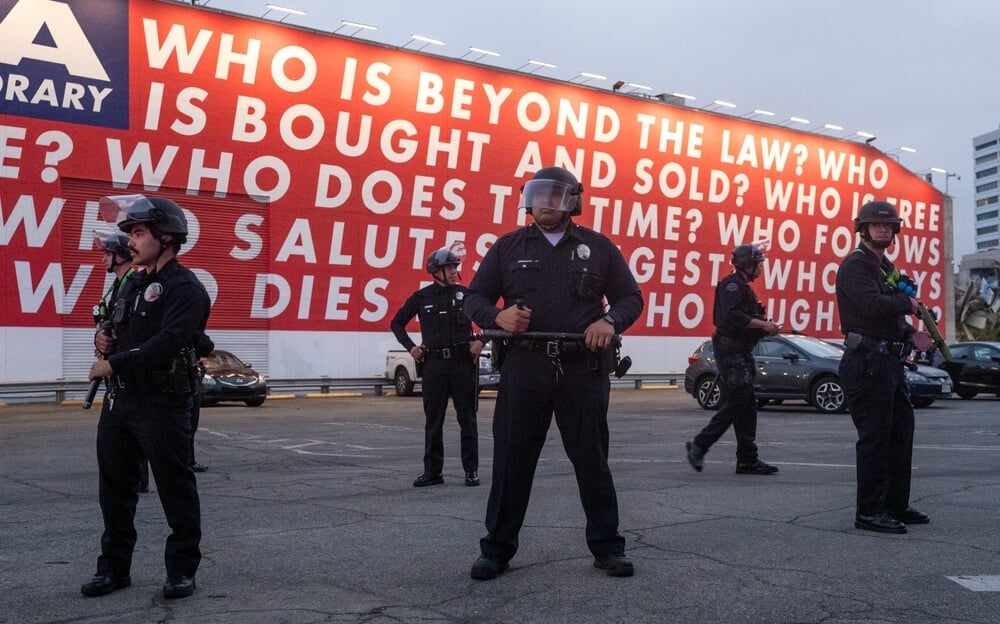 Americans have resisted the move toward fascism: millions of people in protests around the country, including thousands or tens of thousands in cities invaded by federal agents
Trump could try to combine the two, claiming that elections cannot be held because of terrorist threats associated with the war he started in Iran or elsewhere. But if journalists, judges, and others are prepared for this gambit, it will fail.
As for the real state of the union, Americans have resisted the move toward fascism: millions of people in protests around the country, including thousands or tens of thousands in cities invaded by federal agents.
Individual expressions of courage and commitment are everywhere. Even as many major media outlets bend the knee, others do good work, and local reporting keeps the public informed. Civil-society groups make plans and file lawsuits.
Trump has brought the country to a threshold that he cannot cross. But there is no going back to normality. What comes next is unclear.
Fascists remain in positions of authority, and federal institutions continue to implement policies that cannot be reconciled with the rule of law.
There will be more bad news in the next six months, and more moments of courage and organizing.
There will be elections in November, but they will most likely be more challenging than usual.
The opponents of authoritarianism can certainly win, but it will be an uphill struggle that involves building big coalitions and imagining better futures. We cannot go back, but we can do much better.
Timothy Snyder, the inaugural Chair in Modern European History at the Munk School of Global Affairs and Public Policy at the University of Toronto and a permanent fellow at the Institute for Human Sciences in Vienna, is the author or editor of 20 books.
