There’s a lot of not-so-subtle messaging in all the reports stating that the United States has now built up to its largest military presence in the Middle East since the 2003 invasion of Iraq.
The statements read like an incantation against repeating something that went so disastrously wrong.
Iran is not Iraq, and what’s under consideration now is not a full-scale invasion, proponents of an attack might argue. And they’d probably be right: if this intervention goes disastrously wrong, it will do so in its own specific ways.
As always, there are both parallels to and differences with similar crises of the past. Those advocating for an attack on Iran will not look at Iraq; they’ll cite Israel’s success against Hezbollah in 2024 and the joint Israeli-American ostensible successes against Iran in 2025.
At this point, it almost feels prudent to insert one of those bland financial product disclaimers: Past performance does not guarantee future results. But then again, the same might be said for past disasters.
Iran is not Iraq
Iran now and Iraq at the time of the 2003 invasion are indeed two vastly different countries with different types of government, different institutions, militaries, infrastructures and so on. And very different societies and cultures.
Donald Trump and many of his entourage, who are mostly ignorant of the region, often speak as if the Middle East is one undifferentiated and backward religious and tribal mass.
This doesn’t hold up for the core of the Arab Middle East and certainly isn’t true for non-Arab Iran. In many ways, Iran shares more cultural, organisational and structural markers with NATO ally Turkey than with Iraq.
In the context of the current crisis and the attack that is now under consideration, this has several implications.
First, the Iranian armed forces and the various regime militias are unlikely to melt away as the Iraqi army did during the 2003 invasion. Nor is a ‘decapitation’ strike liable to bring about the crumbling of the whole regime.
Unlike the Shiites in Iraq at the time, Iran has no semi-organised, foreign-supported large demographic bloc that can step in to take over the country
In Iraq, the Republican Guard stalwarts of the Baathist regime, complemented with disgruntled former soldiers, quickly morphed into a Sunni resistance, which eventually gave rise to ISIS.
In Iran, which is unlikely to face a similar full-scale invasion, there’s an even stronger likelihood that the Revolutionary Guards and the Basiji militia, among others, remain an organised pro-regime force that will be almost impossible to dislodge.
Unlike the Shiites in Iraq at the time, Iran has no semi-organised, foreign-supported large demographic bloc that can step in to take over the country.
The Kurds in Iran are also in an entirely different position than their Iraqi brethren, who had been de facto autonomous for years at the time of the 2003 invasion.
The wild card in Iran is the regular army, but the regime is also aware of this and has moved to more closely integrate the armed forces command with that of the Revolutionary Guards.
This, however, could also work against the regime, given the underperformance of the Revolutionary Guards’ defences in the 2025 war with Israel.
Why now?
But speculation about the possible consequences of an American and Israeli attack on Iran ignores the intended goal of such an operation.
Here, several interests overlap, not in a dissimilar way from the lead-up to the Iraq invasion. Main among these is the apparent Iranian drive towards acquiring nuclear weapons, however much Tehran denies this. This mirrors the given reason for the Iraq invasion: Saddam Hussein’s supposed chemical weapons programme.
Doubts about the reliability of the intelligence estimating that Iran is on its way to building a nuclear bomb mirror those surrounding Iraq’s chemical warfare capabilities by 2003.
In this context it’s good to recall that Iraq was not fully cooperating with UN inspections by 2003. It is now thought that Baghdad pursued ‘strategic ambiguity’ and deliberately kept alive the suggestion that it might have chemical weapons in order to deter its regional enemies, mainly Israel and Iran.
In Iran’s case, the International Atomic Energy Agency last year, just prior to the Israeli and American attacks on Iran, found the country in “non-compliance with its obligations under its Safeguards Agreement”.
More pertinent is the question about timing: why now?
The Safeguards Agreement is part of the International Nuclear Non-Proliferation Treaty, to which Iran is a signatory, and is intended to make sure its nuclear programme is not geared towards weapons production.
Its high level of uranium enrichment, to degrees and in quantities not needed for a civilian nuclear programme, makes the assumption that Iran is working towards a nuclear weapon seem more solid than outdated estimations of Iraq’s chemical programme at the time.
Other than in Iraq, which had used chemical weapons in the past and was known to have possessed them, Iran has no immediate strategic ambiguity to maintain; it currently is not thought to have a nuclear deterrent.
Still, many observers connect the regime’s insistence on keeping a nuclear programme at a breakout threshold level and also a ballistic missile programme with it maintaining a deterrent posture.
In Iraq’s case, the chemical weapons rationale for a full-scale invasion did not hold up. The question is whether a different type of attack, short of an invasion, on Iran’s nuclear programme is justified.
More pertinent is the question about timing: why now? As in June last year, this moment looks to be mostly one of convenience. This is after putting conspiracy theory-type explanations to one side, such as a distraction from the Epstein files or Netanyahu’s re-election prospects.
The perils of ill-thought-out interventions
The Iranian popular protests as well as the degradation of capacities and the intelligence gleaned during last year’s attacks seem to have convinced American and Israeli leaders they have a window of opportunity.
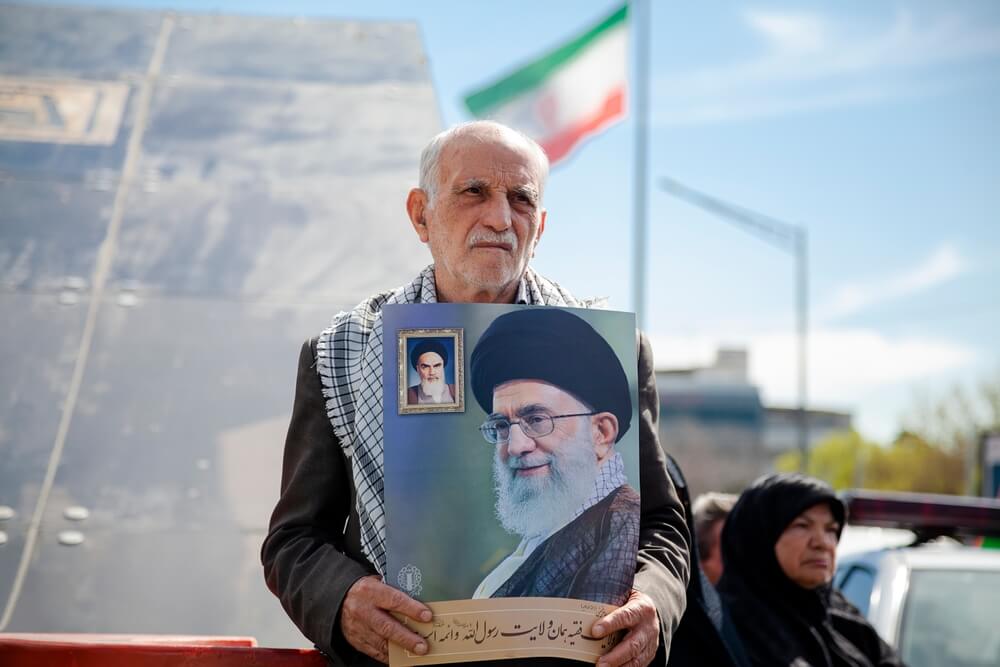 Regime change is not worth the wholesale destruction of a country and the probably inevitable destabilisation of the region in its wake
It is unclear if this in itself would constitute a compelling case without other intelligence not in the public realm, for example, about a covert Iranian acceleration towards building a nuclear weapon in the wake of last year’s attacks.
Another component of the current crisis is the Israeli and American desire for regime change in Iran, shared by many others. And indeed, however much we might recoil from the current Israeli and American leaderships and disagree with their policies, the Iranian regime is nasty, oppressive, and destabilising.
Yet, one of the lessons from Iraq, as well as from the later Arab Spring uprisings, is that you should be careful what you wish for.
Regime change is not worth the wholesale destruction of a country and the probably inevitable destabilisation of the region in its wake.
In Iraq, we saw both the perils of ill-thought-out interventions and the laws of unintended consequences. It should give pause to those rushing to war.
