On January 11, 2026, 1,418 days had passed since the start of Russia’s full-scale invasion of Ukraine. Russia’s full-scale aggression has now equalled in duration the war waged by Nazi Germany against the USSR in 1941–1945.
Russian propaganda frequently employs the slogan “we can repeat it.” Moscow’s media hint that Russians could reach Berlin again, just as Soviet troops did in 1945.
However, the Kremlin consistently distorts historical facts. The Soviet Army was not composed solely of ethnic Russians; it included many other ethnic groups from the former USSR.
Ukrainians at the front were no fewer than Russians. There were three Ukrainian Fronts that, as part of the Soviet Army, entered Europe. On these fronts, Ukrainians made up about 60 per cent of personnel.
The First Ukrainian Front crossed all of Poland and ended its combat path in Berlin.
The Second Ukrainian Front fought in Czechoslovakia and ended its path in Prague.
The Third Ukrainian Front advanced through Romania, Bulgaria, Yugoslavia, and Hungary to Austria.
It operated through Bucharest, Sofia, Belgrade, and Budapest and ended its combat path in Vienna.
More than 20 million Soviet citizens lost their lives during World War II. Nearly 10 million of them were Ukrainians. This is 1.5 million more than the number of Russians killed and the highest toll among all European nations.
Only the Chinese suffered greater losses—15 million—but at that time China’s population was ten times larger than Ukraine’s.
Moreover, Ukrainians suffered even greater demographic losses than Russians. Of the total 27 million demographic losses of the Soviet population, Ukrainian losses amounted to 14.3 million people.
For its enormous contribution to the victory over Nazism, Ukraine received a seat among the 51 founding countries of the United Nations.
Security guarantees
Russians threatened Europe that they could “repeat it.” They did repeat the abuse of people, they repeated fascism, and they repeated almost everything that was worst about the twentieth century.
Since February 2022, Russia has not achieved a single strategic objective in its war against Ukraine.
As of early 2026, the total losses of the Russian army in Ukraine amounted to 1.22 million killed and wounded. The number of those killed alone has already reached 400,000.
During World War II, Stalin ruthlessly sent millions of people to their deaths. Today, Putin is doing the same. Russian fascism—politically defined as “rashism”—now threatens all of Europe. Yet Europe, together with Ukraine, has the capacity to repel Russian aggression.
The “Coalition of the Willing” has stated that NATO countries are ready to provide security guarantees to Ukraine in the postwar period.
Europeans can rely solely on themselves and on Ukraine
In reality, however, Ukraine itself is becoming a security guarantor for European NATO countries.
After the significant reduction of American troops in Europe, it is precisely the Armed Forces of Ukraine that can provide effective support to European states—especially those that may soon face Russian aggression.
This is why accelerated accession of Ukraine to the EU is included in the peace plan to end the war in Ukraine.
Russia could strike again not only against Ukraine but also against one of its neighbouring European countries—Estonia, Latvia, or Lithuania, which were part of the Soviet Union until its collapse in 1991.
A possible attack could also target Finland and Poland, which were part of the Russian Empire until 1917.
The United States has now begun to shy away from providing security guarantees to Europe. Therefore, Europeans can rely solely on themselves and on Ukraine.
Strikes on infrastructure facilities
Meanwhile, Russia continues its aggressive war. On the night of January 9, 2026, the Russian Federation carried out another massive missile attack on Ukraine.
The main strike was directed at Kyiv; explosions were also heard in Lviv and other regions of Ukraine.
With temperatures of minus 10 to minus 17 degrees Celsius, the capital and many Ukrainian cities were left for many days without heating, electricity, or even water. This is yet another war crime by the Kremlin against the Ukrainian civilian population.
The shelling triggered a crisis in Kyiv’s energy and municipal services. The most critical situation concerns heat supply.
Due to strikes on infrastructure facilities, the operation of 30 large boiler plants was halted. As a result, two million residents of the capital were left without heating, electricity, and hot water.
The Lviv region became a target of an attack using the medium-range ballistic weapon “Oreshnik.” The main strike hit the Stryi district.
An underground gas storage facility came under fire—the largest in Ukraine and on the entire continent, and strategically important for all of Europe.
The nature of the explosions and the speed of the target, reaching 13,000 km/h, indicate the use of an “Oreshnik”-type missile.
The Kremlin is attempting to force Western capitals into capitulation and acceptance of Russian terms in future agreements
The use of “Oreshnik” missiles was a direct act of intimidation against Europe.
Moscow is demonstrating its ability to strike strategic targets with hypersonic weapons near NATO borders.
The Kremlin is attempting to force Western capitals into capitulation and acceptance of Russian terms in future agreements.
A deliberate strike on Europe’s largest underground gas storage facility is an attack on the energy security of the entire continent.
Moscow is deliberately striking critical nodes during a period of maximum cold. The Kremlin is trying to turn winter frosts into a weapon of mass destruction.
This proves that Russia views the destruction of civilian infrastructure as a means of achieving political objectives.
While the world discusses “peace plans,” Moscow demonstrates that its only plan is the continuation of destruction and war.
The Russian Federation seeks to undermine the morale of Ukrainians from within, hoping that the absence of light and heat and the constant threat of death will force society to pressure the authorities for “peace at any cost.”
West’s red lines
The attack on Ukraine’s energy infrastructure occurred simultaneously with the strengthening of international controls over the logistics of Russian energy exports.
The American side has begun mass detentions of “shadow fleet” tankers. Moscow is using missile terror as direct retaliation for Western attempts to cut off the channels financing the war.
The Russian Federation is trying to prove that it can inflict energy damage on Europe faster than sanctions can affect the Russian economy. The attack on a region located near NATO borders is Putin’s attempt to test the West’s “red lines.” This is a direct challenge to European leaders. The Kremlin shows that it is ready for escalation directly at the EU’s borders.
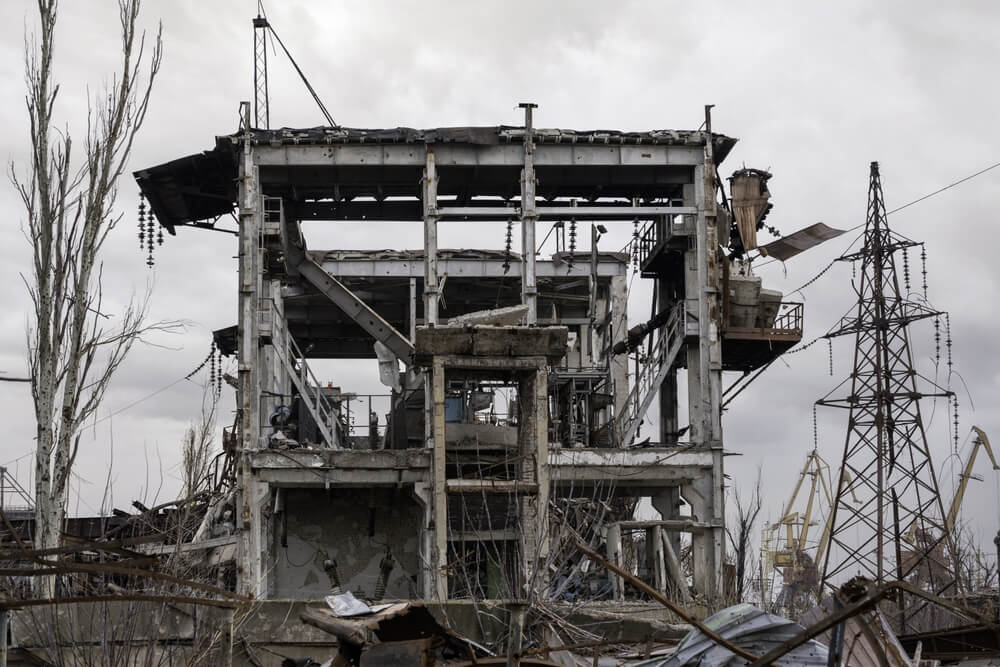 Russia is trying to prove that it can inflict energy damage on Europe faster than sanctions can affect the Russian economy
It seeks to provoke internal divisions between those who call for a decisive response to Russia and those inclined to appease the aggressor out of fear of a major war.
The use of medium-range ballistic systems that enter the upper layers of the atmosphere indicates that Russia is elevating the conflict to the level of a global technological confrontation.
In response to Russia’s aggressive actions, the United States, together with a group of key international partners, agreed to a large-scale support package for Ukraine totalling $100 billion.
A significant portion of the funds will be provided in the form of defence credit.
This will allow Kyiv to procure modern weapons and ammunition on a long-term basis.
In Western capitals, the decision is viewed not only as a financial instrument but also as a clear political signal to Russia of the allies’ readiness to ensure stable military support for Ukraine.
The new financing mechanism enables Ukraine to plan defence procurements several years ahead and accelerate the delivery of critically important air defence systems and missile complexes.
The package includes both direct loans and guarantees that open access to broader arms markets, helping to avoid supply delays.
In Washington, officials emphasise that the decision was made amid growing threats from Russia and will strengthen Ukraine’s defence capabilities during a period of active hostilities.
Partners stress that supporting Kyiv is an investment in Europe’s security and in deterring further aggression.
The $100 billion package may become one of the most powerful instruments of long-term deterrence against the Kremlin.
It demonstrates that the West is ready to act in a coordinated and systematic manner, regardless of political cycles. In Kyiv, there are expectations that the new programme will significantly accelerate the receipt of weapons and strengthen defence capabilities in the coming months.
Oleksandr Levchenko, a former Ukrainian diplomat, is a professor at the State University (Kyiv) and a member of the Academy of Geopolitics and Geostrategy (Kyiv).
