Iranian Foreign Minister Abbas Araghchi proposed reopening the Strait of Hormuz within two days if the United States accepts Tehran’s terms. He explained that Washington would implement the agreed measures on the first day, and Iran would restore navigation on the second.
At the end of September, Tehran proposed reopening the strait within seven days, but President Donald Trump rejected the plan. Iran then, through Qatari mediation, shortened the deadline to two days.
Iran is seeking the lifting of the blockade of its ports and new sanctions, the restoration of earlier exemptions for oil exports, the release of frozen funds, a reduction in the US military presence and a cessation of hostilities in the region.
Talks mediated by Qatar resumed on 1 November without a final agreement, while Iran’s nuclear programme is scheduled to be negotiated later.
Iran is demanding recognition of the route it discussed with Oman and the closure of others, including the southern passage through which its neighbours maintain exports. Among the terms of the September offer that were made public, there was no explicit request to close other routes.
According to data from the energy trade monitoring company Kpler, at least 16.5 million barrels of crude oil per day were exported from Gulf states, excluding Iran, in September, roughly the same volume as before the war, using the same methodology.
The International Energy Agency estimates production at 13.9 million barrels per day for the same month, slightly more than three-quarters of the pre-war level, according to a separate calculation.
Kpler estimates that about 40 per cent of exports bypassed the strait via pipelines, while the remaining 60 per cent, approximately 9.9 million barrels per day, passed through it. The recovery in exports, despite high costs and risks, reduces the value of Iran’s pledge to allow passage.
Negotiations on the security of navigation must not grant Iran a permanent right to decide which ships may pass through an international strait.
Removing mines, exchanging hazard data and fostering cooperation among coastal states are necessary to make navigation safe for all ships again, and such cooperation does not require a single state to decide on the passage of others.
Recognising unilateral control would also enable Tehran to make international trade conditional on political concessions during future crises.
The strait is closed to normal trade, but ships still pass through
Following the April ceasefire, the US and Iran signed a memorandum of understanding in Islamabad on 17 June, but it collapsed and expired on 17 August without extension. US air strikes ceased in early September, but the blockade of Iranian ports remains in place, and attacks on merchant shipping continue.
The strait is considered closed to normal safe navigation because many shipowners and insurers refuse to accept the risk. Other ships transit with special protective measures and significantly higher costs.
On 30 October, the Revolutionary Guards, the Iranian regime’s elite military and security organisation, claimed that four tankers had been hit on what Tehran calls off-limits routes.
By that date, the International Maritime Organization had recorded 122 confirmed incidents in Hormuz and the wider region, and 24 dead seafarers.
The usual shipping corridors through the narrowest part of the strait mostly pass through Omani waters, but their use is now not recommended because of the danger from mines.
In April, Iran established a route closer to its island of Larak, while tankers under the protection of US forces used the southern passage along Oman.
At the end of June, the International Maritime Organization initiated the evacuation of ships in the Gulf via a temporary northern route along the Iranian coast and a southern route along the Omani coast, with each coastal state responsible for the safety of its section. By early July, 136 ships carrying about 2,900 sailors had been recovered.
Accepting Iran’s request to determine all permitted routes would create the possibility of permanently restricting freedom of navigation
The Secretary-General of the organisation, Arsenio Domínguez, then suspended the evacuation because the safety of the ships and crews could no longer be guaranteed, after three ships had been hit in the southern corridor.
In June, Oman supported free passage without transit fees, and in August it discussed demining and a joint temporary corridor with Iran.
In mid-August, the Iranian Ministry of Foreign Affairs announced that an agreement in principle had been reached on the route by which ships would enter the Gulf along the Iranian coast and exit along the Omani coast.
On 17 August, Trump threatened to bomb Oman if it ‘got in the way’, at a time when Muscat was discussing joint route management with Tehran. Muscat has announced consultations with other Gulf states, and its statements contain no agreement for Tehran to close other routes unilaterally.
The UN Convention on the Law of the Sea provides for transit passage through international straits that coastal states cannot unilaterally suspend. Iran signed the convention but has not ratified it, while the US maintains that the right of such passage also applies as customary international law.
Accepting Iran’s request to determine all permitted routes would create the possibility of permanently restricting freedom of navigation.
The oil pipelines have restored some freedom of choice to exporters
The Saudi East–West pipeline transports oil from fields in the east of the country across the Arabian Peninsula to the port of Yanbu on the Saudi Red Sea coast. It is about 1,200 kilometres long.
The Emirati pipeline runs to the port of Fujairah on the east coast, on the Gulf of Oman, outside the Strait of Hormuz. Both routes allow exports without passing through the Strait.
In September, according to Kpler, about 23 per cent of crude oil exports from the Gulf, excluding Iran, departed from ports on the Gulf of Oman and another 17 per cent from the Red Sea. Before the war, these routes together carried about 17 per cent of exports, and the oil pipelines did not operate at full capacity.
According to the International Energy Agency, in addition to the oil they were already transporting, they could carry between 3.5 and 5.5 million barrels per day, while around 20 million barrels of oil and oil derivatives passed through Hormuz every day.
The 11 September drone attack temporarily halted the Saudi East–West pipeline
Oil pipelines could, at most, handle a quarter of the traffic through the strait. Since their share of exports has more than doubled, most of that spare capacity is probably now used, so any further growth in exports would have to go by ship through the strait.
The 11 September drone attack temporarily halted the Saudi East–West pipeline. Saudi Arabia said the drones had been launched from Iraq.
The office of the Iraqi Prime Minister confirmed this following an investigation and dismissed the military commander in charge of operations in Maysan province, in the south of the country, from where the attack was launched.
The perpetrators have not been publicly identified. While the pipeline was down, Saudi Arabia loaded more oil onto tankers at its Persian Gulf ports, which then had to pass through the strait, and exports via Yanbu resumed in late September.
When one route is disrupted, Saudi Arabia can divert part of its exports to another. Both routes, however, remain vulnerable to attack: the oil pipeline to drones launched from land, and the tankers to assaults in the strait.
Manufacturers undertake work that other shipowners avoid
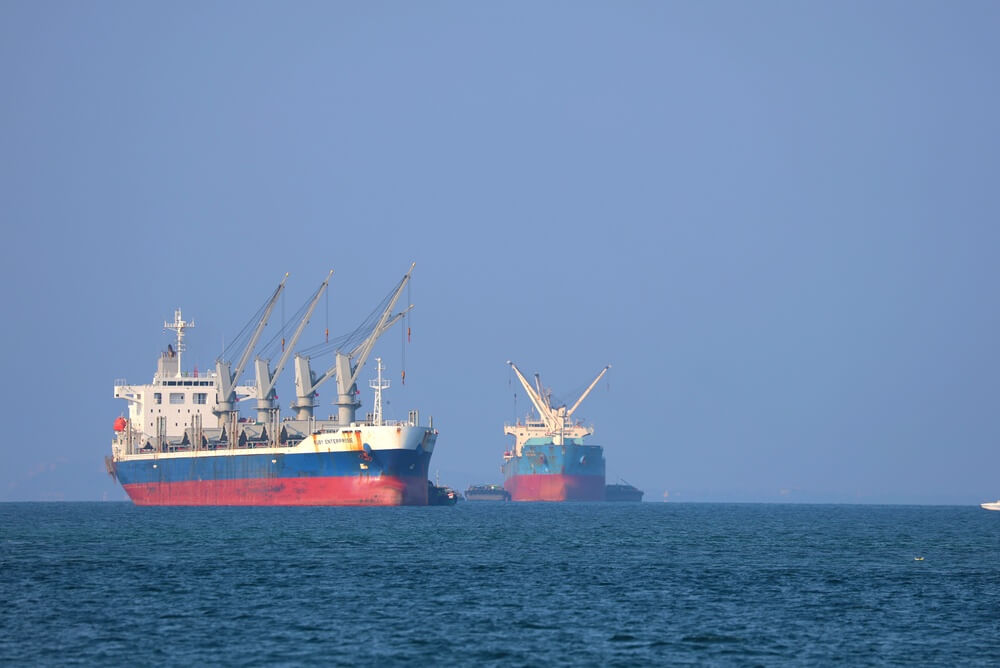
Maritime analytics firm Windward has identified a network of approximately 230 tankers owned, chartered, or controlled by Gulf producers and their partners. These ships transport oil from the Persian Gulf to the coasts of Oman or the Emirates, where they transfer it to tankers whose owners avoid the most dangerous stretch.
 In October, loadings reached about 11 million barrels per day, roughly three-quarters of the 14.5 million recorded before the war
Kpler estimates that in August more than 70 per cent of the crude oil that passed through the strait was transhipped to other ships in Fujairah or Sohar.
Terminals in the Persian Gulf, from which oil must pass through the strait to reach customers, loaded just 1.56 million barrels of crude a day in May, excluding Iran, according to data from Vortexa, cited by Windward.
In October, loadings reached about 11 million barrels per day, roughly three-quarters of the 14.5 million recorded before the war. These figures are lower than Kpler’s because they exclude oil exported via pipelines through Yanbu and Fujairah.
Four-fifths of the network of about 230 ships consists of supertankers, the largest vessels for transporting oil, each of which carries about 2 million barrels, and at certain times between 15 and 20 per cent of all the supertankers in the world were engaged in these shipments.
The return of quantities does not eliminate the cost of the war
According to the International Energy Agency, transporting a barrel of oil by supertanker from the Gulf to Asia in late October cost more than $37, five times the pre-war figure. For the full cargo of one supertanker, this amounts to over $74 million, compared with less than $15 million before the war.
Transport is also more expensive because of transhipment: cargo is transferred from one ship to another in Oman, so each delivery takes longer and requires two ships instead of one. As a result of these costs, some Asian refineries have begun losing money on processing oil from the Middle East.
Qatar also has a practical role in any possible deal because about $6 billion of frozen Iranian funds is held in its banks
For liquefied natural gas, the options for adjustment are even more limited. In 2025, more than 112 billion cubic metres of liquefied natural gas, almost one fifth of world trade, passed through Hormuz.
Qatar does not have a pipeline to export gas that bypasses the strait, and gas is transported exclusively by specialised ships, so Doha has a strong economic interest in restoring safe navigation as quickly as possible.
Qatar also has a practical role in any possible deal because about $6 billion of frozen Iranian funds is held in its banks, transferred in 2023 from South Korea as part of a prisoner exchange with the US. The release of that money is one of the conditions set by Tehran.
Sanctions complicate renewed trade
There is a shortage of ships to transport oil from the Gulf, so the Gulf states are asking Washington for permission to charter certain tankers under US sanctions for the lawful export of their oil.
These are ships that previously transported Iranian or Russian oil and concealed its origin to circumvent sanctions.
According to the maritime intelligence service Lloyd's List Intelligence, about 45 tankers and gas carriers that previously transported Iranian or Russian oil and gas in the same way are now carrying cargo in lawful trade.
Those ships were not on the US sanctions list, so they did not require special approval, whereas sanctioned ships do.
Any decision on tankers that have carried Iranian or Russian oil for years would be far more sensitive
The current practice of the US Treasury Department does not provide a clear answer. On 8 October, the department imposed sanctions on a further 17 ships connected to Iranian exports and, on the same day, removed from the list two container ships that had changed ownership.
Any decision on tankers that have carried Iranian or Russian oil for years would be far more sensitive. Washington should help the Gulf states maintain exports, but with safeguards that prevent sanctioned oil from re-entering lawful trade under cover of those permits.
Negotiations will also be shaped by the risk of new strikes
The US administration has warned governments in the region that, after the 3 November congressional elections, there could be new strikes on Iran and that Iran could retaliate by attacking its neighbours’ energy facilities.
Trump had not yet decided on the strikes, and on 31 October he said that the talks were going well, but that he did not trust the Iranian authorities and that Washington was not in a hurry to reach an agreement.
 Washington should reject any agreement that grants Tehran a permanent right to close maritime routes through the strait by political decision
In the event of renewed conflict, the routes through which the Gulf states have restored their exports, the pipelines to Yanbu and Fujairah, the locations where oil is transhipped near Oman, and Qatar’s gas facilities could all come under attack.
Before such a decision, a comprehensive agreement is unlikely. If Washington abandons the strikes, mediators are most likely, in the coming weeks, to reach a limited agreement on safe routes, mine clearance and cooperation between Iran and Oman, while the nuclear programme is left for later negotiations.
The negotiating positions are not equal, because Iran cannot restore its oil exports without lifting the blockade, whereas its neighbours have largely already restored theirs and expect from the opening of the strait chiefly cheaper and safer transport, as well as relief for the export of gas and oil derivatives, which are far more difficult to redirect.
Washington should reject any agreement that grants Tehran a permanent right to close maritime routes through the strait by political decision. Genuine security will only be assured when independent shipowners and insurers once again send ships through Hormuz without military escorts and transport costs begin to fall.
A new escalation could damage the ports and pipelines on which the Gulf states now rely, eroding the advantage they have gained in these negotiations. The right of passage through an international strait must remain separate from any agreement on sanctions, blockades or other concessions in this war.
