It can take generations to build a reputation for reliability – and a matter of weeks to destroy it.
That asymmetry is the most important strategic fact of the current US-Israeli war against Iran.
This conflict’s most harmful consequence will figure in no damage assessment, and no postwar reconstruction fund will be able to repair it.
What is being degraded is the premise that the Gulf is a reliable place to conduct the world’s business.
Iran understands this. It is not trying to defeat the Gulf militarily. It is trying to make it too risky to insure, making business there untenable.
The Iranian regime has identified its adversaries’ specific vulnerability and is exploiting it.
The Gulf monarchies are not primarily military powers. Their security has rested on something subtler: the construction of indispensability.
If enough sovereign wealth funds, LNG buyers, international banks, and expatriate professionals have deeply embedded interests in Dubai and Doha, then attacking those cities imposes costs on a wide range of actors far beyond any formal alliance.
The financial system does the work of mines and missiles
Iran has found the flaw in that logic. You do not need to destroy the Gulf to destroy its development model.
You need only to make it impossible to insure. The Strait of Hormuz does not have to be closed militarily to be shut down commercially.
When insurers can no longer model risk – when war-risk premiums become prohibitive, when navigation cannot be reliably guaranteed, when shipping companies cannot guarantee the safety of their crews – the financial system does the work of mines and missiles.
In this case, war-risk coverage technically remains available for strait transits. But ship masters are declining to transit regardless, which means the commercial closure operates through their own judgment rather than through the formal insurance market.
Iran is blockading the Strait by manufacturing uncertainty. That is cheaper than destruction, and more durable
Iran is blockading the Strait by manufacturing uncertainty. That is cheaper than destruction, and more durable – a logic already visible in recent strikes on Gulf energy infrastructure.
A single successful transit, as the CEO of one of the world’s largest shipping companies recently observed, does not establish security.
What markets price is expected volatility, not current conditions – whether tomorrow’s risks can be bounded, not whether ships get through today.
Desalination-dependent societies
The Gulf states are among the world’s most desalination-dependent societies. Their cities – including the expatriate populations that underpin their economies – cannot function without continuous desalination from coastal plants. Water reserves are measured in days, not weeks.
The Gulf is also an unusually fragile maritime environment: shallow, enclosed, and slow to flush contaminants.
A significant oil spill would not disperse quickly. Desalination systems cannot operate under heavy hydrocarbon contamination.
If oil were drawn into intake systems, desalination plants could be forced offline within hours
If oil were drawn into intake systems, desalination plants could be forced offline within hours, cutting potable water to urban populations across the region. The precise threshold at which disruption would trigger commercial withdrawal is unknowable, but markets do not wait for certainty.
Iran does not need to execute such a catastrophe to weaponize it. The credible possibility is enough. Insurance markets price the distribution of risk, not only realized events.
Once the vulnerability of Gulf desalination becomes a standard variable in risk assessment (as this conflict is fast ensuring), the calculus shifts in ways that are difficult to reverse.
Unlike Ras Laffan, which can be physically rebuilt over years, a reputation for existential water vulnerability can be repaired only by a comprehensive transformation of the regional security environment. Nothing suggests that is coming.
Manufacturing the uncertainty
This is the trap Iran has constructed: not the capacity to destroy the Gulf states, but the capacity to render them uninsurable as a category – too exposed, too dependent on a single irreplaceable water source, too vulnerable to risks they cannot control.
Targeting the Gulf is also a way of targeting the United States. The implicit theory is familiar from the history of asymmetric conflict: raise the costs imposed on US partners, demonstrate the limits of US protection, and erode the political sustainability of US engagement until it becomes more expensive than withdrawal.
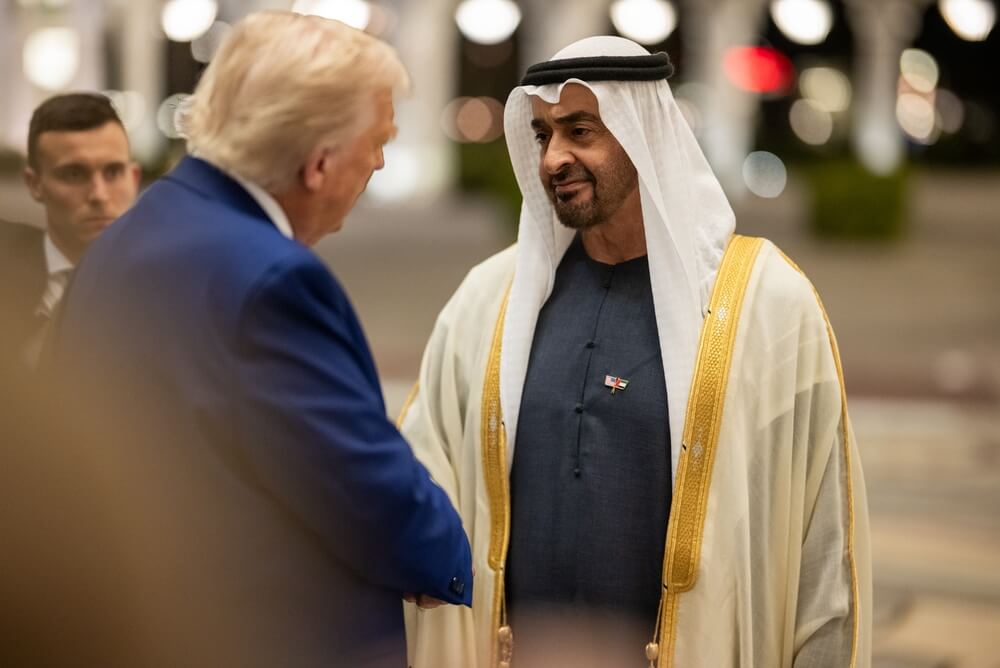 What the Gulf states failed to foresee was that the US would attack Iran without regard to their defense - Donald Trump, Mohamed bin Zayed Al Nahyan
The Gulf’s security model depended not only on US protection, but on the belief that such protection was structurally anchored – driven by deep mutual interests rather than contingent political calculation.
What made the Gulf hard to abandon was the same thing that made it hard to attack: indispensability.
Enough powerful actors, the US included, had embedded themselves so thoroughly in Gulf stability that its defense had ceased to be a choice and become something closer to a necessity.
Iran is now attacking that premise from the outside, by manufacturing the uncertainty that weakens the case for deep engagement, while US President Donald Trump is eroding it from within.
What the Gulf states failed to foresee was that the US would attack Iran without regard to their defense – and that America might end up destroying the very allies it had promised to protect.
Stephen Holmes is a Professor of Law at New York University School of Law and a Berlin Prize Fellow at the American Academy in Berlin.
