The US military build-up in the region had been ongoing for weeks. Aircraft carriers, escort battle groups, strategic bombers and logistics units were deployed openly, with no attempt at concealment. The Israeli Air Force was also put on high alert during this period.
The US-Israel strike on Iran was the expected outcome of this process, not a sudden escalation. The question was never whether there would be a strike, but when and with what objectives.
Immediately after President Trump’s statement that he would not attack Iran, we published a reasoned analysis in which we clearly stated that the US would attack Iran.
This operation therefore exhibits the characteristics of a pre-planned campaign, featuring a defined internal logic, specific objectives, and a clear vision of the reality to be established on the ground before allowing for political messaging.
In this respect, the mere fact that the strikes began is not the most important aspect. Far more important is how they began, in what sequence, with what intensity and with what intention.
The key feature of this operation is not its visibility but its structure. All indications suggest that this is not a one-off strike aimed at symbolic intimidation or a short-term delay of Iranian capabilities, but a complex, phased campaign designed to systematically weaken the state’s ability to manage its own security, military and strategic instruments.
Such an approach requires careful timing, pace control, and the ability to constantly adjust based on actual effects on the ground rather than assumptions.
Disrupting the ability to see, communicate, and react
In military terms, this operation relies on a model in which strikes are conducted in clearly separated waves, with results assessed between each phase.
In practice, this means not pre-emptively striking the entire range of targets but first dismantling the elements that enable the adversary to see, communicate, and react. Only then does the operation proceed to the deeper layers of the system.
This approach is not intended for public effect or visual impression; it is focused on practical results. The essence is to disrupt the adversary's ability to command, coordinate, and make decisions in real time.
A choice of targets indicates an intention to weaken the system's ability to react as a whole, not merely to eliminate one segment of its capabilities
Impairing that capacity leads to a slow, uncoordinated, and limited military response, irrespective of the nominal size of available forces. For this reason, the choice of objectives carries particular weight.
The strikes are not aimed exclusively at nuclear facilities, nor solely at missile capabilities. The targets are the nodes through which the state's internal coordination passes, including the commands of the armed forces, internal security structures, and key infrastructure points that enable the rapid movement of people and assets.
Such a choice of targets indicates an intention to weaken the system's ability to react as a whole, not merely to eliminate one segment of its capabilities.
Formal continuity, internal disruption
In the case of nuclear facilities, the aim of the strike is to halt their operation. When key technical systems are disabled, production and research processes cease.
At that point, the facility no longer has military value, regardless of the condition of the buildings themselves. This means disabling the power supply, control, cooling, ventilation, logistics, and command systems, without which even the most protected facility cannot function.
This approach produces a concrete result: the programme is halted for an extended period, while at the same time there is scope to keep the conflict under control and avoid pushing it towards complete and uncontrolled escalation.
The most significant element of this campaign is not related to the nuclear programme but to the issue of command cohesion
However, the most significant element of this campaign is not related to the nuclear programme but to the issue of command cohesion.
Simultaneous pressure on the political elite, military hierarchy, and internal security apparatus leads to a state of fragmented and chaotic decision-making.
This may not be immediately visible from the outside. Institutions can formally continue to function, statements can be issued, and symbols of government can remain intact.
But the internal dynamics are changing. Parallel centres of power, local initiatives, and autonomous decisions emerge, often lacking coordination, in place of a single chain of decision-making.
In such an environment, the risk of unexpected reactions increases, even if the political message from the centre remains calm.
Asymmetric responses under pressure
This is precisely why it is wrong to assume that such a campaign will automatically lead to a rapid collapse or capitulation. On the contrary, historical experience shows that systems under pressure often develop asymmetric response capabilities.
In recent years, Iran has significantly expanded and dispersed its missile and drone capabilities. Despite striking a large number of launch sites, some inventory remains mobile, hidden, or reserved for future use.
This capability does not need to be activated immediately. Its mere existence forces the attacker to consider the possibility of retaliation in every subsequent move, the timing of which cannot be controlled.
The essential question is not whether Iran can respond, but what response is sensible under the circumstances.
A complete and uncontrolled escalation would not be rational, as it would open the way for a regional war, the consequences of which Tehran cannot control. Equally, the absence of a response would mean a loss of deterrence, which would be just as dangerous in the long run.
Every misinterpreted move, every overreaction, or every internal division can have consequences that extend beyond the original objectives of the campaign
Between these two extremes, there is scope for limited, selective, and politically calibrated reactions, the aim of which is not military victory but the restoration of the balance of fear.
In this respect, the most dangerous part of this crisis is not the initial strike but the subsequent phase. This is a period in which both sides attempt to retain the initiative while simultaneously avoiding any action that would eliminate all options.
Managing this phase requires exceptional discipline, clear internal communication, and the ability to distinguish genuine signals from the noise that inevitably accompanies such conflicts.
Every misinterpreted move, every overreaction, or every internal division can have consequences that extend beyond the original objectives of the campaign.
Beyond monitoring and agreements
This strike occurs at a time when the international system for controlling nuclear programmes has already been seriously weakened.
Monitoring and verification mechanisms no longer provide a reliable picture, which has greatly expanded the political space for military action. When inspections fail to provide a reliable assessment, political decisions rely on estimates rather than facts.
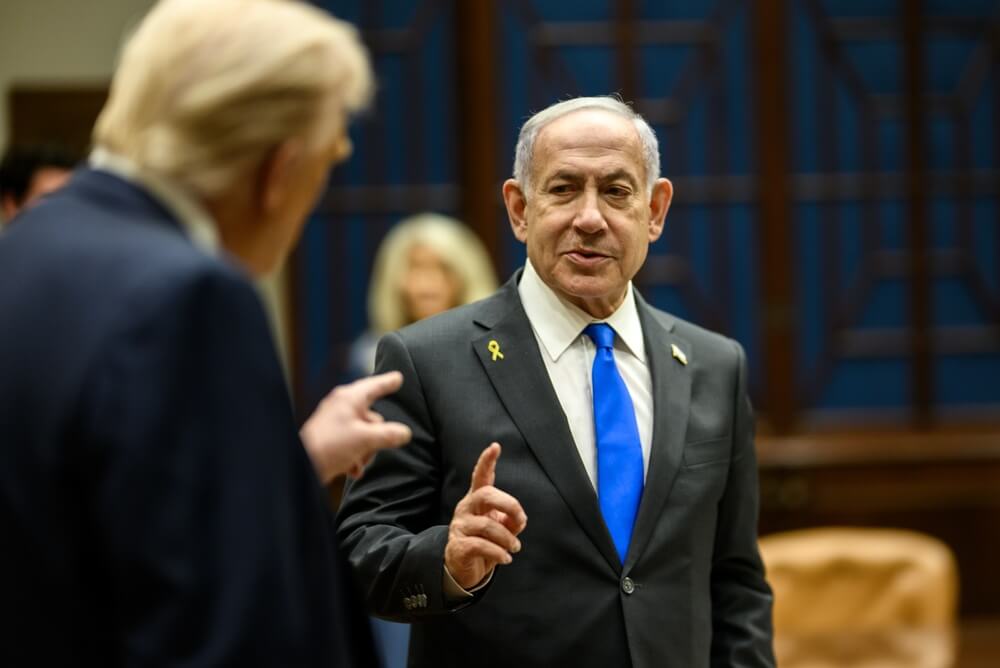 This is neither the beginning of a war which will decide everything nor the end of a crisis - Donald Trump with Benjamin Netanyahu
This creates an environment in which military force becomes a tool for resolving uncertainty. Such a precedent has implications that extend beyond Iran.
It signals that problems once addressed through monitoring and agreements are now being resolved by strikes and phased campaigns.
If a sober forecast is required, it does not point towards a swift resolution. A more realistic scenario involves a prolonged period of pressure, occasional strikes, political signals conveyed through military actions, and constant testing of red lines.
Neither side is interested in total war, but both are keen to demonstrate that they have not lost control of the situation. It is precisely in this space between control and escalation that the greatest risk lies.
What distinguishes this operation from many previous ones is its nature. It is not intended to send a message in a single day but to alter the structure of opportunities over the coming months.
Its success will not be measured by the number of targets struck but by whether the opponent’s room for manoeuvre is permanently reduced and a new framework is established in which their options are narrower than before the strike.
It is a lengthy process, with an uncertain outcome and a cost that has yet to be fully revealed.
In this respect, this is neither the beginning of a “war which will decide everything” nor the end of a crisis. It marks the entry into a new phase in which military force is used as an instrument for managing uncertainty rather than as a means of final resolution.
Such an approach may yield short-term results, but in the long term it produces a world in which verification is weaker, trust is more fragile, and the threshold for the use of force is lower than before. And therein lies its true significance.
