His favourite bands, his support for Everton FC and his propensity to wear t-shirts seem to have caught most of the attention of Europe’s media when it comes to the UK’s imminent new Prime Minister, Andy Burnham.
As to what the European Union can actually expect from him in terms of relations with the bloc, it’s not so much that nobody knows; very few actually seem to care.
There are various reasons for this, but as one German media report put it, “Since the Brexit referendum in 2016, the office of British Prime Minister has become somewhat precarious.”
Forgive the EU members and ‘Brussels’ for being a bit jaded when it comes to British attitudes towards them; prime ministers have come and gone these past ten years with the regularity of record-breaking heatwaves.
Nobody is getting particularly hot under the collar anymore at the prospect of a new one, especially as it’s still doubtful Burnham will be around for more than a couple of years.
When Keir Starmer came to power just over two years ago, the UK’s European partners might have thought, naively it turns out, that his unassailable majority meant that they now, at last, had an interlocutor for the next four to five years.
The Starmer disappointment
In the event, Starmer disappointed, both in terms of his longevity and in his much-touted but too-little-acted-upon ‘reset’ with the EU.
The heavy lifting of stabilising the acrimonious post-divorce relations between the UK and the EU had been done by his predecessor, Rishi Sunak, who both calmed the rhetoric and stopped the Northern Ireland issue from festering by devising the Windsor Framework.
Starmer followed this up with regulatory alignment deals and fishery concessions that a Conservative PM would, or could, not have delivered.
Critics in the UK might rage against the country becoming a ‘rule-taker’; in Brussels the deal is seen as being dangerously close to the UK being allowed to ‘cherry pick’
While an anti-EU amalgamation of British press and politicians excoriates Starmer for this, not all of it is seen as a win in Brussels.
The fisheries deal was part of the price the UK paid for getting what is widely regarded as preferential treatment; it was allowed to pursue the sort of very partial alignment deals to smooth trade that the EU had vowed no longer to conduct, given the painful experience with Switzerland.
Critics in the UK might rage against the country becoming a ‘rule-taker’; in Brussels the deal is seen as being dangerously close to the UK being allowed to ‘cherry pick’.
Continuing rifts between Britain and the EU
Deadlocks on a range of issues, including the vaunted Youth Mobility Scheme and even the UK’s participation in the EU’s SAFE defence loan fund, further illustrate the continuing rifts between Britain and the EU.
Enter Andy Burnham. He might position himself as the anti-Starmer, but on EU relations, his trajectory closely follows that of his soon-to-be predecessor.
In opposition, Starmer was Labour’s Brexit spokesman and an outspoken remainer. When later the Premiership beckoned, he retreated behind his ‘Ming vase’ strategy of not rocking the Brexit boat and came up with the red lines of ruling out rejoining the EU Single Market or the Customs Union and restoring the free movement of people.
Burnham was pro-re-join until he had to compete for the red wall, Leave-voting northern seat of Makerfield
Similarly, Burnham was pro-re-join until he had to compete for the red wall, Leave-voting northern seat of Makerfield.
During that campaign he said the last thing the UK should now do is “re-run” the Brexit arguments. He added, “I am not proposing that the UK considers rejoining the EU.”
Burnham made out that this was because of the ‘democratic’ Brexit vote that had taken place in 2016 – even though in most countries such momentous decisions are not left to relatively small margins in a non-binding plebiscite.
The same restraints
More recently, Burnham wrote in a manifesto-type op-ed in the Times that he’d “consolidate the progress made” in the existing UK-EU negotiations.
Note the ominous “consolidate” part of the statement and the lack of much ambition he expressed apart from defence cooperation.
None of this is remarkable or very different from how Starmer acted most of his term. Apart, that is, from his final few months when the cabinet’s statements started to identify Brexit as a main source of economic hurt.
Burnham will inevitably run into the exact same restraints as Starmer has
All of a sudden, in May, Starmer floated a ‘Single Market only for goods’ idea that was rebuffed by an EU that neither had a taste for such a major concession nor did it see much good in negotiating with an almost certain lame duck at that point.
So much for consolidating ‘existing’ UK-EU negotiations under a new prime minister.
Burnham will inevitably run into the exact same restraints as Starmer has, with the added difficulty of having even less room for progress, as all the ‘easy’ gains – or logical deals – have by now been made or set in motion.
Starmer already emphasised European defence, which earned him – in a first for a British PM – a French Légion d’honneur.
A mere placeholder
While Burnham’s continued support for Ukraine and for a European pillar in NATO is welcome, it is hardly new by now.
In EU capitals, the UK, while important on defence, is not much thought about anymore. The EU has a lot of other headaches, including competitiveness and reforming its financial markets.
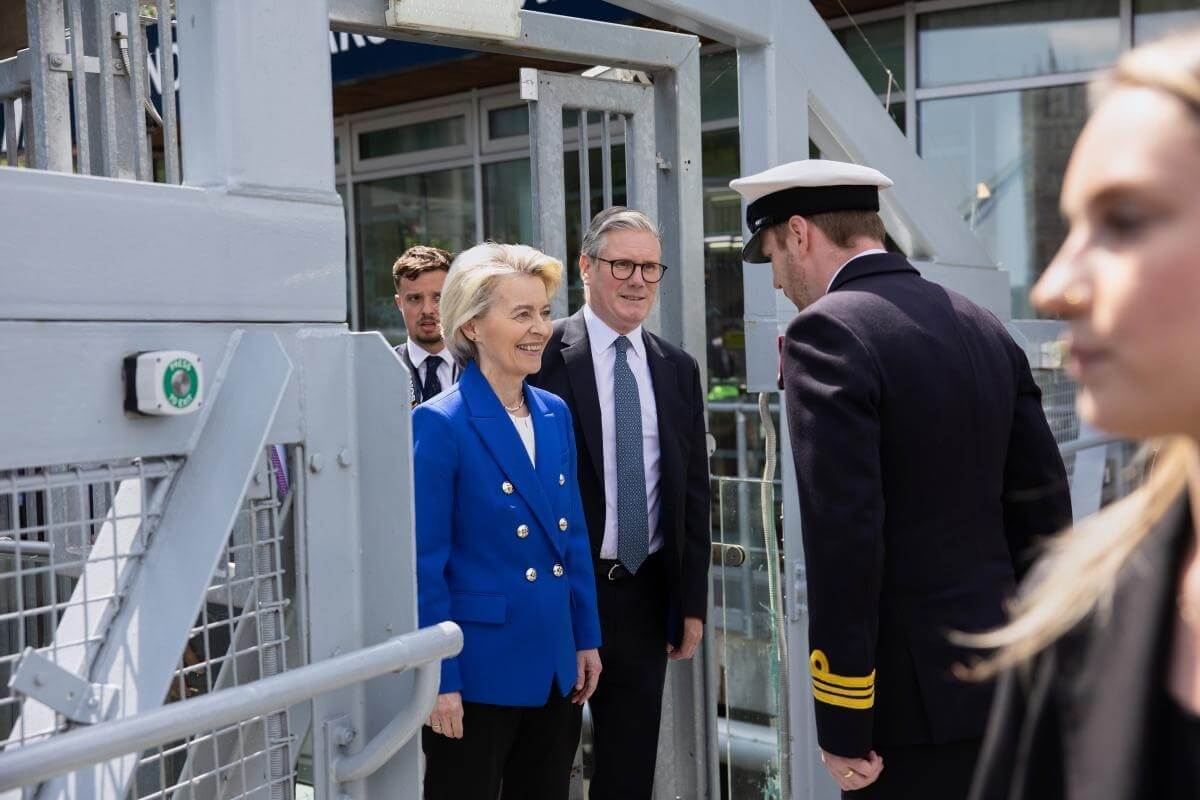 In EU capitals, the UK, while important on defence, is not much thought about anymore. The EU has a lot of other headaches
The latter could, given the position of the City of London, in fact impact the UK and EU-UK relations significantly, although the timeframe on it is so long that other developments might well overtake it.
The sense for now is that very little can be done to remedy the enormous damage that Brexit has done to the fabric of European cooperation, beyond tinkering at the margins.
Institutionally, the relationship has both soured and settled into a new low-level rivalry, not quite antagonistic but not entirely friendly either.
More than likely, the only way to change this will be through the sheer force of will of a visionary new leader. That leader would almost certainly have to be British, as the EU doesn’t do leadership.
Burnham, very clearly, is not that leader. His campaigns for MP, the leadership of Labour and ultimately the post of Prime Minister have been too much characterised by obfuscation, posturing and sloganeering – from Manchesterism to the Makerfield test to “consolidating” UK-EU progress.
When his ‘laser-like focus’ on domestic issues runs into all-too-predictable headwinds and he seeks a break from both his 10 Downing Streets – in London and the North – he might re-engage more seriously on Europe, but that’s not the same as leading on the issue.
While infinitely preferable to any Reform UK Prime Minister who would undoubtedly rekindle the past confrontational phase of the UK-EU relationship, Burnham is, certainly where Europe is concerned, likely to be a mere placeholder.
