European leaders breathed a sigh of relief as US President Donald Trump departed last week’s NATO summit in Ankara, Turkey.
Despite a few unseemly moments in which Trump reiterated his desire to seize Greenland and nonsensically ordered a halt to all trade with Spain, the meeting went off without any major catastrophes.
Most importantly, Trump did not announce any major troop withdrawals from Europe or any moves to leave the alliance.
He even had warm words for Ukrainian President Volodymyr Zelensky, and pledged to grant Ukraine a license to manufacture Patriot air-defense missiles domestically. By the end, even Trump proclaimed that there was “love” in the air.
But optics aside, the summit was an absurd exercise. NATO leaders reveled in their pledges to increase defense-related spending to 5%, even though everyone knows that this arbitrary number means nothing in the absence of deeper discussions about capabilities.The figure was pulled out of thin air last year to appease Trump.
In the months leading up to the summit, the same leaders had worried that Trump would withdraw the United States from the alliance or dramatically reduce its presence in Europe, which would then find itself at the mercy of Vladimir Putin’s Russia.
That is why NATO leaders expended so much energy preparing a summit that would not allow for any unscripted moments.
Fears that the mercurial US president would use the occasion to undermine the alliance were palpable.
When the moment came, European leaders reportedly fell over themselves to praise Trump, with NATO’s secretary general, Mark Rutte, leading the sycophantic charge.
Some commentators believe that saving NATO and keeping the Western alliance alive was worth this self-abasement.
But by kowtowing to Trump and indulgently harking back to the good old days of the transatlantic relationship, Europe’s leaders are risking more than just their dignity.
Eastalgia
Consider the period following the fall of the Berlin Wall. After the initial euphoria, many parts of the former German Democratic Republic (East Germany) were emptied out as their populations left, even as property prices were driven up by an influx of wealthier West Germans.
The result was a wave of nostalgia for a lost world, expressed in films like Good Bye, Lenin!
The term coined to describe this emotion was Ostalgie (“Eastalgia”), and it has shaped German politics and culture for almost 40 years now.
Europe’s problem today is not just that Ostalgie has held back eastern Germany; it is that a new malady, Westalgia, has taken hold
Although many East German writers have criticized such sentimentality for trivializing East Germany’s decades-long repression, some see it as the key to understanding what ails Germany’s eastern regions today.
There one finds a widespread refusal to acknowledge that the world has changed, a habit of free riding, and a tendency—occasionally—to look ridiculous, such as when East Germans parrot Russian talking points on Ukraine.
Ironically, Europe’s problem today is not just that Ostalgie has held back eastern Germany; it is that a new malady, Westalgia, has taken hold. It was on full display in Ankara.
Westalgia
Westalgia has several key features. The first is a refusal to acknowledge that the world has moved on.
By acting as if US security guarantees are still as ironclad as they were under the Ronald Reagan and George H.W. Bush administrations, and by continuing to purchase US weapons, they hope to turn back the clock.
But a better strategy would recognize that America has changed in fundamental ways.
Even if a Democrat moves into the White House in January 2029, US retrenchment will continue.
Those who want to turn back the clock naturally see the past through rose-tinted glasses
Those who want to turn back the clock naturally see the past through rose-tinted glasses, even though elements of the post-Cold War settlement were not to Europe’s advantage.
Specifically, Europe’s hyper-reliance on American power clearly had an infantilizing effect. Even when caught between a predatory Russia, a fickle US, and a coercive China, Europeans are still wont to downplay and underestimate their own power and influence.
The second feature of Westalgia is a tendency to free ride. Just as eastern Germans grew accustomed to the transfer payments and subsidies (the infamous Solidaritätszuschlag, or “solidarity tax”) that flowed eastward after unification, so have Europeans become accustomed to America bankrolling their security.
As a result, Europeans have under-invested, not just in defense but also in their industrial base, technological sovereignty, and energy independence.
Stop selling nostalgia
Instead of complaining that US citizens no longer want to be responsible for defending Europe, and instead of spending billions of dollars to satisfy Trump’s vanity, Europeans would be better off having a serious conversation about how they could fight a high-intensity conflict on their own, if necessary.
Instead of spending an arbitrary share of their GDP on defense, they should critically evaluate their capability gaps and adjust their spending to match their needs.
Coffers are tight everywhere, but it will be easier to justify expenditures on weapons if they appear less geared toward flattering Trump.
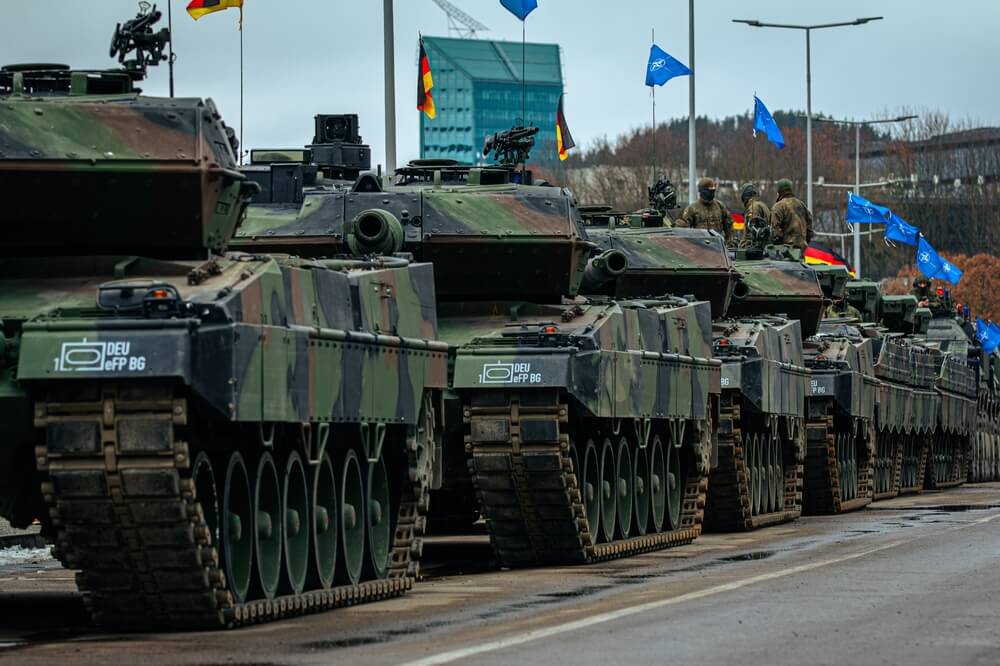 Instead of spending an arbitrary share of their GDP on defense, Europeans should critically evaluate their capability gaps and adjust their spending to match their needs
Third, in their subservience to the US president, Europeans often do not hide it well, which prevents them from being taken seriously—be it by Trump, Putin, or Chinese President Xi Jinping.
If there is one man who presumably respects Rutte less than Rutte himself, it is Trump.
Europe will garner the world’s respect only when it stands up for itself.
Whereas Ostalgie was a bottom-up phenomenon, Westalgia is being driven by elites.
Of course, European politicians need to allay their skittish electorates’ fears. But if they want to succeed in the 21st century, they must stop selling nostalgia and start looking to the future.
Mark Leonard is a Director of the European Council on Foreign Relations.
