China's numerous ethnic minorities have far more reason to worry about their basic human and collective rights today than they did yesterday.
However limited, these rights are often violated, even by the low standards set by the ruling Chinese Communist Party.
The law on “ethnic unity” came into force on 1 July and is causing anxiety not only among ethnic minorities within China, but also among members of these communities living abroad.
Its main goal is to assimilate numerous minorities in China and to narrow the scope for expressing their ethnic distinctiveness, under the constant threat of coercion by the powerful state apparatus.
The law applies to all 56 officially recognised ethnic groups, which, according to estimates, make up slightly less than 10% of China’s total population, roughly equal to Russia’s population.
The most distinctive and, at the same time, most worrying aspect of the law is that it also applies to members of Chinese minorities around the world.
This effectively gives the Chinese state a green light to act against its ethnic dissidents within the framework of the international order, regardless of where they are.
Suppression of minority identities
The law is the crowning achievement of Xi Jinping’s decades-long policy of turning China’s ethnic mosaic into a melting pot, subservient to a majority identity in which differences are constrained and made to submit to supreme state authority.
This kind of centralised ethnic management is reaching the end of its evolution, during which some ethnic groups have had varying degrees of protection for their distinctiveness through rights related to language or education.
The authorities reject claims that the law introduces ethnic engineering or suppresses the collective freedoms and rights of ethnic groups
The authorities firmly reject claims that the law introduces ethnic engineering or suppresses the collective freedoms and rights of ethnic groups.
They are particularly angered by comments in the West that this is a drastic increase in pressure on ethnic dissidents, especially Tibetans and Uyghurs living outside China.
“It is a legitimate, lawful, necessary and feasible legal provision,” said Vice Justice Minister Hu Weilie in Beijing. “Countries around the world all have the right to prevent separatist and destructive activities, and to maintain social solidarity and normal order through domestic legislation.”
Separatism and ethnic minorities
The same deadly edge of China's new law will target activists and dissidents outside China, while their compatriots at home will also come under attack.
Beijing's goal is clear and, as of last week, codified in law: to strengthen the mechanisms and powers of the state apparatus in actions against separatists in China and abroad who identify as members of minority ethnic groups.
The equation between separatism and minority peoples was formalised last week through the law on “ethnic unity and progress”.
Yet while Beijing's strategy is clear, do Western governments even have a clear outline, let alone a plan, for how to protect potentially vulnerable Chinese dissidents on their soil? For now, no.
Over the past year, since the law was passed, reactions have been mostly verbal, largely formal
Over the past year, since the law was passed (12 March 2025), reactions have been mostly verbal, largely formal, and confined to appeals to Beijing to refrain from further expanding repressive measures against critics belonging to ethnic minorities.
“The introduction and enforcement of the law will lead to severe consequences for EU–China relations,” declared the European Parliament in April 2025. Members of the EP urged member states to “suspend their extradition treaties with China”.
However, over the past year, from the adoption of the Chinese law to the start of its implementation, relations between Western governments and Beijing have changed greatly. Issues of human and ethnic rights have been pushed off the agenda, while priority has been given to major economic and security concerns.
Yielding to Beijing's firm position
Silently or otherwise, Western governments yield to Beijing's firm position that the state of human and ethnic rights must not be the subject of international political action, nor be used as a lever in resolving other issues, especially economic ones.
Donald Trump’s policy, which seeks to prevent the human rights situation in China from burdening his negotiation strategies on trade and security with Beijing, has contributed to this turn of events.
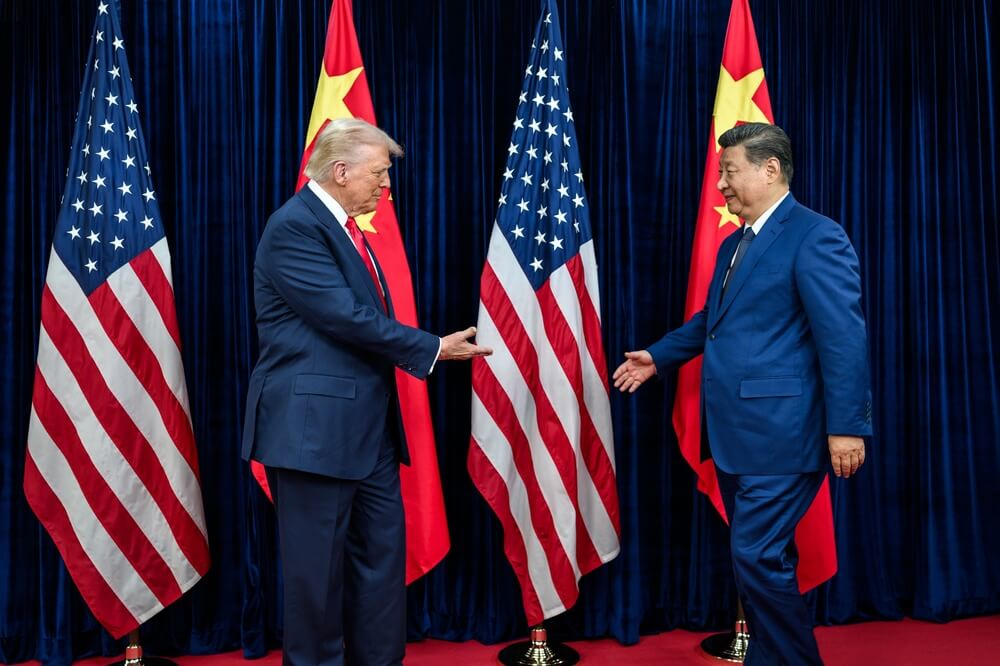 At the May summit between Trump and Xi Jinping, the topic of human rights in China was not discussed
At the May summit between Trump and Xi Jinping, the topic of human rights in China was not discussed.
Although before the trip to Beijing the American president promised that in the talks “I'll bring him up”, referring to the arrested Hong Kong democratic activist Jimmy Lai, this did not happen.
Apparently, Trump and his delegation calculated that Beijing's extreme sensitivity to “interference” in human rights cases could jeopardise agreements in which Washington is far more interested.
After the controversial Chinese law came into force, this restraint by Western governments could only become more pronounced.
Few leaders in Europe and America will be willing to risk opening a new front with Beijing over the worsening state of human rights, which could call into question the complex dialogue on trade, tariffs, supply chains and critical minerals.
Groups of Tibetan and Uyghur activists have been protesting since last week in Washington, Brussels and in front of the UN headquarters in New York over the entry into force of the rigid ethnic law.
But their voices have not carried far; they have gained support only from international human rights organisations and a handful of politicians.
Mainstream Western governments are likely to sideline their calls to increase pressure on Beijing over repressive laws. Beijing is counting on this and will use the new ethnic law as another means of exerting pressure on dissidents in the West.
