Will Europe be able to resist Washington’s bullying over the transition to clean energy?
Europe is still investing in renewables at a fast pace. But many of its leaders have toned down any sense of urgency in their public pronouncements on climate change, raising concern over its global leadership on the issue.
In the latest assault on global efforts to address fossil fuel dependency, Washington managed to remove climate change from the list of priorities the International Energy Agency drew up during a ministerial meeting in Paris last week.
The US threatened to quit the agency if it continued to focus on climate change, which was named its top priority at the last IEA ministerial meeting in 2024 when a joint communiqué referred to a “triple planetary crisis: climate change, pollution and biodiversity loss”.
Rising carbon emissions are simply a “sort of a side effect of the modern world,” US Energy Secretary Chris Wright told AFP. He claimed a “climate cult” is weighing down on Europe's economy.
US President Donald Trump’s antipathy to any climate action is well known, and his administration has been busy trying to destroy any policies designed to lower emissions, domestically and globally.
The cost of weaker clean air regulations
At home, the US Environmental Protection Agency (EPA) announced on 12 February it was rescinding its 2009 landmark determination known as the “endangerment finding” that said greenhouse gases endanger the health and welfare of current and future generations. The endangerment finding served as the legal underpinning of many clean energy policies.
The World Health Organisation estimates air pollution contributes to more than seven million deaths annually.
But the EPA announced last Friday it will also roll back clean air regulations limiting mercury and hazardous toxins from power plants. Its aim is to ease the reduction of costs for utilities using older coal plants.
A coalition of public health groups, including the American Lung Association, and the American Public Health Association announced they would sue the administration.
Trump formally withdrew from the Paris climate agreement in January, putting the US alongside Iran, Libya and Yemen
Last month, the EPA said it will stop quantifying the health benefits in its assessments of the monetary impact of new pollution regulations, including those relating to fine particulate matter and ozone.
Previously, the EPA placed a dollar figure on the benefits of cleaner air, factoring in outcomes such as fewer premature deaths and reduced illness, including asthma attacks.
Trump formally withdrew from the Paris climate agreement in January, putting the US alongside Iran, Libya and Yemen as the only countries not party to the accord.
The US has also pledged to withdraw from 66 international organisations working on environmental, social, and human rights issues, including the UN Framework Convention on Climate Change.
Rebranding green transition
Europe has expressed little outrage publicly over the US destruction of key pillars of the multilateral climate architecture. But some Americans are urging Europe to defy Trump.
In a letter sent on 5 February to European Commission President Ursula von der Leyen, 24 members of the House and Senate said it “would be a misguided approach” to give in to demands from the US Department of Energy to exempt American oil and gas from an EU regulation aimed at clamping down on methane pollution.
As of January 2027, importers will need to comply with monitoring and reporting requirements linked to methane emissions data from countries and companies that produce or export to the EU.
Europe so far has resisted attempts to change the EU Methane Regulation. But Washington’s offensive against climate change means the EU should leverage its influence over decarbonisation, says Stefan Šipka of the European Policy Centre.
European leaders seem unwilling to directly confront Trump over climate change
The recent anti-climate moves by the US confirm “once again that any transatlantic or EU-US global initiatives labelled as ‘climate’ are off the table as long as Trump is in the office,” he says.
European leaders seem unwilling to directly confront Trump over climate change. Instead, they are rebranding their green transition to emphasise the security, not climate-saving, benefits.
"With diplomacy, it’s about looking for those places where you can work together,” a European energy ministry official at the International Energy Agency meeting told Politico. “If the word 'climate change' is a red drape for a bull, then don’t use it.”
Maja Lundbäck, Sweden’s state secretary for climate and enterprise, was a rare official willing to speak more bluntly. “Washington can make their own politics — we have our own initiatives here,” she said.
Global climate action grows despite US retreat
Europe should take heart from evidence showing that globally, climate policies are bucking the trend of US negativity.
A survey of climate regulations in 37 major countries by Oxford University found that new and strengthened climate policies can be found across the world, especially in Asia and emerging markets.
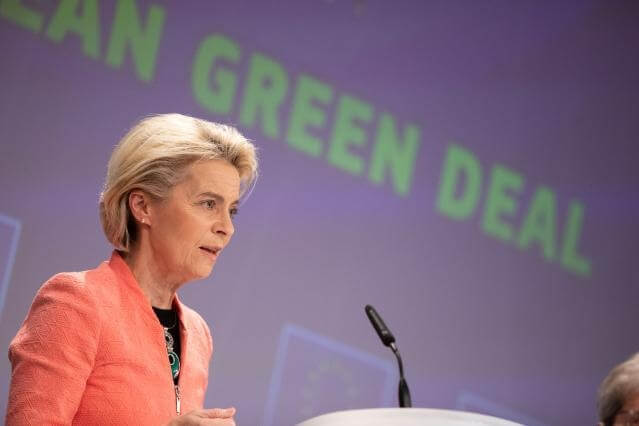 Centrist leaders hope that keeping quieter about climate may help defuse the threat from right-wing parties that have promised to copy Washington’s anti-green agenda - Ursula Von der Leyen
Behind the scenes, Europe is undeterred in its push towards green energy. Last month, nine European countries - Belgium, Denmark, France, Germany, Ireland, Luxembourg, the Netherlands, Norway and the UK - signed a joint declaration on an offshore wind project they say will be “the largest clean energy hub in the world.”
Part of Europe’s impetus behind renewables is cutting energy dependency. After switching from Russia as a major supplier after its invasion of Ukraine, nearly 60% of Europe’s liquified natural gas imports in 2025 came from the US.
Centrist leaders in Europe also hope that keeping quieter about climate may help defuse the threat from European right-wing parties that have promised to copy Washington’s anti-green agenda.
Ultimately, the shifting rhetoric of climate politics matters less than whether fossil emissions fall enough to address the real changes in extreme weather seen around the globe. Many scientists are not optimistic.
