It is hard to begrudge those who celebrate the demise of Iranian theocrats who have gunned down passels of their people – some estimates reach as high as 30,000 in just the last few months.
At the same time, the aerial assault on Iran launched by the United States and Israel heralds a period of undisciplined, unlawful, and arbitrary violence that will be hard to contain.
Americans, and their notional friends on the world stage, should look beyond the unpopular targets of today’s violence and ask how such violence could be applied tomorrow.
With a president who is unbeholden to facts or legality, the answer is discomforting: state violence could be used not only in the international sphere, and not only against tyrannical regimes, but also at home, against those deemed domestic “enemies.”
An odd coincidence illustrates this risk: On the same day that bombs started falling on Tehran, the Washington Post reported that the White House may soon issue a unilateral executive order asserting the power to control how and when people can vote in the upcoming November mid-term elections.
The EO reportedly cites national security – supposed Chinese meddling – as grounds to impose new limits on Americans’ right to vote.
The White House and congressional Republicans no doubt anticipate that their fixes will make it easier to retain control of the House and the Senate.
Electoral miracle
Trump has declined to say he’s about to issue such an order – but then he also hid his intentions on Iran from the American public during his State of the Union speech three days earlier.
And the chances of such an EO must be evaluated in light of current opinion polls, which have Democrats ahead by about six percentage points.
Furthermore, Trump’s mid-cycle redistricting initiative, aimed at keeping control of the House, skidded to a halt when a Republican gerrymander of congressional districts in Texas met a robust Democratic counter-offensive in California, and heavily Republican Indiana balked at a gerrymander of its own.
The White House is under mounting pressure to pull off an electoral miracle
Together with the prospect of a stock-market correction in the coming months, the White House is under mounting pressure to pull off an electoral miracle.
Presidents, however, have no authority under either the US Constitution or federal statutes to take any of the steps mentioned by the Post, such as banning mail-in ballots and mandating voter identification.
Article I of the Constitution gives the power to set rules for congressional elections to US states, subject to override by Congress.
While House Republicans have passed the so-called SAVE Act, which contains a voter-ID requirement, it is not yet law.
National security
One reason for genuine concern is that, as the Iran attacks show, the US presidency is especially weakly bound by law when it comes to national security, which is the purported basis for the EO.
The absence of legal authority did not prevent the strikes on Iran, which are unlawful under the US Constitution, which assigns Congress alone the power to initiate international conflicts, and under Article 2 of the United Nations Charter.
In addition, Trump’s justifications for the attacks are, as the New York Times puts it, “unsupported and exaggerated.”
It is more apt to say simply that the president believes that he can lie with impunity to trigger potentially catastrophic military actions at the cost of hundreds or thousands of lives.
And that applies at home, too. The administration has shown itself to be deft at flipping claims that it has broad legal authority to engage against foreign states into claims that it has similar authority against US nationals.
On at least three occasions, a claim to act externally in the name of national security has been refashioned into an assertion of power to act internally.
Soon after returning to the White House last year, Trump directed Attorney General Pam Bondi to defy the law that Congress enacted – ironically, following Trump’s own lead – banning TikTok.
She did so, successfully, with just a vague invocation of “core presidential national security and foreign affairs powers.”
The operations in which Renee Good and Alex Pretti, were killed embody a domestication of external power
The effect of this claim was to change dramatically the range of social-media options available within the US – and to lay the groundwork for the purchase of TikTok by the president’s political cronies.
Or consider the president’s power to proscribe terrorist organizations. This power is granted by federal statute – tellingly located in the law’s immigration provisions, in respect to “foreign” organizations only.
Yet in September last year, Trump issued an executive order proscribing domestic “anti-fascist” organizations. Since then, cabinet officials such as Homeland Security Secretary Kristi Noem have eagerly labeled civilian protesters “domestic terrorists.”
Finally, the operations in which two of those protesters, Renee Good and Alex Pretti, were killed also embody a domestication of external power.
Historically, immigration enforcement focused largely on the border. By flooding Democratic-led cities and states with violent, militarized enforcement agents, Trump has effectively turned the president’s foreign-facing coercive authority into a potent tool of domestic political repression.
Justification for new domestic policies
There is, then, ample reason to believe that the Trump administration is capable of twisting the national-security powers of the presidency into an instrument of lawlessness at home.
The proposed election EO is just the most recent example of this kind of blowback.
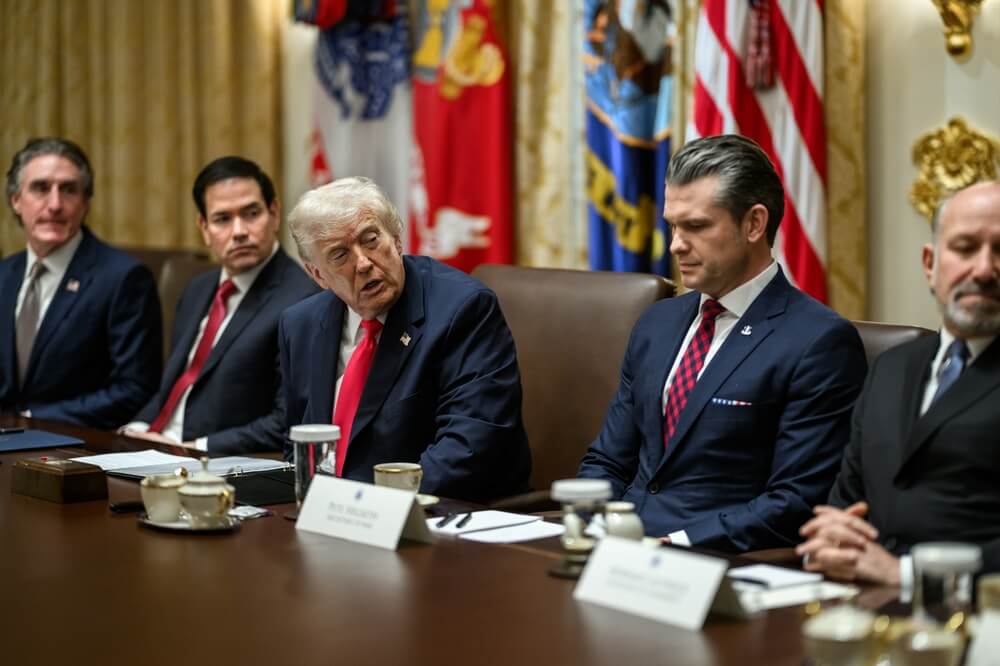 The Trump administration is capable of twisting the national-security powers of the presidency into an instrument of lawlessness at home
The fact that Trump has been able to use national-security power with such brazen disregard for facts and law against Iran will only embolden him to use such powers again.
And if the Iran conflict lingers – as seems likely – we can expect the White House to use the backdrop of bombings and reprisals as justification for new domestic policies.
Neither Congress nor the courts have been able to prevent this kind of retooling of foreign-policy power when it came to TikTok, terrorist designation, or deployment of federal enforcement agents. It remains unclear if other branches would oppose an elections EO.
In the recent tariff decision issued by the Supreme Court, Chief Justice John Roberts expressly rejected the argument that a presidential power to impose duties escapes judicial review simply because it was a “foreign affairs” power.
But the Court has been less solicitous of voting rights than it has been of the structural foundations of economic neoliberalism, such as free trade and the independence of the Federal Reserve.
Today, a national-security emergency has been conjured as a knife targeting Iran’s theocratic despots. But as little sympathy as the Iranian regime deserves, it is worth remembering that tomorrow the blade could be turned against us.
Aziz Huq is Professor of Law at the University of Chicago Law School and an associate professor in the University’s Sociology department.
