In a week in which Washington seemed to lose its collective mind over the existential dangers posed by artificial intelligence, perhaps the strangest sight of all was longtime adversaries Steve Bannon and Bernie Sanders banding together to urge the U.S. government to slow the AI arms race before it’s too late.
It wasn’t quite, as Bill Murray in the seminal film Ghostbusters famously foretold, dogs and cats living together. But a form of mass hysteria did seem to strike policymakers across the political spectrum last week after literally months of standing by and watching as AI steamrolled into almost every facet of American life.
Bannon, a vanguard of Donald Trump’s MAGA movement, and Sanders, the irascible progressive senator and former presidential candidate, spoke to a crowd that included politicians, faith leaders and tech executives at a so-called “Pro-Human Assembly” in Washington.
Sanders lambasted the lack of action by the U.S. Congress in attempting to curb the advancement of AI models.
"Despite living in a so-called democracy, the public has had virtually no input into the AI revolution that's transforming the world," he said. "Congress, under both Democratic and Republican control, has been asleep at the wheel, and we now have a president whose ignorance regarding this issue is truly embarrassing."
Bannon took aim at the tech industry, whose billionaire executives he blasted as unaccountable “oligarchs.” He called the moment “a hinge in history.”
A voice from inside the industry
Bannon and Sanders were hardly alone in their alarmist rhetoric. The week had the feel of lawmakers suddenly unfrozen from suspended animation to discover a world where AI tech has gone at warp speed from a curiosity to an inescapable force.
AI panic is the latest manifestation of a growing uneasiness in the country over the role of tech in society, with those in Washington again trailing significantly behind the sentiments of the public at large.
The discord has expressed itself through opposition to data centers and surveillance cameras and an increasing crackdown on platforms that may be dangerous to young users.
But regulating AI itself, even as it has been injected into everyday interactions such as dealing with a doctor’s office, answering an email or ordering a pizza, has been a bridge lawmakers have resisted crossing – in part because AI has been the swiftest of moving targets.
Development of new AI models has been at times so dizzying that the average member of Congress likely had little idea what was going on
Development of new AI models has been at times so dizzying that the average member of Congress likely had little idea what was going on.
It took a voice from inside the industry to grab their attention. Jacob Coxon, a 27-year-old researcher, quit his job earlier this month at Anthropic – the creator of Claude – and went public with his concerns that the industry is building models that could escape human control.
Remarkably, another researcher at the company then echoed Coxon’s concerns, saying on X that employees at Anthropic “really do earnestly believe AI could kill all humans!”
The admission felt almost Strangelovian. It was as if in 1964, scientists said there was a danger that nuclear missiles could launch themselves.
In a matter of days, calls for slowing down and checking AI development were coming from all corners.
Coxon, along with the CEO of Anthropic, Dario Amodei, joined more than 1,000 AI researchers across the industry who signed a statement in July urging global government coordination on a system to slow AI.
A “hoax” and an “AI force”
There was one notable and powerful exception: President Trump, who proclaimed on social media that fears of the mass extinction of humanity were a “hoax” (see also climate change) and as a capper suggested that any community should be happy to host a data center. He attributed the backlash to a “conspiracy.”
But the comments his posts sparked suggest that a significant part of his political base shares fears over AI development, combined with related concerns about job loss and high energy costs.
It was the most recent example of Trump’s populist radar – one that helped guide him to two campaign victories – seemingly malfunctioning as Republican candidates sail into increasingly choppy waters ahead of the November midterm elections.
Trump remains bullish on AI development, citing worries that the U.S. will fall behind China and a slowdown would harm the economy
By the weekend, Trump appeared to concede that there were widespread concerns by announcing he would create an “AI force” – purpose, details and the head of which all TBD.
But he remains bullish on AI development, citing worries that the U.S. will fall behind China and a slowdown would harm the economy.
Finding a more measured approach
By taking such an extreme stance, Trump has made it easier for Democrats to find a political space that takes a more measured approach.
But until now, they have largely sat out the debate over AI regulation, particularly when it came to slowing development of the most advanced models themselves.
When one Democrat, Representative Lori Trahan, introduced a comprehensive and bipartisan bill to try and rein in AI earlier this year, she was met with the sound of crickets from her party.
Instead, House Democratic leaders set up an AI working group nearly a year ago that has yet to publish a report or a regulatory framework for moving forward but that issued a statement opposing Trahan’s measure as inadequate.
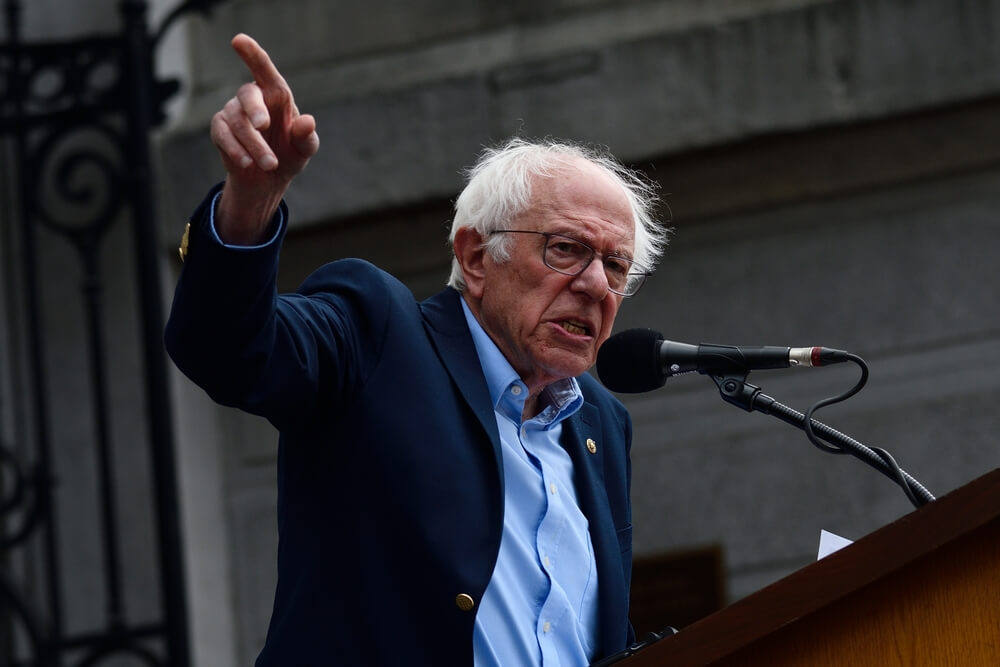 Democrats seem to be realizing that they can’t afford to wait until they potentially regain control of Congress to start calling for constraints on AI - Bernie Sanders
Many Democrats still appear unsure whether they want to stand in the way of technology that could be socially and economically transformative.
But Democrats seem to be realizing that they can’t afford to wait until they potentially regain control of Congress to start calling for constraints on AI.
Sanders, along with Representative Greg Casar, put forth a bill this month that would permanently ban the development and deployment of superintelligent AI and temporarily halt advanced AI development until the government has established safety rules.
It would also direct the U.S. to pursue international agreements to prevent superintelligence from being developed anywhere in the world in what basically would amount to a non-proliferation treaty.
“The answer is simple: We ban A.I. systems that are too powerful for humans to control,” Casar said at the pro-human event.
Other Democrats have floated the idea of forcing tech firms to install “kill switches” that would allow companies – or perhaps the government – to shut down an AI model if it poses a threat to humans or other systems.
Whether we regulate AI – or AI regulates us
The question looming over these nascent efforts is whether it’s already too late to get a handle on technology that has become so pervasive, with open-weight models that can proliferate out of the control of the creator posing a particular concern.
Geoffrey Hinton, a Nobel laureate known as the “Godfather of AI,” offered a dire assessment after a closed-door briefing with lawmakers from both parties last week. He said Congress and the White House are running out of time.
We need to slow down - Geoffrey Hinton
“Maybe a year, but not much more than a year,” Hinton said. “If you look at predictions for when we’ll get superintelligence,” he said, “it used to be maybe 30 years, maybe 50 years. Then it came down to maybe 10 years, maybe 20 years. Now people are saying – a lot of the researchers are saying only a few years.”
“We need to slow down,” Hinton said.
Given the persistent gridlock and hard feelings on Capitol Hill, it’s hard to envision both parties getting their act together in the next Congress to tackle the issue even if Democrats take charge.
A presidential election cycle will be just starting, where the incentives for talk outweigh those for direct action. And Trump’s intransigence – along with his veto pen – is not likely to go away.
Should Washington miss its window, and the long-awaited and long-feared superintelligence does arrive, the debate may shift accordingly. No longer might it be whether we can regulate AI; it may be whether AI regulates us.
