From 18–20 September 2026, Russia held elections to the State Duma, regional parliaments and local self-government bodies, as well as gubernatorial elections in several regions.
Formally, this was another electoral cycle, but its political significance extends far beyond the allocation of parliamentary seats.
The key question is not only who receives the votes, but how competitive and verifiable the process generating these results actually is.
Russia’s electoral system increasingly operates under conditions of limited political competition, tight control over the information environment, and diminishing opportunities for independent public oversight.
Reuters, ahead of the elections, also described the political environment as one in which opportunities for genuine opposition were severely constrained.
The situation involving Yabloko is particularly illustrative. It is one of the few registered Russian political forces that openly opposes the war.
On 10 August, Russia’s Supreme Court cancelled the registration of its federal list for the State Duma elections, citing, among other issues, violations related to financing and copyright.
A week later, an appeals court upheld the decision, while on 3 September the Supreme Court refused to refer the party’s complaint to its Presidium. On 15 September, Yabloko appealed to the Constitutional Court.
At the same time, individual candidates from the party continued to participate in regional and single-member constituency campaigns, although new cases of registration cancellations emerged there as well.
Control over major media outlets
This indicates that political competition in Russia has not disappeared entirely, but its boundaries are increasingly determined by administrative and legal mechanisms that significantly restrict the opportunities available to critical political forces.
The second factor is the asymmetry of the informational and administrative environment.
State control over major media outlets, restrictions on independent journalists and political activists, and the use of administrative resources create unequal conditions long before election day.
The formal presence of several political parties does not necessarily mean that voters have access to fully developed political alternatives
In such a system, the formal presence of several political parties does not necessarily mean that voters have access to fully developed political alternatives.
The third factor is the verifiability of the results. Russia combines three-day voting with remote electronic voting.
Russia’s Public Chamber has presented an updated “Golden Standard” for public election observation, including rules for monitoring electronic voting.
Electronic or multi-day voting, in itself, is not evidence of electoral fraud. The problem arises when independent participants have limited opportunities to verify all stages of the process, from the formation of the electoral environment to the counting of votes.
Occupied territories – a separate legal dimension
The most fundamental issue concerns the conduct of Russian elections in the occupied territories of Ukraine – Crimea and Sevastopol, as well as the occupied parts of the Donetsk, Luhansk, Zaporizhzhia and Kherson regions.
This is no longer merely a matter of Russia’s domestic electoral procedures. Russia is using elections to incorporate the occupied territories into its own constitutional and political space.
Russia’s organisation of elections in the occupied Ukrainian territories violates Ukraine’s sovereignty
On 14 September, International IDEA stated that Russia’s organisation of elections in the occupied Ukrainian territories violates Ukraine’s sovereignty, independence and territorial integrity.
These elections serve a dual function: they establish representative bodies within Russia’s political system while simultaneously creating a political framework for consolidating Moscow’s claimed annexation. However, holding a vote does not alter the international legal status of these territories.
What the results will mean
The results of the September elections should therefore be assessed not only by the number of seats won.
Three indicators will be considerably more important: the level of genuine political competition, the possibility of independently verifying the results, and the authorities’ ability to mobilise voters within a controlled political environment.
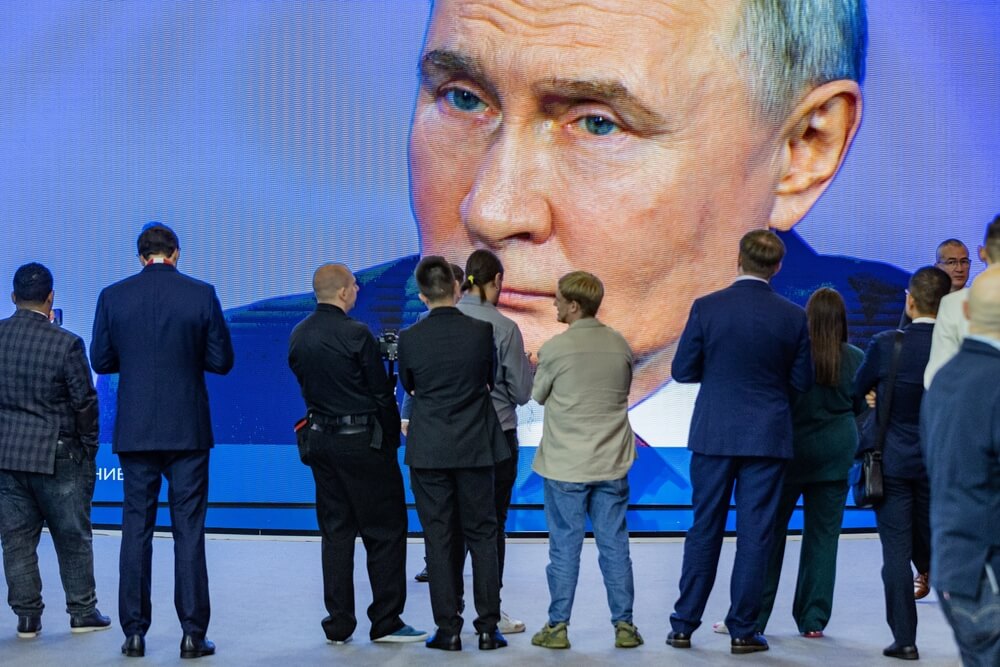 For the Kremlin, the elections are important primarily as a mechanism for demonstrating political stability during wartime
For the Kremlin, the elections are important primarily as a mechanism for demonstrating political stability during wartime.
High turnout and a predictable result for the politically controlled forces could serve as an internal signal that the authorities retain control and as an external argument for public support for the current course.
This is exactly what happened, because the state election commission announced that voter turnout was quite high, at slightly more than 59.3%, about eight per cent higher than in the previous parliamentary elections in 2021.
However, electoral results and political legitimacy are not synonymous. If a significant share of potential competition is eliminated before voting, the information environment is unequal, and independent oversight is restricted, the official result reflects not only voters’ choices but also the conditions under which those choices were formed.
For this reason, Russia’s 2026 elections should be seen not simply as a parliamentary campaign, but as a means of consolidating the Kremlin’s political system and institutionally reinforcing its control over the occupied Ukrainian territories.
Oleksandr Levchenko, a former Ukrainian diplomat, is a professor at the State University (Kyiv) and a member of the Academy of Geopolitics and Geostrategy (Kyiv).
