In the podcast The Rest Is Politics, during a conversation with Alastair Campbell broadcast on 9 April, Volodymyr Zelensky put forward a proposal that is both radical and logical at a time when Europe faces its most serious transatlantic rift since the founding of NATO.
He suggested a defence alliance uniting the European Union, Ukraine, the United Kingdom, Turkey, and Norway. The aim: to take full control of Europe’s seas, skies, and land in the event of an American withdrawal from NATO.
“The EU is in such a situation. They need some countries. UK, Ukraine, Turkey, Norway… I think these countries, this is the army which will be stronger than the army of Russia,” said Zelensky. “Without Ukraine and Turkey, Europe will not have a similar army that Russia has. With Ukraine, Turkey, Norway and UK, you will control security on the seas, not one sea.”
The proposal comes as Donald Trump once again questions the American role in NATO, and European governments can no longer assume that the American security guarantee is permanent or unquestionable. This is no longer a theoretical discussion, but a scenario now considered in planning.
Zelensky does not present a detailed model for the alliance. He does not discuss a treaty, command structure, or defined obligations. Instead, he offers political direction: a security framework that could function without American support.
Such a proposal should not be dismissed, but it is not an operational plan. Its significance lies in clearly exposing the limits of the existing system and raising the question of whether Europe can replace them on its own.
Why these actors?
Each of these actors brings capabilities that cannot be quickly replaced.
The European Union provides an economic and industrial foundation. With a population of around 450 million and increasing defence investments, its key contribution is manufacturing, from munitions to complex systems.
France remains the only nuclear power within the EU and the only actor with a developed strategic doctrine. Germany, although belated, is tangibly translating its political shift into budgetary and industrial decisions.
Poland and the Baltic states bear the greatest burden on the eastern flank and already invest over four per cent of GDP, making them the most motivated and prepared part of the European space.
The UK offers what the rest of Europe lacks: global military reach and operational experience outside the continent. As one of two European nuclear powers and a permanent member of the UN Security Council, alongside France, London retains strategic influence.
Its submarine fleet and access to the Five Eyes intelligence network provide a crucial source of informational and operational advantage. Without this layer, any European framework remains limited.
Countering drones, engaging in electronic warfare, coordinating artillery, and maintaining logistics under constant attack have become routine
Turkey is a geographical and military junction between the Black Sea, the Middle East, and the Mediterranean. Control of the Bosphorus and Dardanelles gives it direct influence over Russian access to warm seas.
Its army, the second largest in NATO, and its increasingly developed domestic arms industry make it an irreplaceable factor. At the same time, Ankara's ability to maintain relations with both Moscow and the West is not a sign of weakness, but a tool that gives it added value in any security configuration.
Norway occupies the northern direction that Europe often overlooks. Its intelligence capabilities and continuous monitoring of the Russian Northern Fleet directly affect control of the Arctic and North Atlantic.
In energy, Norway is a key supplier to Europe as dependence on Russia declines. Its border with Russia is not just a political line on the map, but an operational point of contact.
Ukraine brings experience that no other European army currently possesses. Four years of high-intensity war against Russia have transformed the conduct of conventional conflict.
Countering drones, engaging in electronic warfare, coordinating artillery, and maintaining logistics under constant attack have become routine. This is operational expertise that no NATO exercise could replicate.
The operational dimension missing from the European conversation
If this proposal is seen solely as a political statement, it overlooks the real issue it seeks to address. Zelensky is not referring to a new alliance in the formal sense, but to an effort to connect existing European capacities into a functional whole.
The problem is that these capacities do not currently operate as a system. Command structures are fragmented, standards are not harmonised, and interoperability outside NATO remains limited.
Although there is an American layer, this deficiency is being concealed. Without it, the problem becomes operational.
The question is not whether Europe has the resources, but whether it can organise them
In this context, the question is not whether Europe has the resources, but whether it can organise them. It comes down to a few specific points that, for now, lack clear answers.
Who would integrate intelligence streams in the absence of US SIGINT infrastructure? How can unified command be established over naval and air operations that currently function through NATO mechanisms? Where is the political and military decision-making centre in a crisis, when rapid and binding action is required?
Where the real strength of the proposal lies
If these capabilities were truly integrated, such a bloc would have significant military weight in Europe. Russia has about 1.3 to 1.5 million soldiers, but a substantial portion is engaged in Ukraine, facing evident logistical problems and limited access to technological components due to sanctions.
Meanwhile, the European members of NATO, along with Canada, have increased defence spending for 2025 and accelerated production in areas where Russia lags behind, primarily naval and high-tech systems.
Ukraine provides land depth and experience from an ongoing war
The deployment of the capabilities Zelensky proposes has clear military logic. The United Kingdom and Norway cover the North and the Atlantic, controlling key sea routes.
The Black Sea and its entrance remain under Turkey’s influence. Ukraine provides land depth and experience from an ongoing war. In the air, reliance would be placed on French and British forces, with the gradual strengthening of European systems.
On paper, such a combination could rival Russia in conventional terms. In practice, everything depends on whether these capabilities can operate as a single system. This is where the problem begins.
Structural limitations of the proposal
The main problem lies not in capacities, but in their overlap. Turkey, Norway, and Great Britain are already part of the NATO system, with clearly defined obligations, chain of command, and procedures.
Introducing a parallel framework raises the issue of jurisdiction, which cannot be resolved by a political decision alone. Two structures relying on the same resources and operating in the same zones can hardly function without a conflict of command.
Without a clear relationship between this new framework and NATO, the proposal remains vague.
Within the European Union, the problem is different but equally restrictive. Defence policy relies on political consensus, which is currently absent. Differences between member states are evident not only in allocations, but also in risk assessment and willingness to accept risk.
While Eastern Europe is already operating in a mode of long-term confrontation with Russia, some Western members are still balancing security needs against internal political costs. In such a balance of forces, a joint military structure lacks a stable political foundation.
Any attempt to form a new European security bloc would be regarded as a direct threat
The key question that Europe has postponed for years remains: how to replace the American component without which the existing system cannot function.
Integrated command, satellite reconnaissance, strategic transport, and nuclear deterrence remain heavily dependent on the United States. Without these, European capabilities exist but are not unified into an operational system.
Zelensky made this clear at the beginning of this year in Davos – without American guarantees, the security structure remains incomplete.
This is followed by the expected reaction from Moscow. Any attempt to form a new European security bloc would be regarded as a direct threat.
The response would involve a broader range of instruments, from energy pressure to cyber operations and destabilisation of sensitive regions. In such an environment, the space for the balance that Turkey maintains between the West and Russia would be further reduced, affecting the sustainability of the entire concept.
Europe's problem today is not a lack of ideas, but the absence of a political decision to turn existing ideas into institutions.
Paris and Berlin are still searching for a sustainable model for their leadership in security policy. London seeks to maintain a central role in European security, but outside the formal structures of the Union. Ankara evaluates each option according to its regional priorities and interests.
Capacity exists; what is missing is agreement on how to use it.
What this proposal really means
Volodymyr Zelensky does not present an operational model, but rather a political impetus. The debate on European strategic autonomy has continued for years without concrete results.
Emmanuel Macron's 2019 "brain dead" NATO statement served as a warning but was not followed up. The war in Ukraine has altered the security framework, yet the European political response has not kept pace.
The return of Donald Trump and his open questions about the US role in NATO have made further delays untenable.
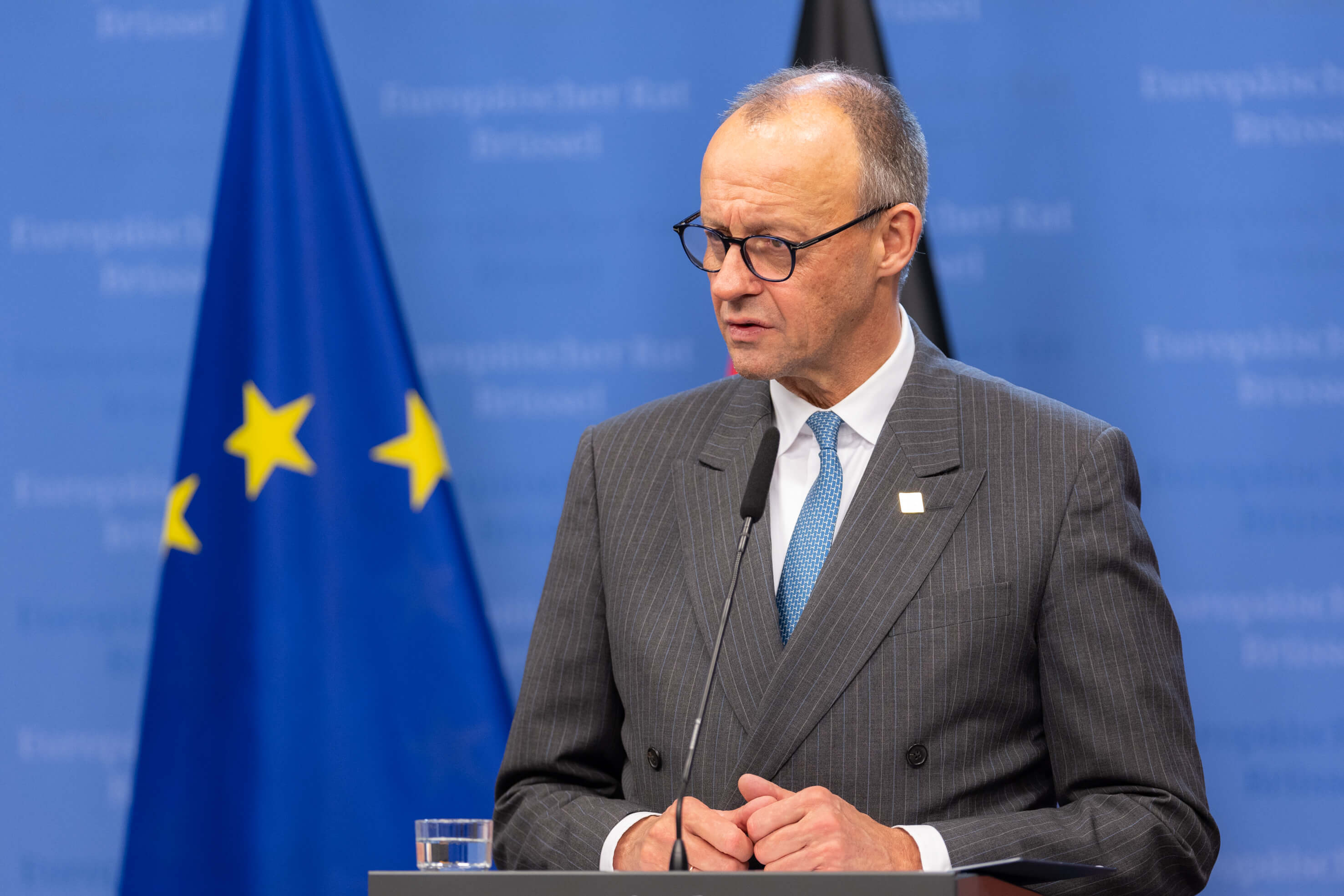 The era of complete reliance on the American security umbrella is over - Friedrich Merz
The proposal is not an alternative to NATO, but an attempt to build a European framework that could function even with reduced American involvement. It recognises that the existing security model can no longer be taken for granted.
German Chancellor Friedrich Merz has already made it clear: the era of complete reliance on the American security umbrella is over.
For Ukraine, such a framework offers a way to remain connected to the European security area in the long term, even without formal NATO membership.
For the European Union, it is a question of political will and readiness to bear the costs of its own security.
For Great Britain, it is an opportunity to remain a key actor on the continent without an institutional return to the EU.
For Turkey, it is a chance to include its strategic position in the European framework under clearer conditions.
Therefore, Zelensky's proposal is not a finished model and cannot be regarded as one. Its value lies in clearly demonstrating the limits of the existing system.
At present, the obstacles are too great to overcome quickly. However, as a political signal, it changes the framework of the discussion.
American withdrawal from NATO is no longer merely a rhetorical question, but a scenario under consideration.
In this context, European governments can no longer avoid deciding about their own security.
