The United States is spending billions of dollars to lose a war in Iran that is enriching its oligarchs, impoverishing its citizens, sabotaging its alliances, and strengthening its enemies.
The war is exposing a guiding principle of US President Donald Trump’s foreign policy: superpower suicide.
Empires rise and fall, but to my knowledge no state has ever deliberately, and systematically, killed its own power—much less with such speed.
This strategic suicide can be difficult to admit: one still hopes that Trump’s misadventures are based on some understanding of the American national interest. They are not.
At a minimum, a superpower must be a modern state that includes, through the rule of law and other institutions, a substantial body of citizens committed to a common endeavor.
But the Trump administration treats the US not as a modern state but as a commercial opportunity for a select few.
A superpower must also have a sense of the national interest. While international relations experts disagree about how leaders define this concept, we are unprepared for a situation in which the president is indifferent to the good of the people or the state.
A capitalist politburo
To remain a superpower, a state must also maintain itself over time. Continuity depends on a principle for transferring political authority.
By aspiring to remain in power indefinitely and undermining faith in elections, Trump is calling into question the principle that enables political succession in the US.
There are of course other ways of going about it, like dynastic rule or a politburo’s decision.
Moving to one of these arrangements—one could image the coven of tech oligarchs responsible for the rise of Vice President JD Vance as a capitalist politburo—would end the American republic.
Ensuring that the right people are in charge is crucial for a state to gain and maintain power.
The Trump administration has gutted the civil service and purged the military’s senior ranks
Historically, powerful states sought ways to identify and elevate qualified people to serve in positions of authority, regardless of birth.
Ancient China had an examination system. Napoleon established the principle of merit in both civilian and military life.
The US, for its part, once had a civil service that was the envy of the world, as well as a highly meritocratic military.
But the Trump administration has gutted the civil service and purged the military’s senior ranks—a process carried out by people who are themselves unqualified for the positions they occupy.
The fact that Tulsi Gabbard, Kash Patel, and Pete Hegseth are now, respectively, Director of National Intelligence, FBI director, and defense secretary is a clear indicator of a superpower committing suicide.
Offensive against science
In a deeper sense, a superpower must have an education system that can prepare its population, and thus its political leaders, to face global challenges.
But in Trump’s America, public education is being starved of resources, universities are facing retaliation for upholding academic freedom, and school libraries, including in military academies, are being purged of useful books.
Likewise, the embrace of science that has fueled the rise of many great powers has come under attack in Trump’s US.
Like the ancient Mesopotamians, whose astronomers devised scientific methods to map the heavens, and the Romans, who operationalized Greek science to build and defend an empire, America became a superpower by establishing state institutions to fund science and attract scientists (often immigrants).
The Trump administration has launched a staggering offensive against science
The Trump administration, however, has launched a staggering offensive against science.
It is withholding research funding based on political ideology, discouraging aspiring and established scientists from relocating to the US, and casting doubt on fundamental scientific findings, such as human-caused climate change.
As a result, the Trump administration has abruptly halted America’s energy transition and instead subsidized fossil fuels, which are being rendered ecologically and economically obsolete.
As a magnificent forthcoming book demonstrates, societies that pioneer new energy forms rise; those that do not fall.
This might be the most profound truth in human history, making Trump’s choice an existential error that will hasten America’s irrelevance and put China, its chief rival and the world’s clean-energy superpower, in a stronger position.
The same is true of the technology and innovation underpinning military might.
The US has always spent huge sums of money on weaponry, but the administration is focusing on the equipment of the past, like a new class of battleships to be named after Trump.
The plan is pure fantasy. Even if these battleships are somehow built, they would be wholly inadequate for modern warfare, the contours of which have been revealed by the high-tech war between Russia and Ukraine. Think of them as sunk on arrival.
The Trump administration disregards the art of diplomacy
The Ukraine war is a prime example of how the Trump administration disregards the art of diplomacy, in favor of “deal-making.”
Yet there is abundant evidence—including his kowtowing to Russian President Vladimir Putin—that Trump does not know how to negotiate.
US allies are abused and marginalized for no reason other than personal grievance
Moreover, US allies are abused and marginalized for no reason other than personal grievance.
With no sense of national interest, there can be no understanding of what alliances are for.
Nor can there be an appreciation of the international system—the laws, rules, and norms that underpinned US global primacy.
It is hard to overstate how primitive Trump’s approach is, and how much joy it brings to America’s enemies.
Strategic defeat
That brings us back to Iran. In international confrontations, a superpower wins at least some of the time. But the Trump administration loses time and again.
The war on Iran is a clear strategic defeat; insofar as the US had any objectives, they were not achieved.
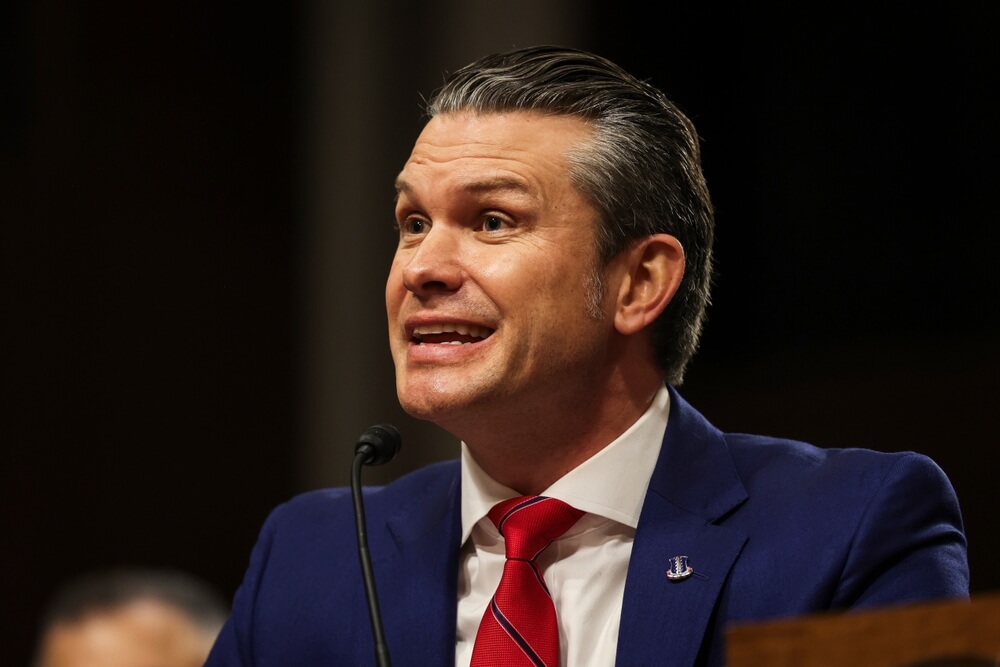 The administration celebrates defeat in symbolic terms characteristic of declining states - Pete Hegseth
Trump’s policies have left more enriched uranium in the hands of a more hardline Iranian regime, which holds new sources of economic power (control of the Strait of Hormuz; intimidation of the Gulf states), and made it all but impossible for the US to influence Iranian society.
The administration also celebrates defeat in symbolic terms characteristic of declining states.
Consider Hegseth’s comparison of a downed US pilot’s rescue to the resurrection of Jesus—a screaming blasphemy that might distract us from the underlying strategic helplessness.
Such Christological images are used to transform defeat in the real world into victory in some imaginary one.
Polish Romanticism, for example, regarded the collapse of a republic (chiefly owing to wealth inequality) as proof that Poland was the “Christ of nations.”
Government as a service to the ultra-rich
Lastly, many states lose power because they cannot afford to keep it. For the first time since 1945, US national debt is higher than US GDP.
That is a useful point of comparison: running big deficits is normal when facing a challenge like World War II.
But the Trump administration is doing so for an entirely different reason: to avoid taxing wealthy individuals and corporations.
What made the US a superpower also enabled the current attempt at self-annihilation
That approach—government as a service to the ultra-rich—is not consistent with winning wars or maintaining the social services that allow a modern society to function.
Reform and repair are no longer relevant, because America’s superpower suicide under Trump is a symptom of the democratic distortions and inequalities that have enabled such world-historic strategic buffoonery.
What made the US a superpower also enabled the current attempt at self-annihilation.
Instead of seeking a return to the previous status quo, strenuous efforts must now be made to restructure US politics in ways that give people greater power to create a more just future.
Timothy Snyder, the inaugural Chair in Modern European History at the Munk School of Global Affairs and Public Policy at the University of Toronto and a permanent fellow at the Institute for Human Sciences in Vienna, is the author or editor of 20 books.
