Ukrainian President Volodymyr Zelenskyy met US President Donald Trump at the World Economic Forum, although he had previously stated that he would attend Davos only if genuine agreements on Ukraine were reached first.
However, the American leader publicly invited the Ukrainian president to attend the summit in Switzerland. At the same time, documents agreed upon with the American side prior to the summit remained unfinished and unsigned.
These concerned an agreement on Ukraine’s postwar reconstruction and recovery, as well as security guarantees.
Trump refused to sign this agreement. Among the reasons were the uncompromising position of European partners regarding Washington’s request to be flexible on the issue of Greenland in exchange for support for Ukraine, as well as the Ukrainian president’s refusal to compromise on the territory of northern Donetsk Oblast.
This territory is controlled by Ukrainian forces. Transferring it to Russia at Moscow’s demand would make neighbouring regions of Ukraine vulnerable.
Northern Donbas consists of high ground that serves as a natural shield against Russian offensives. Therefore, this issue remains the most difficult and unresolved.
As a compromise, Ukraine proposes the creation of a free economic zone in Donbas. Kyiv insists that if the Armed Forces of Ukraine are forced to withdraw, Russian troops must retreat the same distance. However, the Kremlin does not accept this condition.
Trump's formula for a deal
The philosophy of Donald Trump’s peace deal is to end the war through Ukraine’s territorial concessions in exchange for financial injections and security guarantees.
Among other things, this involves Ukraine relinquishing the part of Donetsk Oblast that is not occupied by the Russian army—20% of its territory.
In return, Trump promises investments in reconstruction of up to USD 800 billion and Western security guarantees.
In other words, the formula of the deal is the loss of strategic territories for Kyiv now in exchange for promises of future investments, despite the fact that specific investors have not yet been identified.
Thus, the Ukrainian side faces an extremely difficult choice. The loss of Ukrainian fortifications in northern Donetsk Oblast could open the way for Russian forces to the cities of Dnipro and Mykolaiv and further westward to Odesa.
The transfer of strategically important high ground in northern Donetsk Oblast to Russia faces strong resistance within the Ukrainian army and among citizens
This could result in the loss of significant territories and access to the Black Sea, creating a critical dependence of Ukraine’s entire exports on Moscow.
In addition, the northern direction of a potential Russian offensive remains under threat—towards the cities of Poltava and Kharkiv, which are strategic centres in central and eastern Ukraine.
Therefore, the Kremlin’s insistence on the transfer of unoccupied territories of Donetsk Oblast is not accidental.
According to the text of the peace agreement, vast territories of Kherson and Zaporizhzhia oblasts would already remain on the Russian side behind the front line.
Consequently, the transfer of strategically important high ground in northern Donetsk Oblast to Russia faces strong resistance within the Ukrainian army and among citizens.
It should not be forgotten that when President Trump speaks of concessions by both sides, he refers exclusively to Ukrainian territory.
Partial success of talks in Abu Dhabi
The following day, by agreement among Kyiv, Washington, and Moscow, negotiations involving delegations from Ukraine, the United States, and Russia took place in Abu Dhabi.
These included not only trilateral talks but also bilateral negotiations between Ukraine and Russia.
Over two days, key issues were discussed: Russia’s territorial claims in Donbas, the dispute over the Zaporizhzhia Nuclear Power Plant, and steps towards de-escalation.
The parties needed to clearly understand what must be done to ensure that the war does not resume after it ends.
The meeting in Abu Dhabi became a certain step towards the next stage of negotiations
However, the talks cannot be described as successful. One of the goals was to agree on an energy ceasefire—Moscow would stop destroying Ukraine’s energy system, while Kyiv would refrain from attacking Russian oil refineries.
Moreover, between the first and second days of negotiations, the Russians again launched a massive missile attack on Kyiv’s energy infrastructure.
This was done deliberately to provoke the Ukrainian side into withdrawing from the talks.
However, Kyiv did not fall for this blatant Russian provocation. The meeting in Abu Dhabi became a certain step towards the next stage of negotiations.
The role of the church in Moscow's strategy
Thus, the negotiation track towards achieving peace in Ukraine continues. The Ukrainian side demonstrates maximum commitment to achieving concrete results. However, Kyiv also has limits to the compromises it can make.
The Kremlin sees Trump’s significant willingness to accommodate Russian demands and takes full advantage of it.
Russia is pressing for the inclusion in the peace agreement of issues related to the functioning of the Moscow Church in Ukraine and the legalisation of the Russian language as a second official language in Ukraine.
This is not surprising. In its foreign policy and defence doctrine, Moscow mentions obligations to protect not only ethnic Russians abroad but also all Russian-speaking populations.
That is, if any Russian-speaking group in a country appeals to Moscow for protection, the Kremlin will respond decisively, up to and including the use of armed force.
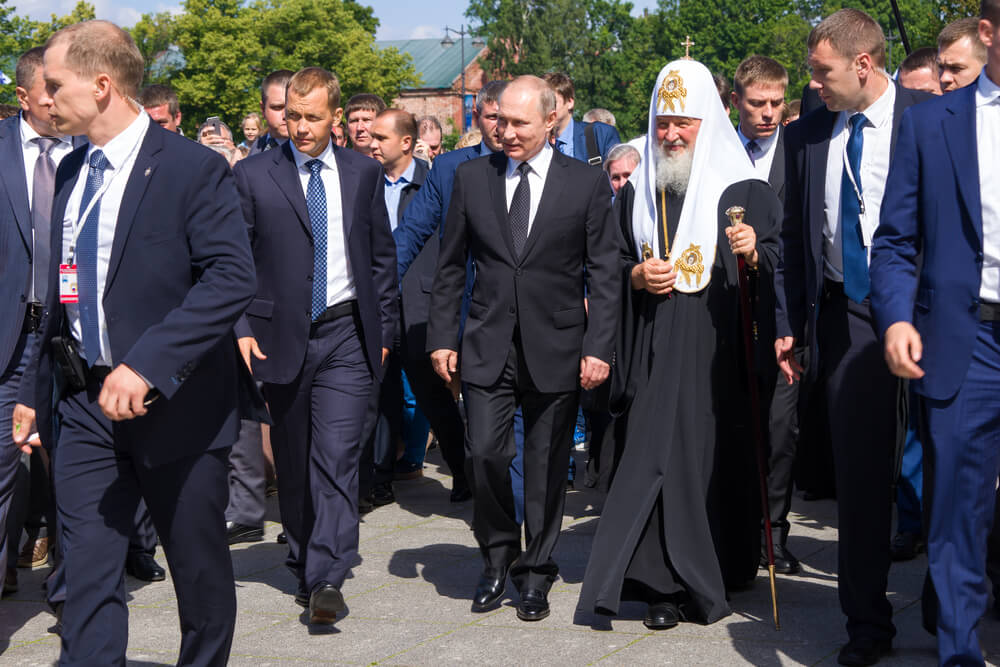 Moscow has not abandoned the approach in which the Orthodox Church and the Russian language are the main pillars of Russia’s ideological aggression - Vladimir Putin with Patriarch Kirill
Therefore, provoking an attack by Russian forces on Estonia or Latvia—where ethnic Russians make up 27–28% and the Russian-speaking population exceeds 30%—or on Kazakhstan, where ethnic Russians account for 20% and the Russian-speaking population exceeds 30%, would pose no difficulty for Russia.
For comparison, before Russia’s seizure of Crimea in February 2014, Ukraine had 17% ethnic Russians and 38% Russian speakers.
All Russians and Russian speakers in Latvia, Estonia, and Kazakhstan are believers of the Russian Orthodox Church.
Centres of the Moscow Patriarchate in Ukraine were also often places for the dissemination of Kremlin ideology or Putinism propaganda.
Unlike the Orthodox Church of Ukraine, the Ukrainian Orthodox Church of the Moscow Patriarchate, although having a certain degree of autonomy, is organisationally fully subordinated to Moscow.
Through a peace treaty, the Kremlin seeks to retain in Ukraine another important source of influence over Ukrainians.
Moscow has not abandoned the approach in which the Orthodox Church and the Russian language are the main pillars of Russia’s ideological aggression.
The Kremlin continues to prepare for further territorial claims. The “protection” of Russian speakers and believers of the Russian Orthodox Church can be used by the Kremlin as a casus belli for an attack on Estonia, Latvia, or Kazakhstan—or for a renewed attack on Ukraine.
This is the reason why Kyiv insists on security guarantees from the United States and Europe.
Oleksandr Levchenko, a former Ukrainian diplomat, is a professor at the State University (Kyiv) and a member of the Academy of Geopolitics and Geostrategy (Kyiv).
