The Trump administration’s “flood the zone” strategy can make it difficult to see when a turning point occurs in the United States’ slide into authoritarianism.
Some might say this is an objective of the strategy, which is built on gradual encroachments on people’s rights and institutional checks.
But the killing of two US citizens by Immigration and Customs Enforcement (ICE) agents in Minneapolis this month may just be that turning point.
A key distinguishing feature of authoritarian governments is their ability to use excessive force against opponents.
Every government uses coercive tactics in policing, but there are clear thresholds.
The British government can use force to clear some spaces of protesters. But various institutional checks and the strength of norms against authoritarianism make it unthinkable for the police to engage in the indiscriminate killing of protesters in the United Kingdom.
In contrast, there was no surprise whatsoever when then-Syrian President Bashar al-Assad responded murderously to protests during the Arab Spring.
Most people understand that authoritarian governments can and will use such force against opposition, independent media, and other pillars of civil society.
Such violent suppression of opposition in democratic or broadly non-authoritarian societies faces several barriers.
Indignation from both other branches of government
First, a similar crackdown would generate shock and indignation from both other branches of government and civil society, thus likely becoming counterproductive.
Second, the government cannot even be certain that its security forces will follow such an order. During Trump’s first term, US military leaders made it clear that they would not.
ICE expanded significantly during 2025 and, by all evidence, has recruited young men who are highly sympathetic to the more extreme version of Trump’s anti-immigrant agenda.
It has also been given an extremely broad mandate and allowed to use tactics that would have been viewed as unthinkable for any federal agency in the past.
By granting ICE agents de facto immunity, the Trump administration has given them a green light to ratchet up their violent tactics
The Department of Justice has shown unwavering support for ICE’s arguably illegal actions, even refusing to investigate them.
The symbolism of the events in Minnesota is unmistakable. ICE has now killed two innocent civilians: Renée Good, a mother of three who had just dropped her son off at school, and now Alex Pretti, an intensive-care nurse who was observing and recording an ICE raid.
These federal agents routinely use threats and violent tactics against protesters who document their activities.
Most significantly, however, by granting ICE agents de facto immunity, the Trump administration has given them a green light to ratchet up their violent tactics.
A turning point
If this violence goes unchecked, it could indeed be a turning point, because it will create a template for other security forces more closely aligned with Trump to use force against any manifestation of opposition.
In that case, the slide toward an authoritarian regime could become difficult to reverse, as civil society becomes prostrate in the face of mounting repression and the norms against such crackdowns become steadily eroded.
Already, the two branches of government that are supposed to check the presidency (Congress and the Supreme Court) have proven to be highly solicitous of Trump’s agenda.
The administration’s overarching aim is to form a type of unfettered imperial presidency – which is exactly how authoritarianism is consolidated
And the equally important institutional check from independent agencies has also been weakened, especially by the president’s ability to appoint allies and cronies to key positions.
As I recently argued elsewhere, the administration’s overarching aim is to form a type of unfettered imperial presidency – which is exactly how authoritarianism is consolidated, as contemporary examples from Hungary to Ecuador, Mexico, Nicaragua, Turkey, and Venezuela illustrate.
The resolve of civil society
There is another sense in which this moment could prove to be a turning point. In January 2017, I argued that the first Trump administration could be contained only by peaceful protests.
Even then, it was obvious that other branches of government would not constrain Trump effectively, and that even if they tried, Trump would bend the norms in his favor.
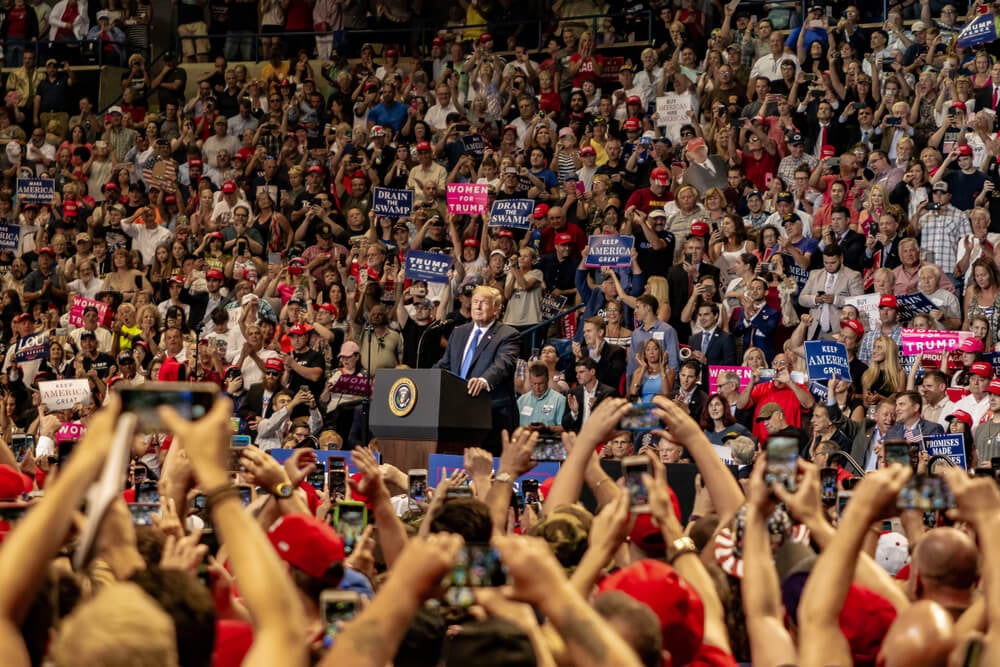 The outcome will be decided in part by how willing Trump’s allies in Congress are to go along with official violence and lawlessness, and by Trump himself and the tight group of like-minded advisers around him
But while protests turned out to be a potent defense against the first Trump administration’s efforts to expand its powers and edge toward authoritarianism, by 2025 the energy that had propelled them in 2017 was gone.
This was partly because many pundits and much of the population interpreted the outcome of the 2024 election, in which Trump won the popular vote, as giving a bigger mandate than 2016, when he did not.
There was a more important reason, however: Democratic Party activists had exhausted their legitimacy during the Biden years.
In the civil service, universities, NGOs, and even in the private sector, Democratic activists had overplayed their hands and lost a lot of support by suppressing legitimate concerns about their desired social changes.
So, in January 2025, civil society’s defense against Trump, who now had a much more radical agenda, was inchoate.
Minneapolis may change that. The energy and solidarity among people supporting their immigrant neighbors and protesting ICE’s brutal tactics herald a defining showdown.
The outcome will be decided in part by how willing Trump’s allies in Congress are to go along with official violence and lawlessness, and by Trump himself and the tight group of like-minded advisers around him.
But the biggest factor will be the resolve of civil society itself, starting in Minnesota.
Daron Acemoglu is a 2024 Nobel laureate in economics and an Institute Professor of Economics at MIT.
