For a century, military planners and political leaders have believed that control of the skies could determine the outcome of wars – and perhaps even make wars unnecessary.
From Giulio Douhet's theories before World War I, through RAF Marshal Arthur “Bomber” Harris and General Curtis LeMay, airpower transformed the way nations thought about war.
The promise was extraordinary: destroy an adversary's military capacity, cripple its infrastructure, impose unbearable costs on its leadership, and perhaps force political capitulation without the enormous cost of a prolonged ground war.
For decades, that theory was never completely validated, but its promise appeared increasingly credible by the end of the 20th century.
In 1991, the United States and its allies used overwhelming airpower to destroy much of Saddam Hussein's military capability and establish air superiority in remarkably short order.
The lesson absorbed by policymakers was powerful: if airpower could paralyze one of the world's largest armies from above, perhaps future national-security problems could increasingly be solved from the air.
That assumption is now being tested.
Airpower has not become irrelevant. But the era in which airpower alone could reliably deliver strategic victory is ending.
The wars in Ukraine and the Middle East are demonstrating something more complicated: modern airpower is no longer simply about aircraft.
It is about missiles, drones, electronic warfare, intelligence, air defense, industrial capacity, logistics, and – perhaps most importantly – the ability to sustain all of them over time.
The paradigm has shifted again.
Air superiority can no longer be assumed
The most important lesson from Ukraine is not that airpower has failed. It is that air superiority can no longer be taken for granted for a larger military power.
Russia entered Ukraine with expectations that its Aerospace Forces would rapidly suppress Ukrainian air defenses and dominate the skies. That did not happen.
More than four years into the war, neither Russia nor Ukraine has achieved sustained air superiority across the battlefield.
Layered ground-based air defenses, electronic warfare, and the rise of drone warfare have kept the airspace contested.
That has profound consequences. Without control of the air, conventional ground maneuver becomes vastly more difficult.
Armies are becoming more dependent on drones, for everything – logistics, medevac, support, and fires
This is difficult for NATO armies to understand. For that reason, reportedly, the advice from European and U.S. generals to Ukraine in 2023 was to “press on,” and “punch through,” with armored offensives, just like the U.S. had done against Iraq, twice. “Just use a combined arms attack, mass artillery and airpower on a narrow front and punch through.”
So went the advice…over and over. Ukraine took massive casualties trying such offensives, albeit on a smaller scale than Iraq, and they failed. So has Russia, many more times.
Aircraft cannot operate freely near the new contested Ukrainian-Russian front. Armies are becoming more dependent on drones, for everything – logistics, medevac, support, and fires. And increasingly, both sides rely on stand-off weapons rather than sending expensive combat aircraft deep into defended airspace.
The result is a battlefield in which the most sophisticated aircraft in the world can be constrained by a network of comparatively inexpensive systems designed specifically to keep them away.
This is the essence of anti-access/area denial, or A2/AD: an adversary need not defeat your air force. It may only need to make operating inside a particular battlespace so dangerous and expensive that your aircraft cannot operate there effectively.
The drone has changed the economics of airpower
For much of the twentieth century, airpower was synonymous with enormously expensive platforms: fighters, bombers, tankers, reconnaissance aircraft, and airborne command-and-control systems that cost hundreds of millions, or even billions, of dollars to develop and deploy.
This is why the United States alone could develop and deploy the vast majority of these systems for our allies. That equation is changing.
A modern warhead does not care whether it arrives on a $100 million aircraft or a relatively inexpensive unmanned system.
Ukraine has repeatedly demonstrated the strategic potential of this new economics.
In August 2026, Ukraine confirmed that a domestically produced MICH 2000 drone, reportedly costing about $48,000, was used in a deep strike that destroyed a Russian Tu-95 strategic bomber (actually many of them, as part of Operation Spider Web).
Drones can compel an enemy to change strategic course and direction changing the calculation for every military
The Iranians also allegedly destroyed a U.S. AWACS-style command and control aircraft with a similarly inexpensive Shahed-style drone.
Ukraine has evolved this approach to the sea, forcing the once-vaunted Russian Black Sea Fleet to retreat from Crimea to ports in the North Caucasus.
The significance is not simply the loss of strategic aircraft, or the retreat of a fleet.
It is the possibility that relatively inexpensive, mass-produced systems can impose strategic costs on extraordinarily expensive platforms.
Drones can compel an enemy to change strategic course and direction. That changes the calculation for every military.
It also means that the future air battle may be decided as much by production capacity as by technological sophistication, and this is where electronic warfare is also changing everything.
The electromagnetic spectrum is now part of the air war like never before
Western air forces, which have dominated the skies for the past generation, did so under conditions that cannot be assumed in a major-power conflict today.
American and NATO pilots have spent decades operating with extraordinary advantages in intelligence, communications, GPS, electronic warfare, and air superiority.
No fighters were rising to challenge them in the air; air defenses were weak or non-existent. Man-portable or MANPAD systems remained some of the only threats in Afghanistan and Iraq. No U.S. aircraft in those theaters was ever lost to one.
Ukraine is demonstrating what happens when many of those advantages are contested simultaneously.
Airpower cannot be understood simply as aircraft against aircraft
Jamming, GPS denial, electronic attack, mobile air defenses, and increasingly sophisticated sensors can disrupt the kill chain before a pilot ever reaches the target.
Airpower therefore cannot be understood simply as aircraft against aircraft.
The battle is increasingly about who can see, communicate, navigate, target and strike inside a contested electromagnetic battle space and environment.
That is a very different proposition from the permissive air campaigns of the post-Cold War era.
Airpower still matters – but under very specific conditions
The lesson of the recent U.S.-Israeli war with Iran is not that airpower has failed, but that the rules of victory have changed.
In its first campaign (largely without U.S. fighter-bombers, until the Operation Midnight Hammer strike), Israel achieved air superiority over Iran remarkably quickly, enabling sustained strikes against Iranian military and nuclear infrastructure.
But that success should not be confused with a return to the old model of overwhelming airpower.
Israel's achievement depended on intelligence, surprise, special operations, suppression of enemy air defenses, technological superiority, and extensive preparation.
It was an integrated campaign – one combined with an overwhelming attack on Iran’s leadership. It was not simply an exercise in sending fighters and bombers to drop bombs and shoot missiles.
And even after gaining control of the air, the strategic problem did not go away; the Iran “problem” for Israel was not resolved. The regime remained defiant. Iran retained missiles, drones, dispersed and regrouped its forces, and the ability to impose costs beyond the immediate air battle.
Shortages of Patriot interceptors have left Ukraine increasingly vulnerable to Russian ballistic-missile attacks
That distinction matters. Winning the air campaign is not necessarily the same as winning the war. It is something the U.S. is now experiencing too from the past several months of renewed air war and campaigning against Iran. Another lesson has emerged: modern airpower consumes enormous quantities of ammunition.
The United States and its allies have discovered that sophisticated air and missile defenses can themselves become a strategic vulnerability when interceptor inventories are finite.
In recent months with the Iranian conflict, the United States expended significant numbers of missile-defense interceptors, raising concerns about the ability to replenish stocks quickly enough for a prolonged conflict.
Ukraine is now experiencing a similar problem. Shortages of Patriot interceptors have left Ukraine increasingly vulnerable to Russian ballistic-missile attacks.
This is the uncomfortable arithmetic of modern warfare: The side that can manufacture and replace weapons faster may eventually defeat the side with the better weapon.
Technology matters. But quantity has returned as a strategic variable.
The West cannot build an air strategy around the United States alone
This brings the discussion beyond aircraft and air power to a new paradigm. The United States remains the world's most capable airpower.
Still, it cannot simultaneously maintain sufficient stocks of every interceptor, missile, bomb and precision weapon required to confront Russia, China, Iran, North Korea and other potential adversaries indefinitely.
Nor can Europe expect the United States to provide the bulk of the strategic defense of the continent.
The problem is not merely how many fighters NATO possesses.
It is how many missiles, interceptors, drones, sensors, replacement engines, spare parts and trained personnel NATO can sustain in a prolonged war.
Europe is beginning to recognize this.
Britain's 2025 Strategic Defense Review explicitly described the security environment as more serious and unpredictable than at any point since the Cold War and called for a shift toward warfighting readiness. Its 2026 Defense Investment Plan commits hundreds of billions of pounds over four years to transform British defense.
Behind all of it must be something that has received far less attention during the post-Cold War period: industrial capacity
And even with that commitment, British ministers have resigned and there is stark disagreement over whether this will be enough. And rightly so. But it is not just about budgets as much as how to spend them smartly.
The direction is clear: the post-Cold War assumption that major conflict was unlikely and that small, highly sophisticated forces could substitute for mass is becoming increasingly difficult to sustain.
The answer then is not necessarily less airpower. It is integrated power.
The lesson should not be that the West needs fewer aircraft. It is that aircraft alone are insufficient.
The future force will require manned and unmanned aircraft, long-range missiles, air and missile defenses, electronic warfare, space-based capabilities, and cyber operations.
These will all need to be complemented with new intelligence, ground forces that can use drones effectively, and naval power operating as a single system.
And behind all of it must be something that has received far less attention during the post-Cold War period: industrial capacity.
The next generation of military power
A military that can win the first week of a war but cannot replace its missiles in the sixth month has not built a sustainable force.
A country that possesses superb aircraft but cannot protect its airbases (from drones flying out of conexes) is vulnerable.
And an alliance that depends on one nation to provide the majority of its critical munitions has created a strategic dependency that an adversary can exploit, or that temporary shifts in politics can endanger (though they should never impact on an alliance as strong as NATO).
For a century, airpower promised to make warfare faster, more decisive and increasingly independent of armies and navies. That promise was never completely fulfilled.
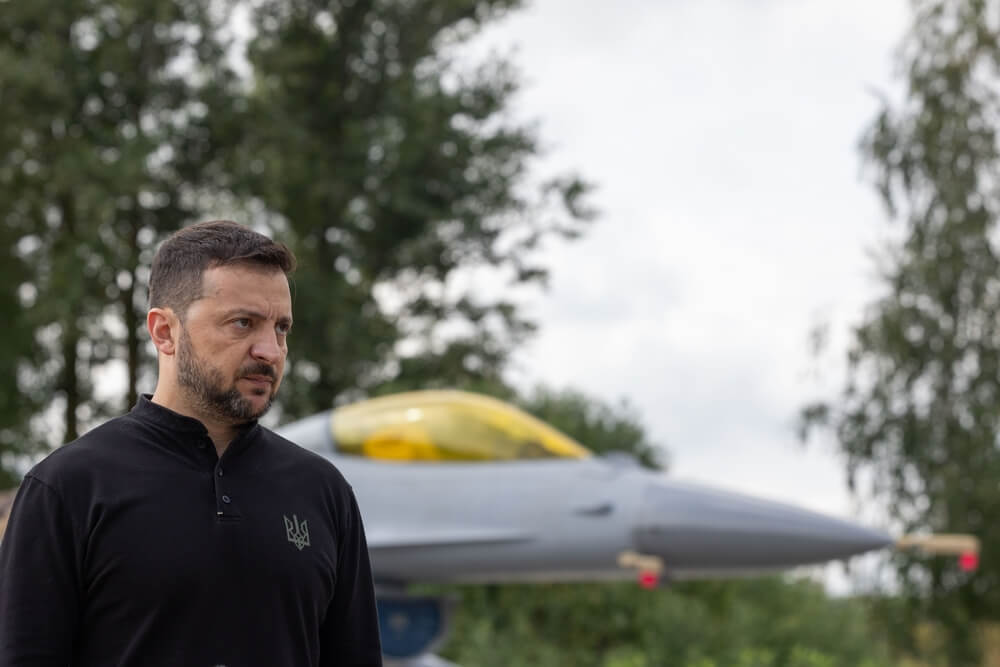 What Ukraine and the Middle East have demonstrated is something more important: airpower remains indispensable, but it is no longer sufficient - Volodymyr Zelenskyy
What Ukraine and the Middle East have demonstrated is something more important: airpower remains indispensable, but it is no longer sufficient.
The United States and its allies therefore face a strategic choice. They can continue preparing to fight the wars they have been best at fighting for the past thirty years – wars in which Western air forces rapidly establish air superiority and operate with extraordinary freedom.
Or they can prepare for the wars that may actually come.
Those wars will be fought in contested skies, under constant electronic attack, against dense air-defense networks and thousands of drones and missiles.
They will demand not only exquisite new platforms, but mass. Not only technological superiority, but ammunition by the thousands, or in the case of drones, by the millions, literally. Russia is projected to build millions of drones this year, Ukraine possibly as many as 5 million.
It is a question not only of national capabilities, but of allied capacity and a type of collective resolve not seen in recent decades among our allies.
We should be in a desperate race to catch up. But we are not there yet; we can get there if we recognize the threat.
The great mistake would be to interpret Ukraine and the Middle East as proof that airpower is dead. The lesson is more consequential. The era of airpower as a stand-alone strategic solution is dead.
The next generation of military power will belong to nations that understand how to integrate airpower with every other instrument of war – and, crucially, have the industrial capacity and alliances to sustain it.
The sky is still a battlefield. But it no longer belongs to whoever has the best aircraft.
Sean Wiswesser is a former CIA Senior Operations Officer and an expert on Russian Intelligence, Espionage, and Defense Issues.
