One of the most disturbing images from the final weeks of World War II is Adolf Hitler emerging from his bunker to decorate members of the Hitler Youth. They were not hardened soldiers, not even young men. They were boys.
The images showed a collapsing regime reaching ever deeper into the next generation for bodies to sustain a war it could no longer win. An uncomfortable echo of that image appears in Vladimir Putin’s Russia today.
The comparison has limits, but the image raises an unsettling question about Russia today: What does a regime do when it begins treating the next generation as a resource for sustaining conflict?
Putin’s Russia is an authoritarian state increasingly willing to militarize, manipulate, and exploit its young people in service of the regime, while also targeting the youth of its adversaries.
What Russia is doing to its own children – and what its intelligence services are increasingly willing to target and do to children abroad – tells us something important about the system Putin and the siloviki have built.
Militarization of education
It begins at home. Russia’s intelligence services used to operate in the shadows of Russian society. Increasingly, Russian society is being remade in their image.
The extraordinary film Mr. Nobody Against Putin, winner of the Academy Award for Best Documentary, provides perhaps the most intimate view yet of what has happened inside Russian schools since the invasion of Ukraine.
Pavel Talankin was a teacher and school videographer in an industrial town in the Urals. After the 2022 invasion, he found himself required to document the transformation of his school as Moscow imposed a new “patriotic” curriculum. Aghast at the changes he saw, Talankin kept filming.
What his camera captured was remarkable: pro-war assemblies, militarized youth organizations, state-directed lessons about the war, and even representatives of the mercenary Wagner Group providing weapons training.
Some of the students Talankin had watched grow up were eventually drafted; some have likely already died in a war that has cost Russia 1.5 million casualties.
This was not simply one enthusiastic school principal somewhere in the Russian provinces. And it has gone far beyond what Talankin documented since he was forced to leave Russia. The militarization of education has become government policy in Putin’s Russia.
Russia's Ministry of Education reorganized its national school-safety curriculum around courses involving mandatory Initial Military Training
Beginning just this September 1, Russia's Ministry of Education reorganized its national school-safety curriculum around courses involving mandatory Initial Military Training.
Students now study preparation for military service, military discipline, drill, and broader concepts of national defense.
This includes mandatory visits from the security services, the military, and even mercenaries like the Wagner Group – glorified former prison felons and criminals allowed to carry out war crimes in Ukraine.
But it goes far beyond that. Children are not simply being told to love their country – every country teaches some form of patriotism.
They are being introduced to a worldview in which military preparedness, confrontation with external enemies, and subservience to the state become normal parts of childhood.
Russia is mobilizing the next generation for sustained conflict with the West and democracies worldwide.
Turning teenagers into “non-state actors”
This is how a permanent-war mentality reproduces itself. But there is an even darker side to Russia’s exploitation and corruption of youth, and not just in Russia.
Russian intelligence services are increasingly recruiting teenagers and kids abroad to do their dirty work.
The methods can be remarkably simple: money, online gaming, and targeting via Telegram.
Ukrainian authorities have implicated the FSB in recruiting youth through this app and other online platforms to photograph military installations, monitor air-defense systems, burn military vehicles, and sabotage railway infrastructure.
A small task that leads to another task. A request to photograph something, followed by perhaps a task to leave a package somewhere.
Young recruits may not initially understand who is directing them, or how far the assignment will eventually go. When they realize, it is too late; their lives are ruined, and the services extort them for more.
The same tactic has moved west. European security officials have encountered teenagers allegedly recruited online for espionage and sabotage.
A 17-year-old in the Netherlands was accused of spying on government and law-enforcement facilities in The Hague after being approached through Telegram by a hacking group linked to Russia.
In Lithuania, prosecutors charged a Ukrainian who was 17 at the time with carrying out the 2024 arson attack on an IKEA store in Vilnius, alleging that he acted in the interests of Russian military and security services.
Criminals, extremists, and people desperate for money are being used as proxies
Western and Ukrainian officials believe the division of labor is increasingly recognizable: the FSB has played a major role in recruiting inside Ukraine and across the former Soviet space, historically treated by Moscow as its ‘near abroad.’
Meanwhile, operations farther into Europe have also been associated with Russia’s GRU military intelligence and the SVR foreign intelligence service.
This fits a much broader evolution in Russian intelligence tradecraft: criminals, extremists, and people desperate for money are being used as proxies.
Russian services are increasingly turning teenagers and children into “non-state actors.”
Operatives can be disposable because the Russian intelligence officers directing the activity remain safe somewhere else.
The trend also helps explain another feature of this war: Russia's removal of Ukrainian children.
In March, a U.N. commission concluded that Russian authorities' deportation and forcible transfer of Ukrainian children – and the enforced disappearances associated with them – amounted to crimes against humanity.
The commodification of people: children as assets
Russia is waging a fight for the next generation of minds and bodies. It is the commodification of people: children become assets and future soldiers, teenagers become potential agents bred to be criminals, and criminals become saboteurs.
And, under Putin, that intelligence mentality has spread far beyond the intelligence services themselves.
Casualties have become numbers that can be absorbed in pursuit of the state’s objectives.
Nature itself offers a useful contrast. Watch a bird defend its nest. Watch a bear defend its cubs.
Across the natural world, protecting the next generation is one of the most fundamental instincts for survival. But not in today’s Russia.
Like Nazi Germany, it is ready to expend the supposed “pride of the nation” for the benefit of a wealthy and corrupt elite.
Healthy societies understand something. Their children represent their future – the scientists, teachers, entrepreneurs, soldiers, artists, and parents who will inherit the country.
Ukraine is desperately trying to preserve its next generation of the same, along with future civil servants who will help rebuild their war-torn country.
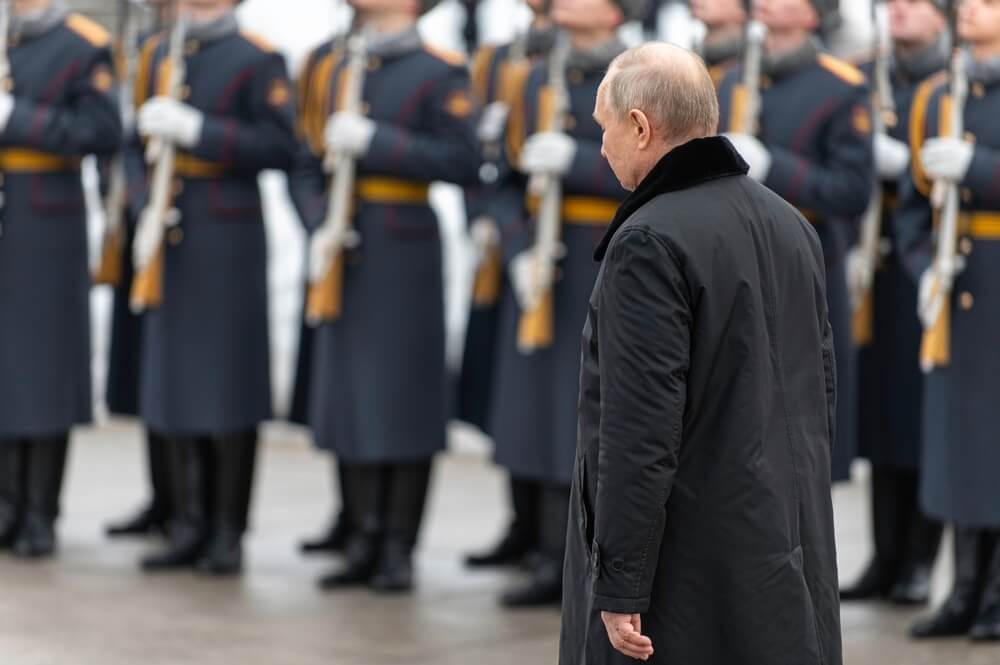 Putin’s system increasingly treats that future as simply another resource to be mobilized
Putin’s system increasingly treats that future as simply another resource to be mobilized.
At the same time, the Russian services target the West’s youth via social media manipulation.
Russian influence operations have repeatedly exploited America's most divisive political and social issues – from race and policing to immigration, abortion and LGBTQ rights – not because Moscow necessarily cares about the underlying causes, but because division itself is useful.
The Russian services care only about getting Americans to fight each other. More than anything else, they push the cynical view that free elections don’t work.
They want the youth of America and Europe not to participate in elections. Their message: “You can’t trust democracy.”
That may prove to be one of the most damaging legacies of Putin’s rule and of his intelligence services targeting our societies with cognitive warfare – a new front and an all-out effort to corrupt our youth.
Sacrificing the future to preserve the regime
Putin did not invent Russia’s intelligence culture. The traditions of the Cheka, NKVD, and KGB preceded him by generations, but he was deeply ingrained in them.
He lives by their creed, and that of Iron Felix Dzerzhinsky: “We stand for organized terror.”
Putin has empowered these institutions and elevated many of their assumptions to principles of governance: secrecy, loyalty, manipulation, suspicion, and the belief that individuals ultimately exist to serve the state. They should also live in fear of the state.
The siloviki – men from the security and power structures – have become central to Russia’s political system
The siloviki – men from the security and power structures – have become central to Russia’s political system.
And now their worldview is filtering downward into schools, youth organizations and the internet via vast operations run by the FSB, GRU, and SVR, whose active measures or information warfare department alone measures in the thousands.
And increasingly into the lives of teenagers far beyond Russia’s borders. That is why the exploitation of young people deserves more attention than it currently receives.
It is not merely another disturbing feature of the war in Ukraine. It tells us something much larger about the adversary the West is confronting.
A government reveals its values not merely through what its leaders say, but also through what it is prepared to sacrifice.
Increasingly, Putin’s Russia is demonstrating that even the next generation is not beyond the reach of the state.
That is the more disturbing image today: not an aging dictator decorating boys outside a bunker, but a modern security state reaching through classrooms, smartphones, gaming platforms and encrypted chats to turn young people into instruments of its wars.
Technology has changed. The willingness to sacrifice the future to preserve the regime has not.
Sean Wiswesser is a former CIA Senior Operations Officer and an expert on Russian Intelligence, Espionage, and Defense Issues.
