When the United States ousted Venezuelan President Nicolás Maduro earlier this year and put him in a New York jail cell, Venezuelans at home and abroad rejoiced.
For the first time in 27 years, the country faced a real possibility of regime change.
But removing an autocrat does not necessarily dismantle the authoritarian system that kept him in power, particularly when the man who removed him is an aspiring authoritarian and kleptocrat in his own right.
Nearly nine months after Maduro’s capture by US special forces, the prospect of democratic change is dimming by the day.
That was evident last week during the United Nations General Assembly, where US President Donald Trump warmly welcomed the leader he left in charge of the country, Delcy Rodríguez, who had been Maduro’s vice president.
Trump’s backing has prompted several US allies in Latin America to warm to the chavista government, as seen in last month’s meeting between Paraguayan President Santiago Peña and Rodríguez.
This is happening even as the UN’s fact-finding mission on Venezuela reports that the machinery of repression built under chavismo remains largely intact.
While some political prisoners have been released, and access to some previously blocked media outlets has been restored, the most recognizable figures of the Maduro regime are still in power.
The security services and military high command have not been purged of regime loyalists, and armed colectivos continue to operate with impunity.
No matter how US Secretary of State Marco Rubio tries to spin these facts, or how often Rodríguez promises free elections, a democratic transition is not in sight.
Access to low-cost oil
Trump’s priorities—energy security, access to low-cost oil, and rewarding his business cronies—help explain this authoritarian inertia.
Venezuela offers all three, with its vast oil reserves providing US refineries with additional supplies and reducing exposure to energy-market instability.
In August, for example, the Trump administration struck a deal with North American Blue Energy Partners, granting the company a 100-year concession to 17 Venezuelan oil fields containing roughly 65 billion barrels of proven reserves.
The US government also acquired a 35% stake in the company and the right to buy 20% of its production at cost.
And more investment is on the way, as Venezuela’s interim government expects the NABEP deal alone to deliver as much as $100 billion in infrastructure investments.
Chevron is expanding its Venezuelan operations, and ExxonMobil is discussing a return to the country almost two decades after Hugo Chávez nationalized its oil assets.
There is no inherent contradiction between economic recovery and democratization
There is no inherent contradiction between economic recovery and democratization.
The two can and should go hand in hand, as they did in countries like Poland in the 1990s.
The problem begins when economic stabilization is put first, without a clear plan for a democratic transition—precisely the Trump administration’s approach.
In his first press conference after Maduro’s capture, Trump barely mentioned democracy but had plenty to say about oil.
Not an ordinary foreign investment
A 100-year concession is not an ordinary foreign investment. It assumes the basic arrangement will survive across US administrations.
And since the US government has a direct stake in the company, American taxpayers have a vested interest in protecting it.
Trump’s oil deal, brokered by businessman Alejandro Betancourt, a chavista loyalist who has been implicated in multiple corruption scandals, was negotiated with little transparency and no competitive bidding by the Rodríguez government, whose constitutional legitimacy remains contested.
Nothing requires American oil companies to oppose democracy or deliberately block elections
The deal places a significant share of Venezuela’s main asset under the control of a foreign government for an extraordinary length of time.
Add Trump’s declaration at the UNGA that the US should control Venezuela’s oil because “to the victor go the spoils,” and it’s easy to see why a future democratically elected Venezuelan government may want to revisit the deal.
Nothing requires American oil companies to oppose democracy or deliberately block elections, but billions of dollars in US and foreign investment create powerful incentives to avoid the uncertainty that free elections and a new government would bring.
Trump’s oil heist
A Venezuelan government that protects contracts, keeps the oil flowing, cooperates with the US government, and allows American companies to operate freely is immensely valuable, regardless of how democratic it is.
If this deal does materialize, then those incentives will not disappear when Trump leaves office.
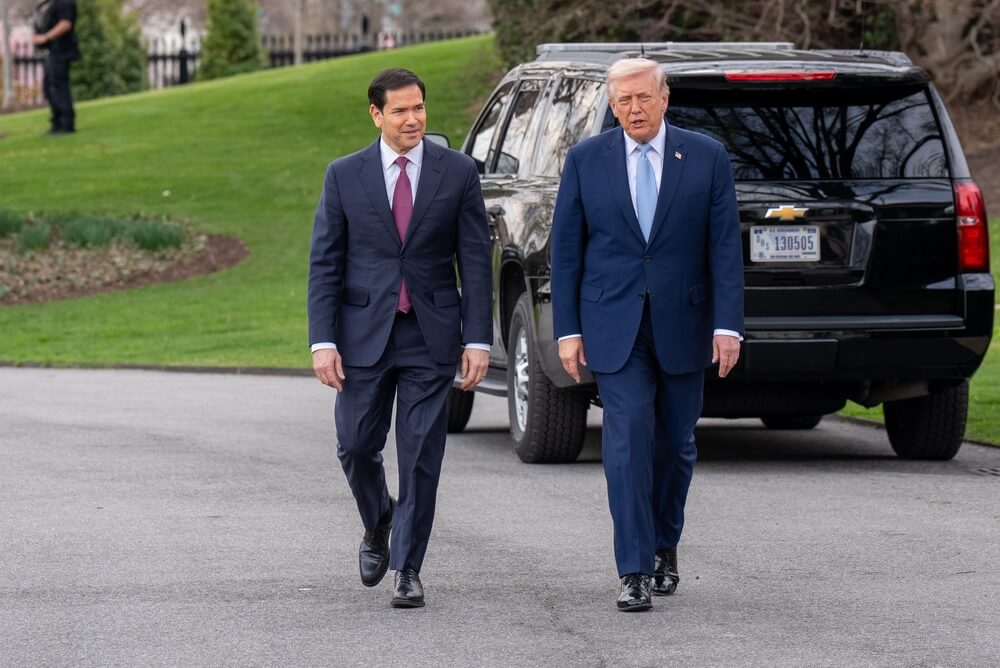 The Trump administration has demonstrated its eagerness to work with the same repressive regime it once bitterly opposed when its interests are at stake
Venezuela could end up stable enough for foreign companies to invest, yet never democratic enough to put those investments at risk.
The Trump administration has already demonstrated its eagerness to work with the same repressive regime it once bitterly opposed when its interests are at stake.
Before Maduro’s removal, the impoverished chavista government was grappling with collapsing oil production and had few international partners. New oil revenues could ease some of Venezuela’s economic misery and enable the regime to rebuild relations with neighboring countries, making it harder to dislodge.
That leaves the chavista regime with a better chance of survival, while the US gets greater energy security and a pliable ally in Caracas—a win-win for everyone but Venezuelans yearning for political freedom.
Maduro’s removal created an opportunity for democratic change. Trump’s oil heist is turning it into the path not taken.
Cristina Ramirez is an international political analyst for Panamá en Directo and CNN en Español and lectures on comparative political economy and the political economy of corruption at King’s College London.
