The Ukrainian anti-corruption institutions NABU and SAPO announced that they were conducting an operation against a criminal organisation which, according to their statements, was led by current and former MPs, with the participation of senior officials from the Office of the President.
The names and details of the cases have not yet been released, and the agencies have announced that further information will follow.
What has already been confirmed is politically serious enough: the investigation reaches into the circle of senior officials in the presidential administration, at a time when the question of the authorities' responsibility during the long war is coming sharply into focus in Kyiv.
The political moment is particularly difficult for Volodymyr Zelenskyy because, a few hours earlier, Mykhailo Fedorov, his defence minister until July and for years one of the most recognisable figures in the presidential team, had demanded that Ukraine find a legally and security-viable way to hold elections during the protracted war.
Fedorov spoke of a systemic crisis in governance, corruption, and a state apparatus that protects its own inertia.
There is no confirmed connection between his statement and the NABU and SAPO operation; their almost simultaneous appearance in public nevertheless shows that internal political competition, suppressed since February 2022, is returning well before the end of the war.
Fedorov emerged from Zelenskyy’s shadow
For Zelenskyy, Fedorov represents a far more complex problem than most traditional opposition politicians. He came to power with him in 2019, becoming, at 28, the youngest minister in Ukraine’s history, and over the next six years he led the country’s digital transformation.
In January 2026, he took over the Ministry of Defence with the ambition of accelerating the technological modernisation of the military, expanding the production and use of drones, reforming procurement, and managing a vast war system that for years had suffered from bureaucracy, corruption scandals, and slow decision-making.
During the July government reshuffle, Zelenskyy did not retain Fedorov as Minister of Defence, ending his mandate after only six months, following an increasingly open conflict with the then commander-in-chief, Oleksandr Syrskyi, over the conduct of the war and the pace of reforms.
After his departure, Fedorov claimed that the military leadership was blocking the changes demanded by the front, while Zelenskyy explained the replacement as due to the impossibility of effective cooperation between the civilian defence leadership and the military command.
Soon afterwards, the president dismissed Syrskyi and appointed Mykhailo Drapatyi as the new commander-in-chief.
Fedorov refused the advisory role he was offered and kept his distance from the presidential team in public
Fedorov’s departure prompted a political reaction that went beyond the usual discussion of personnel changes. Protests began in Kyiv and other cities, calling for his reinstatement at the Ministry of Defence, and at the end of July several thousand people again took to the streets of the capital.
Fedorov refused the advisory role he was offered and kept his distance from the presidential team in public. Within a few weeks, he became a potential focal point for discontent with the way the war and the country are being managed.
The August polls showed that this political weight can already be measured. The Socis survey, conducted from 28 July to 2 August, gave Zelenskyy 17.8 per cent in a hypothetical first round of the presidential election, Valerii Zaluzhny 17.1 per cent, and Fedorov 10.5 per cent among all respondents.
In the imagined second round, Fedorov had 43.4 per cent and Zelenskyy 24.7 per cent, with a large number of undecided voters, abstainers and people who would vote against both of them.
In a country at war, such numbers have limited value, but they clearly show that Fedorov already has enough support to turn his demand for the restoration of the democratic process into a question that the presidential authorities must answer politically.
Elections are prohibited, the question remains open
The Ukrainian legal framework leaves little room for flexibility. The law on the legal regime of martial law prohibits presidential, parliamentary and local elections while martial law is in force, and Article 157 of the Constitution prevents constitutional changes under the same conditions.
Such a framework turns Fedorov's request into a question for lawmakers, lawyers, military leaders and election administrators, who would have to find a model for safe and legitimate voting if the war drags on for years, with no prospect of an imminent end or peace deal.
Organising such elections would present a series of problems that are difficult to solve with a single legal change. Millions of Ukrainians are outside the country or displaced, many voters serve in the armed forces, parts of the territory are under Russian occupation, and the electoral infrastructure would be exposed to missile and drone attacks.
The issue of democratic mandate and regular political competition will increasingly return to public debate if the current situation continues
Any viable solution will have to ensure the participation of soldiers, refugees, and citizens from the occupied territories, restrict the scope for Russian interference, and produce a result that political opponents can accept after a wartime campaign.
Fedorov's intervention also changes how political time is measured in Kyiv. From 2022, the government could proceed on the assumption that full political competition would return after the end of the war, so the postponement of elections clearly had a temporary character.
The war has entered its fifth year with no reliable end in sight, which is why the issue of democratic mandate and regular political competition will increasingly return to public debate if the current situation continues.
NABU and SAPO are now testing presidential power
This morning’s operation carries added weight because of the Zelenskyy government’s history with the institutions responsible for combating high-level corruption.
In July 2025, parliament, with support from the presidential camp, passed amendments that gave the Attorney General far greater control over NABU and SAPO cases.
The largest street protests since the beginning of the full-scale Russian invasion, along with strong pressure from European partners, followed. As a result, the government reversed course within a few days and restored the independence of both institutions.
The crisis of summer 2025 now defines the limits of the president’s room for manoeuvre. The European Union explicitly linked the independence of NABU and SAPO to the rule of law and to Ukraine’s progress towards membership, while the domestic reaction showed that the war had not extinguished society’s willingness to defend institutions from political control.
Any attempt to slow the new investigation, transfer it to a more politically convenient body, or weaken it by pressuring personnel would have consequences extending far beyond the criminal case itself.
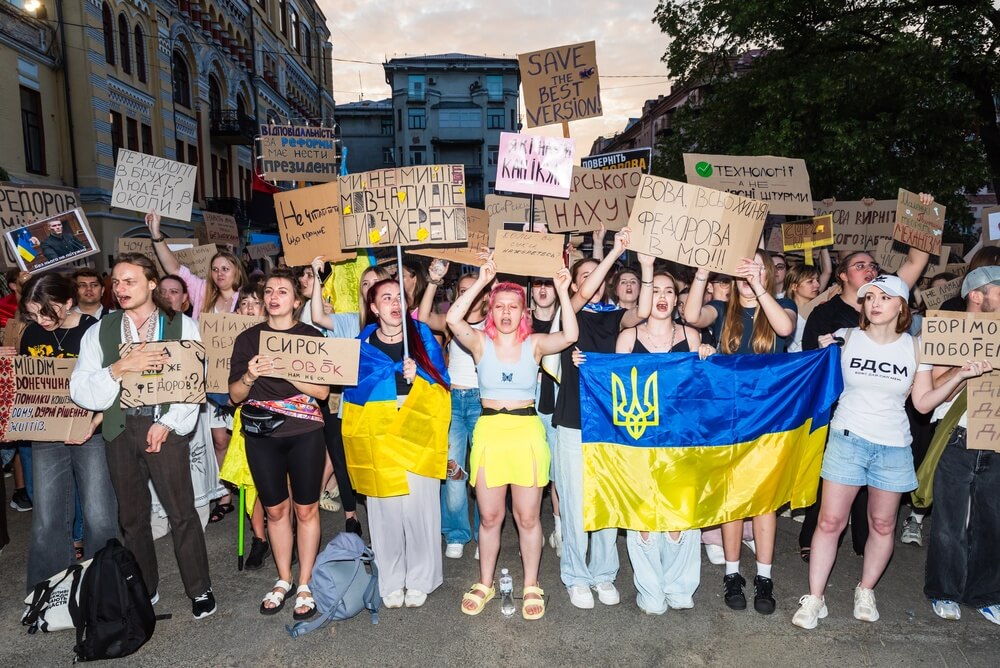 The domestic reaction showed that the war had not extinguished society’s willingness to defend institutions from political control
Previously, NABU and SAPO had already pursued cases against individuals from the highest political and state structures, including former officials from the Office of the President, the government, parliament, and major state-owned companies.
The current operation is particularly sensitive because it involves high-ranking officials in the current presidential administration.
Zelenskyy’s political position will largely depend on his attitude towards the investigation, his willingness to remove any official against whom serious evidence emerges, and his ability to ensure that investigators can work without interference.
Such a development could paradoxically strengthen Ukrainian institutions even as it politically harms the top of the government. A state that allows independent bodies to investigate its own elite during wartime offers far more compelling evidence of institutional maturity than any declaration of reform.
The opposite response, especially after the 2025 crisis, would turn the corruption case into a question about the nature of wartime governance and Kyiv’s relationship to the rules central to its European path.
War legitimacy is no longer enough to secure a political monopoly
Zelenskyy still has advantages that no potential competitor currently possesses. He is leading the country through the Russian invasion, representing Ukraine to its allies, controlling the executive branch, and maintaining a high level of public trust as president of a country that has lived under the pressure of war for years.
Internal political tensions also pose a genuine security risk, because Moscow will try to exploit every division, every corruption scandal and every conflict within the Ukrainian leadership to weaken trust in the state.
During the early years of the invasion, the perceived legitimacy of the war almost eliminated the space for serious political competition, whereas now that space is opening up again.
An open presidential candidacy while the fighting continues could easily be seen as turning a national crisis into a personal political opportunity
Fedorov is the first serious example of a politician from Zelenskyy's original circle who can challenge the way the country is run without reverting to the old Ukrainian divisions and personalities of the pre-2019 period.
His political advantage rests on his experience in the digital state, war technology, drones, military procurement and administrative reform, areas that voters directly associate with the country's ability to survive the war.
Such a position carries great risk for Fedorov himself. An open presidential candidacy while the fighting continues could easily be seen as turning a national crisis into a personal political opportunity, especially by voters who regard any internal conflict as helping Russia.
It is far more likely that he will, for some time, continue to build political space through demands for transparency, institutional reform and clear rules for future elections, without formally announcing his candidacy.
Protests, opinion polls and the further development of anti-corruption investigations will determine how quickly that space can grow into an organised political alternative.
The campaign began before the election
Legal restrictions, martial law and security concerns make elections in the coming months unlikely, but political competition can develop without a formal campaign.
Discussion about the future government is already shifting towards personnel decisions, anti-corruption investigations, relations between the civilian leadership and the army, protests and the struggle for public trust, so every new case involving the top of the administration will have immediate political significance.
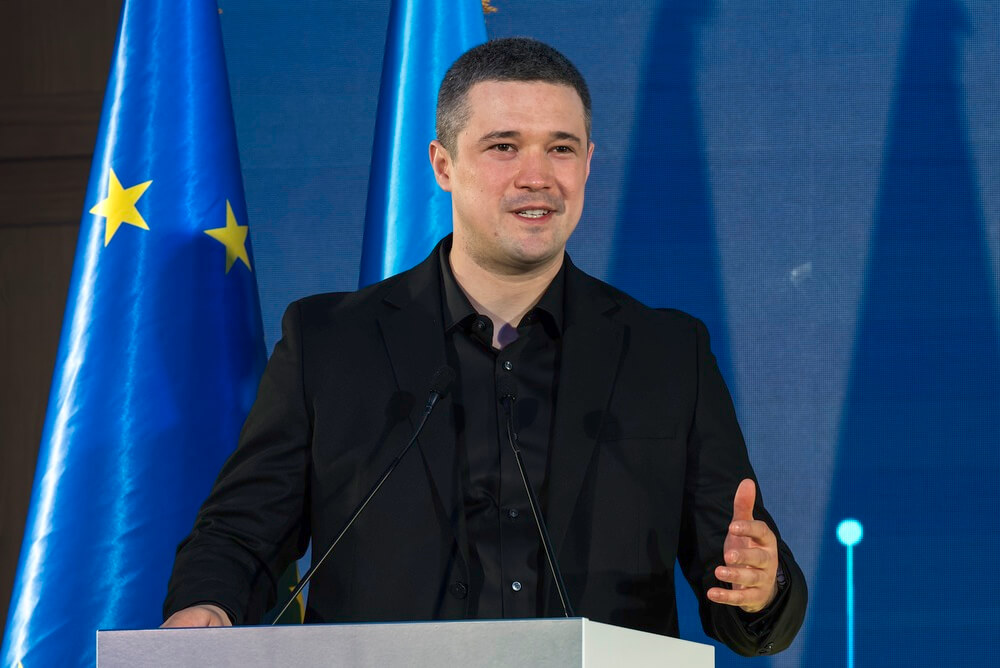 Mykhailo Fedorov opened the discussion from within, as someone who for years belonged to the system he is now criticising
The greatest immediate risk for Zelenskyy is that NABU and SAPO may, in the coming days, publish the names of current high-ranking officials in the presidential office together with evidence linking them to serious criminal acts.
In such a situation, the president will have limited scope for political defence and far stronger reasons to demonstrate that the investigation is entirely independent.
Rapidly distancing himself from compromised associates could limit the damage, while a confrontation with investigators would reignite protests, strain relations with the European Union and give Fedorov precisely the topic around which to rally criticism of the system of government.
The date of the presidential election is still beyond the immediate political calendar, yet the political game itself has already returned to Ukraine. Its first phase will focus on who can convince the public that a state under wartime pressure can be efficient, responsible and open to scrutiny at the same time.
Fedorov opened the discussion from within, as someone who for years belonged to the system he is now criticising, and the actions of NABU and SAPO will show how capable these institutions are of controlling the government at the very moment when it is most vulnerable. For now, Fedorov does not need an election date or a formal candidacy.
Any decision by the presidential authority that confirms his claim that the system has closed itself to scrutiny and accountability is sufficient for him.
That is why Fedorov can now afford to take his time. Any new evidence against people at the top of the government will work in his favour more than any campaign he could launch today.
